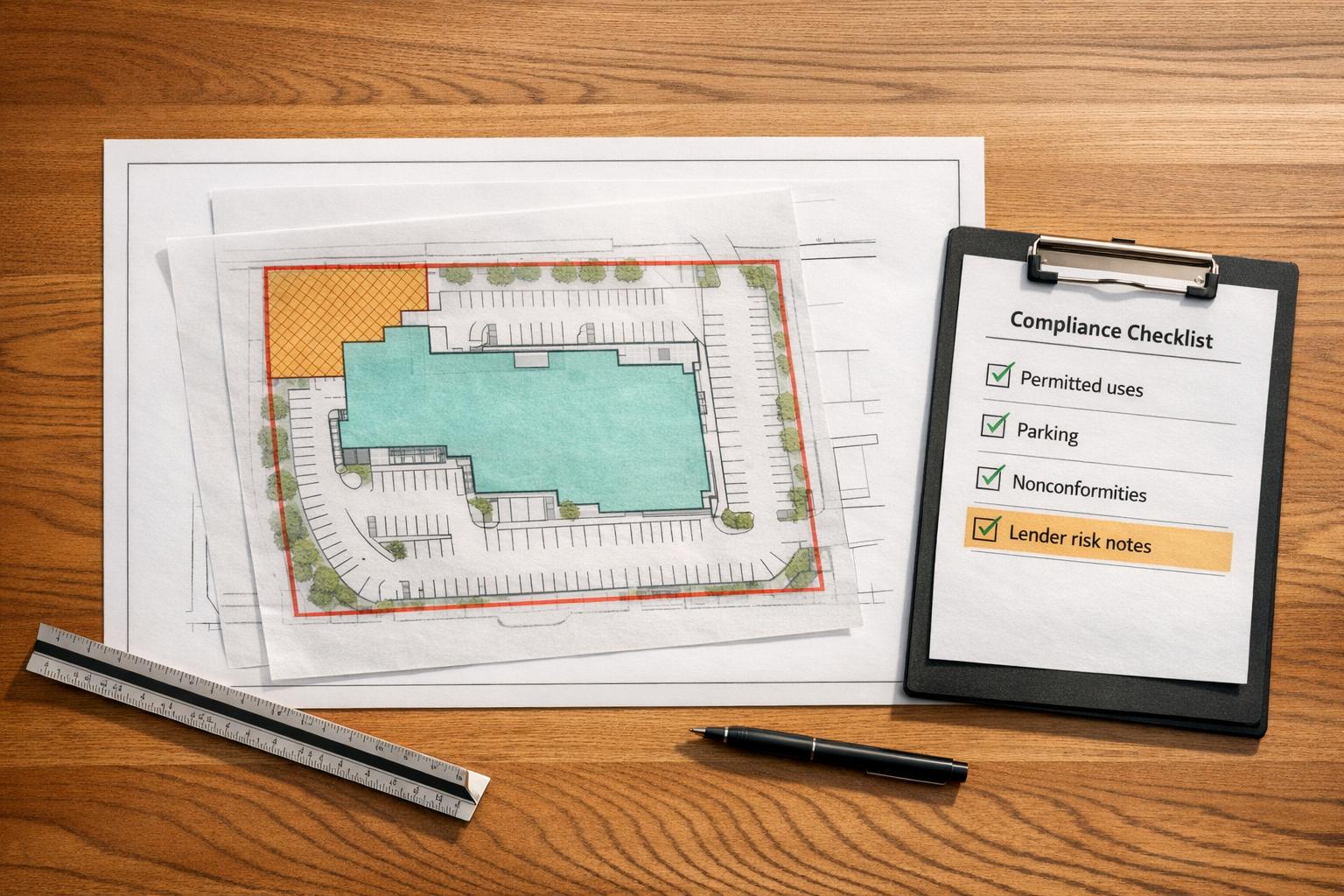
Zoning compliance reports are critical in commercial real estate (CRE) transactions. They verify whether a property complies with local zoning laws, including permitted uses, dimensional standards, and parking requirements. These reports help identify risks like nonconforming structures, open violations, or expired permits, which can impact financial stability and legal standing.
Key takeaways:
- Purpose: Confirm zoning compliance, identify risks, and ensure property use aligns with local codes.
- Importance: Helps buyers, lenders, and investors reduce risk, negotiate better terms, and avoid costly surprises.
- Timing: Typically ordered after signing the Purchase and Sale Agreement (PSA) during the due diligence phase.
- Components: Zoning designation, permitted uses, physical compliance, parking analysis, and reconstruction feasibility.
Zoning reports are essential for financial modeling, lender requirements, and deal structuring, making them a vital step in CRE due diligence.
Key Components of a Zoning Compliance Report
Zoning Designation and Jurisdiction Overview
A zoning compliance report begins by identifying the property’s zoning district, such as C-1 (neighborhood commercial), M-2 (heavy industrial), or R-3 (multifamily residential). This classification, along with the applicable municipal or county code sections, outlines permitted activities and development guidelines.
Typically, these reports include a Zoning Verification Letter (ZVL), which is an official statement from the local jurisdiction confirming the property’s zoning designation and whether its current use aligns with the zoning code. Some reports also go further by noting the zoning classifications of neighboring properties, which can help identify potential land-use conflicts. [1]
The Planning and Zoning Resource Company (PZR) plays a key role in simplifying this process. With connections to 99% of U.S. municipalities, a database of over 20,000 municipal contacts, and a library of more than 6,000 zoning ordinances, PZR provides access to accurate, up-to-date information – even from smaller jurisdictions that may have limited resources. This is especially valuable during tight due diligence timelines. The report also outlines permissible uses, noting any restrictions or special permits required.
Permitted, Conditional, and Prohibited Uses
A key question the report addresses is whether the property can legally support its current use – or the buyer’s intended use. Uses are generally categorized into three groups:
- Permitted by right: Fully allowed under the current zoning code without the need for additional approvals.
- Conditional uses: Require a Conditional Use Permit (CUP) or Special Use Permit, adding time and complexity to the process.
- Prohibited uses: These are not allowed under the current zoning, making the site unsuitable for certain purposes unless rezoning is pursued.
As Sara Ehrentreu, Zoning Operations Manager at Partner ESI, explains:
"The zoning report should verify whether the subject’s current use and structures are permitted by the current zoning code or through the issuance of a special use permit, use variance, or conditional use permit." [5]
For legally nonconforming properties – often referred to as "grandfathered" – there are additional risks. If such a property is damaged beyond a specific threshold, commonly 50%, the municipality might not allow reconstruction to the original specifications. It’s crucial to confirm these thresholds in the local code when dealing with nonconforming properties. [5] The report also evaluates physical compliance with zoning standards and intensity requirements to ensure the property aligns with current regulations.
Dimensional and Intensity Standards
Another focus of the report is verifying compliance with bulk requirements, which include setbacks, building height, lot coverage, Floor Area Ratio (FAR), and parking. Parking often becomes a critical issue, as the report compares actual off-street parking spaces to municipal requirements based on the property’s use and size. A shortfall in parking can disrupt operations, cause issues with lenders, or necessitate a variance before finalizing a transaction. [6][5]
The table below provides an overview of the main components typically included in a zoning compliance report:
| Component | What It Addresses |
|---|---|
| Zoning Letter | Confirms official designation and use-by-right status [5] |
| Bulk Standards | Evaluates setbacks, height, lot coverage, and FAR [5] |
| Parking Analysis | Compares required vs. actual parking spaces [6][5] |
| Violation Search | Identifies open zoning, building, and fire code issues [6] |
| Reconstruction Clause | Outlines rebuild feasibility after a casualty event [5] |
| Certificate of Occupancy | Verifies legal right to inhabit or operate the building [5] |
In more detailed reports, you might also find information about planned public improvements – such as road expansions or condemnation actions – that could impact property boundaries or access. These insights are often missing from standard property reviews but can significantly influence the property’s value and operational viability. [5]
sbb-itb-df8a938
Zoning Due Diligence for Real Estate Investors: How to Avoid Costly Lot Mistakes
How to Use Zoning Reports Throughout the Due Diligence Process

CRE Zoning Compliance Report: Due Diligence Process & Key Components
Zoning reports play a critical role during property transactions, guiding decisions and mitigating risks. How you use them depends on the specific stage of the deal.
Pre-LOI and Pre-Contract Screening
Before submitting a Letter of Intent (LOI), it’s essential to identify any glaring zoning issues. Start by reviewing the broker’s Offering Memorandum (OM) for a basic zoning check, then consult a zoning professional for a quick evaluation.
At this stage, the main question is whether the intended use of the property is permitted by right under the current zoning district. If it isn’t, you may need to pursue a Conditional Use Permit, variance, or even rezoning – all of which can add time, cost, and unpredictability. For raw land or redevelopment projects, ensure the property aligns with the city’s General Plan, as misalignment can lead to extended due diligence timelines. [4]
Spotting zoning challenges early can offer leverage for negotiating price adjustments or adding contingencies.
"As much time as the seller will give you." – Josh Green, Partner, Alchemy Design & Development [4]
Once the property is under contract, these preliminary insights pave the way for a deeper dive during early and mid-due diligence.
Early and Mid-Due Diligence Coordination
After the initial screening, it’s critical to order a comprehensive zoning report as soon as the contract is signed. Many experienced deal teams recommend ordering the zoning report and the ALTA Survey simultaneously. This ensures that both the physical and legal property data align from the outset, avoiding last-minute surprises.
To get the zoning report started, you’ll typically need to provide the property address, parcel number, current use, any previous surveys, and the OM. Depending on the jurisdiction’s complexity and the type of report needed, turnaround times can vary from one business day to a full week. [8]
During mid-due diligence, cross-check the zoning report’s findings with the ALTA Survey. Pay close attention to details like setbacks, height restrictions, parking requirements, and Floor Area Ratio (FAR). This step is crucial for identifying any physical encroachments or zoning deficiencies. Additionally, confirm the property’s conformance status: is it fully conforming, legally nonconforming (grandfathered), or illegally nonconforming? This distinction can significantly impact rebuild rights and how lenders approach underwriting.
"A zoning report is your best tool for quickly identifying fatal flaws – like use restrictions or non-conformities – so you can walk away from problematic sites early." – Michael Robinson, Permit Place [7]
In complex jurisdictions, especially in dense urban areas, unresolved violations (e.g., fire, elevator, or boiler issues) may require prompt action with local authorities. Once all data is verified, it’s time to incorporate these findings into your closing strategy.
Closing and Final Deal Structuring
During closing, the zoning findings should be fully integrated into the deal. Disclose any zoning deviations to lenders and prepare for potential contingencies tied to unresolved approvals. Most major lenders, particularly those involved in securitized loan transactions, will require a detailed summary of zoning deviations before issuing a loan commitment. [3]
If deviations are confirmed, additional safeguards like ordinance and law insurance may be required. This type of insurance helps address gaps in rebuild feasibility caused by zoning restrictions. As Melissa Dahl, National Client Manager at Partner ESI, explains:
"Lenders will require borrowers to have a full summary of any deviations from zoning code requirements before issuing a loan. Depending on the findings, the lender may then require the borrower to purchase ordinance and law insurance coverage." [3]
In some cases, purchase agreements can include contingencies tied to zoning approvals, such as rezoning applications, site plan approvals, or building permits. This approach is particularly common in development deals where the buyer’s business plan hinges on entitlements that are still pending. By using zoning findings strategically, both the buyer’s investment and the lender’s collateral can be safeguarded effectively.
Identifying and Managing Zoning Risk
When conducting due diligence, it’s critical to evaluate property-specific zoning risks. These risks – ranging from occupancy challenges to compliance issues – can directly impact financial stability and operational plans.
"Zoning risk is not simply about compliance. It is about financial exposure, operational continuity, and strategic positioning." – Keyser Editorial Team [11]
Use and Occupancy Risks
Properties with "grandfathered" status might seem secure, but they can be surprisingly fragile. If a nonconforming use is discontinued for a certain period, the right to that use can vanish. Similarly, bringing in a new tenant with a different use type can jeopardize these rights. Zoning restrictions related to operating hours, outdoor storage, or truck traffic can also limit income potential and reduce the pool of viable tenants – especially for industrial properties.
"A surprising number of warehouses, manufacturing plants, and logistics hubs operate legally only because they pre-date current zoning regulations… they often lack replacement rights." – LightBox Insights [9]
Beyond use and occupancy, the property’s physical characteristics present another layer of risk.
Physical Conformance Risks
Physical conformance risks revolve around whether a building meets current zoning standards, such as setbacks, height limits, lot coverage, or floor area ratio (FAR). If a property suffers damage exceeding a specific threshold – often 50% – rebuilding must comply with updated codes. This can lead to a smaller building footprint, reduced density, or a layout that no longer fits the original purpose. These limitations can significantly affect a property’s value and lender assessments. As Sara Ehrentreu, Zoning Operations Manager at Partner ESI, explains:
"A property’s conformance status cannot be assumed to be Legal Nonconforming solely based on its age." [5]
To catch these issues early, ordering an ALTA/NSPS Land Title Survey alongside the zoning report is invaluable. This allows for cross-referencing setbacks and easements with the building’s physical structure, minimizing surprises later.
Entitlement and Compliance Risks
Issues like missing permits, expired approvals, open building code violations, or an invalid Certificate of Occupancy (CO) can delay closings and create additional liabilities for buyers. They can also prompt lenders to require supplemental insurance, adding to transaction costs.
Florida provides a cautionary example: unlike most states, unrecorded municipal liens and permit violations attach to the property itself rather than the owner [10]. A standard title search won’t reveal these issues, making a separate municipal lien search essential in such markets.
The table below outlines the three types of conformance statuses and how to address them:
| Conformance Status | Risk Level | Mitigation Action |
|---|---|---|
| Conforming | Low | None required |
| Legally Nonconforming | Moderate | Obtain Ordinance & Law insurance; verify rebuilding thresholds |
| Illegal Nonconforming | High | Require seller to obtain variances or rezoning before closing |
When violations or compliance issues arise, it’s best to resolve them during due diligence – not after closing. In densely populated cities, hiring an expediter to liaise with municipal inspectors can speed up the process. For properties in jurisdictions with intricate land use laws, such as New York City, involving a land use attorney early on can make the difference between a smooth closing and months of delays. Integrating zoning risk assessments into your overall due diligence process helps build stronger financial models and ensures deals are structured effectively.
Applying Zoning Findings to Financial Models and Deal Structuring
This section dives into how zoning findings directly influence financial modeling and deal structuring. A zoning report isn’t just a formality – it plays a critical role in underwriting, capital planning, and negotiation strategies.
Adjusting Financial Assumptions Based on Zoning
Zoning findings impact nearly every aspect of a financial model. Key zoning metrics like Floor Area Ratio (FAR), maximum unit density, and parking ratios set clear boundaries on a property’s revenue potential. Simply put, your income projections must align with zoning regulations, not just the property’s current performance. And if there are open code violations, they translate into immediate capital expenditures, which should align with your Property Condition Assessment (PCA). Ignoring these costs can derail your returns.
"Zoning laws don’t just regulate development – they shape project feasibility." – Rocky Ranch, APPRO Development & CERRON Properties [13]
If a project requires a Conditional Use Permit or a variance, factor in the extended approval timeline and additional carrying costs. These delays compress your Internal Rate of Return (IRR) more than many buyers anticipate. Confirming the property’s "by-right" status before finalizing your development model is essential.
Here’s a breakdown of how specific zoning findings impact financial models:
| Zoning Finding | Financial Model Impact | Recommended Action |
|---|---|---|
| Legal Nonconforming | Higher insurance premiums; possible density cap | Purchase Ordinance & Law insurance; adjust exit assumptions [3][5] |
| Open Code Violations | Immediate capital expenditure requirement | Negotiate seller credit or price reduction; sync with PCA [12] |
| Conditional Use Required | Extended timeline; increased legal and carry costs | Adjust IRR for delayed stabilization [13] |
| Parking Ratio Deficiency | Limits tenant types or occupancy; reduces rent potential | Seek variance or lower rent projections [5][13] |
By adjusting these financial assumptions, lenders and investors can better account for zoning constraints in deal terms.
How Zoning Constraints Shape Lender and Investor Terms
Zoning isn’t just a box to check for lenders – it’s a critical factor in stress-testing properties. Lenders often assess worst-case scenarios, like whether a property can be rebuilt to its current state after a casualty event [5]. If rebuilding isn’t possible, lenders may require Ordinance and Law insurance, which increases operating expenses.
For loans intended for securitization, a detailed summary of zoning deviations is typically mandatory before issuance [3]. Significant findings – such as nonconforming status or density limitations – can lead to loan covenant changes, reserve requirements, or even pricing adjustments. In some cases, these findings can trigger re-trades if they reduce asset value by 5–10% or more [12].
"The buyer who understands these risks before signing is positioned to price them, negotiate appropriate representations and indemnities, or renegotiate deal terms." – Alex Lubyansky, M&A Attorney [2]
To safeguard your timeline, negotiate extension options in the Purchase and Sale Agreement (PSA) upfront. Municipal zoning letters and ALTA survey revisions are common culprits for closing delays, and having pre-arranged extensions can prevent mid-deal renegotiations [12].
Using The Fractional Analyst for Zoning Data Integration

Accurately reflecting zoning findings in financial models requires the right tools and expertise. Each zoning detail – whether it’s nonconforming status, open violations, or density restrictions – affects underwriting assumptions, debt terms, and exit strategies.
The Fractional Analyst simplifies this process with both expert analyst services and its CoreCast intelligence platform. Their analyst team integrates zoning findings into underwriting models, fine-tuning CapEx estimates, density assumptions, and IRR projections. For teams handling their own analysis, CoreCast offers a platform to track zoning-related variables alongside other deal data, ensuring zoning compliance is tied to financial outcomes rather than treated as a standalone issue.
"A Zoning Report can benefit the borrower by minimizing risk and ensuring your investment is feasible, safe, and profitable." – Melissa Dahl, National Client Manager, Partner ESI [3]
Whether you’re stress-testing a legal nonconforming property or calculating the carry costs of a conditional use approval, integrating zoning data into your financial models is critical. This approach ensures more precise underwriting and strengthens your overall deal strategy.
Conclusion
Zoning compliance reports play a crucial role in any commercial real estate (CRE) transaction. They clarify permitted uses, highlight legal nonconforming statuses, and flag open code violations that could impact the deal.
As Sara Ehrentreu, Zoning Operations Manager at Partner ESI, explains, "A zoning report is essential to any real estate transaction." [5] These reports influence underwriting assumptions, lender requirements, and even the timing of a deal’s closing. Because of this, zoning data should be fully integrated into financial assessments, not treated as an afterthought.
It’s important to note that zoning reports are time-sensitive. Municipal codes can change often, so a report older than 12 months may no longer reflect current regulations. To avoid complications, order the report early, pair it with an ALTA/NSPS Land Title Survey, and address any significant findings with the local municipality during the due diligence phase. These steps can help prevent costly surprises after closing.
"The buyer who understands these risks before signing is positioned to price them, negotiate appropriate representations and indemnities, or renegotiate deal terms. The buyer who discovers them post-close inherits them." – Alex Lubyansky, M&A Attorney, Acquisition Stars [2]
FAQs
What can a zoning compliance report miss that could still delay closing?
A zoning compliance report might miss recent developments or unrecorded changes, like newly approved construction projects, updates to infrastructure, or shifts in regulations. These overlooked details could affect property usage or necessary approvals, which might lead to delays in the closing process.
How do I tell if a property is legally nonconforming or illegally nonconforming?
To figure out whether a property is legally or illegally nonconforming, start by reviewing its zoning compliance report. A legally nonconforming use refers to a property that was in compliance with zoning laws when it was established but no longer aligns with current regulations due to zoning changes. On the other hand, if the property’s use was never allowed or it violates existing regulations, it’s considered illegally nonconforming. The zoning compliance report is a key resource, offering details about the property’s zoning history and compliance status, helping to clarify its classification during the due diligence process.
What should I do if the zoning report shows a parking deficiency?
If the zoning report highlights a parking shortfall, there are a few ways to address it. You could explore modifying zoning requirements, applying for a parking waiver, or requesting a variance. Interestingly, some areas are doing away with parking minimums altogether, which could influence your strategy. It’s a good idea to consult with local zoning officials or a zoning expert to figure out the best path forward. This will help ensure your project stays on track and meets all necessary regulations.
Leave a Reply