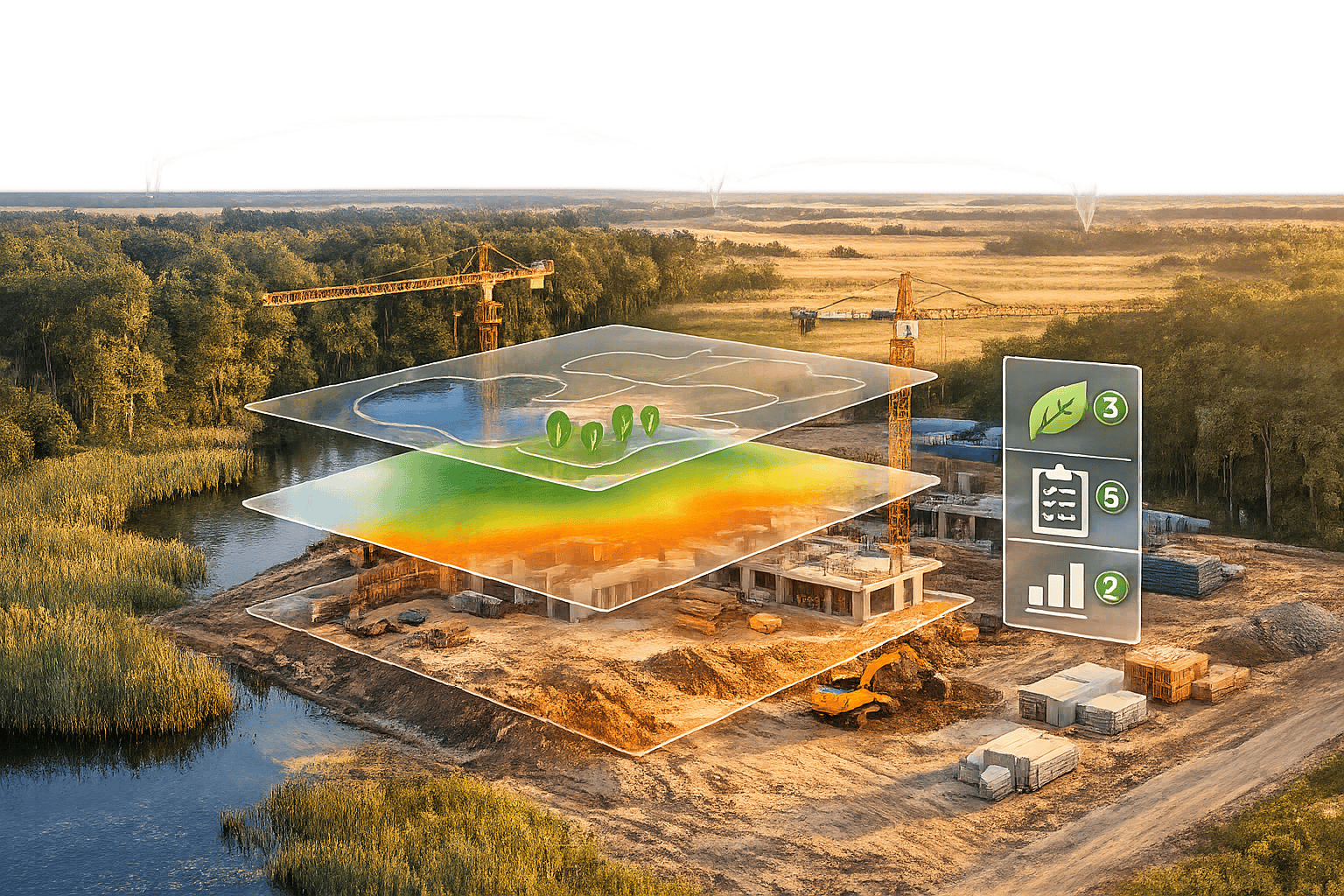
When managing construction projects, addressing biodiversity risks is no longer optional – it’s mandatory. Stricter regulations like the CSRD and TNFD require companies to assess and report their impact on ecosystems. Ignoring these risks can lead to project delays, financing challenges, and compliance issues. Fortunately, specialized tools can help companies navigate these challenges effectively.
Here are the top tools for biodiversity risk analysis, each tailored to different project stages and needs:
- CoreCast: Offers short-term biodiversity forecasts for land-use planning and compliance.
- One Click LCA Biodiversity Supply Chain Stress Tool: Evaluates upstream biodiversity impacts in supply chains.
- IBAT: Provides rapid site risk screening for areas near protected habitats.
- ENCORE: Focuses on sector-wide biodiversity risks and ecosystem dependencies.
- ecoinvent with SimaPro/openLCA: Delivers detailed life cycle assessments for supply chain biodiversity impacts.
- BioScope: Uses economic data to identify biodiversity hotspots in supply chains.
- BRiSK: Flags biodiversity risks early in the project planning process.
These tools simplify compliance with frameworks like TNFD and CSRD while helping construction teams make informed decisions. Whether you’re screening potential sites, analyzing supply chains, or reporting impacts, these platforms can streamline your process and reduce risks.
Preserving & promoting nature in construction: How can developers prepare for Biodiversity Net Gain?
sbb-itb-99d029f
1. CoreCast

CoreCast stands out as a tool designed to provide near-term insights for managing biodiversity risks in construction projects. Rather than relying on long-term climate projections, this platform uses short-term forecasting to deliver actionable data that construction teams can use immediately. By leveraging a transformer-based spatio-temporal model, CoreCast predicts monthly and seasonal changes in species distributions and habitat quality. This gives construction teams the critical information they need before breaking ground, ensuring compliance with regulations while enabling smarter planning.
Primary Use Case
CoreCast is particularly effective for scenario analysis in land-use planning. It allows construction professionals to assess how different infrastructure layouts – like road alignments or building footprints – could affect local wildlife and their habitats. Hammed A. Akande from Concordia University‘s Department of Biology explains:
"This could guide scenario analysis for land‐use planning, evaluating the potential impacts of infrastructure projects (for instance, new roads) on bird habitats, and inform more sustainable development strategies" [2].
By identifying biodiversity hotspots early, developers can allocate resources to protect these areas before construction begins [2].
Geographic Specificity
CoreCast operates on a continent-scale grid with a spatial resolution of 0.1° – approximately 6.2 miles (10 km) at the equator [2]. While its initial focus was on Africa, the platform is built to expand to other global biodiversity hotspots. It incorporates data from Sentinel-2 satellite imagery, ERA5 climate variables, and GBIF citizen science records to ensure comprehensive coverage [2].
Integration with Construction Workflows
CoreCast is designed to fit smoothly into existing construction processes. Its continual learning capability ensures forecasts are updated as new data becomes available [2]. With climate data accessible within just five days of observation, the platform provides near-real-time updates, making project management more responsive. Impressively, CoreCast has shown a +34 percentage point improvement in macro-averaged F1 scores and a +43 percentage point boost in PR-AUC when compared to traditional Random Forest models [2].
This combination of precision and adaptability makes CoreCast a valuable tool for balancing development needs with biodiversity protection.
2. One Click LCA Biodiversity Supply Chain Stress Tool

This tool takes biodiversity risk analysis to the next level by shifting the focus from just on-site impacts to the broader supply chain. Unlike earlier tools that primarily focus on habitat changes at the project site, the One Click LCA Biodiversity Supply Chain Stress Tool evaluates upstream impacts, offering a more thorough perspective on biodiversity risks.
The tool zeroes in on the environmental effects of materials and logistics. By analyzing supply chain activities, it helps identify biodiversity hotspots long before materials reach the construction site. It assesses environmental stressors in three key areas – climate change, pollution, and resource use – and uses an ecosystem condition metric to provide clarity.
Primary Use Case
This tool is particularly effective for supply chain screening and regulatory reporting. Construction teams can pinpoint where material sourcing intersects with natural ecosystems and adjust specifications to reduce the impact. As One Click LCA explains:
"Reduce the biodiversity impact of your supply chain quickly and directly with design changes synchronized across tools" [3].
The tool also allows for real-time scenario testing. For example, teams can tweak transport distances or switch to reused materials, and the tool immediately recalculates the biodiversity footprint. This makes it incredibly useful for meeting disclosure requirements under frameworks like the EU Corporate Sustainability Reporting Directive (CSRD) and the Taskforce on Nature-related Financial Disclosures (TNFD). Its streamlined evaluation process integrates smoothly into existing construction workflows.
Integration with Construction Workflows
One Click LCA eliminates the need for extensive primary data collection upfront by leveraging established Life Cycle Assessment (LCA) datasets. This means construction teams can begin evaluating options during site selection without waiting for supplier-specific data. Additionally, the tool syncs seamlessly with carbon modeling workflows, enabling teams to optimize sourcing and logistics decisions in real time.
Alignment with TNFD/CSRD Frameworks

The tool supports the first two steps of the TNFD LEAP approach – Locate and Evaluate [3][4]. For CSRD compliance, it addresses Disclosure Requirement E4-5 of the European Sustainability Reporting Standards (ESRS), which requires companies to report biodiversity and ecosystem impact metrics. According to One Click LCA:
"Disclosure Requirement E4-5 requires companies to report metrics of the impact on biodiversity and ecosystems for its direct operations and supply chain, and impacts on ecosystem condition may be disclosed based on life cycle assessment" [3].
This dual functionality allows construction firms to generate a single set of results that meets multiple disclosure frameworks, making compliance more efficient. By offering insights into both direct and indirect biodiversity impacts, the tool enhances overall risk management for construction projects.
3. Integrated Biodiversity Assessment Tool (IBAT)

IBAT serves as a screening tool that construction firms rely on during the initial stages of site selection and due diligence. By inputting project coordinates, teams can quickly determine if a proposed site is near protected areas, habitats of threatened species, or Key Biodiversity Areas (KBAs). This digital screening happens before any on-site evaluations, helping developers sidestep costly delays and potential regulatory issues.
Primary Use Case
The tool’s ability to provide rapid feedback is invaluable for identifying risks early in the due diligence process. It specializes in location-specific risk screening and environmental assessments, enabling construction teams to generate reports that highlight biodiversity risks within a set radius of their project site. One user shared their experience:
"IBAT provides essential screening on threatened species and endangered habitats that helps us assess risks, focus accompanying investigations, and prioritise restoration activities at our operating sites globally" [5].
This early detection mechanism also simplifies compliance with standards like IFC Performance Standard 6 (PS6) and the World Bank Environmental and Social Standard 6 (ESS6). Evonik emphasized this benefit:
"IBAT has been an essential tool to help Evonik understand our biodiversity risks and opportunities on-site" [5].
Geographic Specificity
IBAT combines data from three major global datasets: the IUCN Red List of Threatened Species (166,045 species as of November 2025), the World Database on Protected Areas (303,313 areas as of April 2026), and the World Database of Key Biodiversity Areas (16,495 sites as of April 2026) [5]. This comprehensive global coverage provides high-resolution data, though IBAT is often used as a preliminary filter before conducting in-depth ecological studies on the ground. To maintain accuracy, the platform updates its data monthly [8].
Integration with Construction Workflows
IBAT integrates smoothly into construction workflows through web services and APIs, allowing biodiversity data to be embedded directly into GIS systems and integrated management platforms. The tool generates automated reports in formats like PDF, CSV, and map files, making it accessible even for teams without ecological expertise. To date, over 600,000 sites have been uploaded by approximately 30,000 users for biodiversity risk screening [9].
Alignment with TNFD/CSRD Frameworks
IBAT plays a key role in the "Locate" phase of the TNFD LEAP approach [5] [6]. In 2024, it introduced a Disclosure Preparation Report (DPR) designed to align with CSRD, GRI, and TNFD frameworks [9]. LVMH highlighted how this feature supports broader biodiversity goals:
"The outcomes have served several purposes from the CSRD disclosure to the launch of specific biodiversity conservation projects. IBAT is a powerful tool which has definitely help LVMH and its Maisons making the biodiversity Group’s strategy more reliable and science based" [5].
4. ENCORE

This tool shifts the focus from site-specific evaluations to a broader, sector-wide perspective.
ENCORE (Exploring Natural Capital Opportunities, Risks and Exposure) is a screening tool designed to evaluate how projects depend on and affect natural ecosystems. Unlike tools that zero in on specific locations, ENCORE uses a sector-based approach aligned with ISIC classifications. This allows users to sort through construction-related categories – like civil engineering or building construction – and explore their interactions with key ecosystem services such as water supply, flood protection, and climate regulation.
Primary Use Case
ENCORE is particularly useful during the early stages of project planning, such as pre-feasibility studies and site selection. It helps construction teams identify which ecosystem services their projects might depend on and highlights potential risks to natural capital. With its recent data updates, the tool has enhanced its ability to pinpoint areas at risk. This macro-level insight helps set the groundwork for more detailed, localized evaluations.
Geographic Specificity
The platform offers global spatial data via an interactive map, identifying regions most vulnerable to natural capital depletion. However, because it relies on sector-level averages and modeled data, ENCORE is best suited as an initial filter for risk assessment. Construction teams can then follow up with more detailed, site-specific tools to refine their understanding. This global perspective complements localized analyses, providing a well-rounded view of potential risks.
Alignment with TNFD/CSRD Frameworks
ENCORE plays a significant role in the TNFD LEAP approach [10][3]. Its Biodiversity Module helps organizations align their projects with global biodiversity objectives and supports early-stage risk assessments to meet regulatory standards. As the platform explains:
"ENCORE can help financial institutions take their first steps towards understanding their dependencies and impacts on nature" [10].
Additionally, the tool is aligned with CSRD reporting requirements, specifically addressing biodiversity and ecosystem impacts as outlined in ESRS E4 [3].
5. BRiSK (Biodiversity Risk Screening Kit)

BRiSK is designed as a quick screening tool to identify potential risks related to biodiversity. It flags areas near protected zones, habitats of threatened species, or Key Biodiversity Areas (KBAs) [6][11]. This early-warning system helps guide decisions before more detailed and resource-intensive field surveys are conducted.
Primary Use Case
BRiSK is particularly useful in the early stages of project planning and due diligence. Construction teams often rely on it when assessing multiple potential sites. By identifying locations with lower biodiversity risks, the tool helps streamline the selection process and reduces the likelihood of unexpected challenges later on [6]. This early identification aligns well with standard practices in construction planning, saving both time and resources.
Integration with Construction Workflows
What makes BRiSK effective is its ability to integrate directly into existing workflows. It uses data already available, such as from a Bill of Materials (BoM) or Life Cycle Assessments (LCA), eliminating the need for entirely new data collection systems [6]. This seamless compatibility allows construction teams to incorporate biodiversity considerations into their routine evaluations without disrupting established procedures.
Geographic Specificity
BRiSK’s strength lies in its global datasets, which highlight protected areas and biodiversity hotspots. This broad coverage makes it applicable for projects both within the United States and internationally. However, its role is limited to initial screenings. When BRiSK identifies potential risks at a site, localized assessments are essential to provide more detailed, site-specific insights [6][11].
6. ecoinvent with SimaPro or openLCA

Building on initial risk screening, combining ecoinvent with SimaPro or openLCA offers a deeper look into the environmental impacts of supply chains. ecoinvent is a massive database with over 26,000 peer-reviewed datasets, serving as a cornerstone for Life Cycle Assessment (LCA) in construction [12]. When paired with SimaPro or openLCA, it enables construction teams to measure biodiversity impacts throughout the supply chain – from raw material extraction to manufacturing and transportation. This duo goes beyond basic screening to provide measurable insights into how materials and processes affect ecosystems.
Primary Use Case
The real strength of this combination lies in its ability to bring supply chain transparency and detailed quantification into focus. While earlier tools highlight risks, ecoinvent’s datasets allow for precise measurement of biodiversity impacts. Construction teams can pinpoint biodiversity "hotspots" within their supply chains by analyzing key production metrics [6] [7]. This level of detail uncovers areas of significant ecosystem impact that traditional carbon-focused metrics often overlook, providing a foundation for scenario analysis for real estate portfolios facing environmental risks. With Version 3.10 of ecoinvent, construction-specific data is included, enabling project-level assessments that set it apart from broader, less targeted tools, much like how teams benchmark real estate portfolios to identify performance gaps [13].
"For organisations moving beyond risk screening into quantifying their supply chain’s footprint, ecoinvent is indispensable." – Karel Maly, Carbonpunk [6]
Geographic Specificity
ecoinvent excels in offering region-specific data that reflects real-world supply chain conditions [12]. For instance, its construction materials database includes regional data for locations like Tunisia, Ecuador, Switzerland, and wider European regions (RER) [13]. In the oil and gas sector, the database covers 41 regions, accounting for over 96% of global crude petroleum production and 98% of natural gas output [13]. This geographic precision is crucial because biodiversity impacts vary significantly depending on location. For example, the biodiversity effects of cement production in Ecuador differ greatly from those in Switzerland due to varying ecosystem sensitivities.
Integration with Construction Workflows
These tools are designed to fit seamlessly into standard construction sustainability practices. Supporting the EN15804 standard, openLCA’s free platform and ecoinvent’s tiered licensing structure make it possible for teams to conduct collaborative, real-time sustainability assessments for large projects [12] [13] [14]. For larger-scale efforts, openLCA’s Collaboration Server allows multiple users to work on biodiversity impact models simultaneously, with synchronized databases ensuring consistency. This level of integration strengthens the role of ecoinvent in advancing sustainability goals.
Alignment with TNFD/CSRD Frameworks
This integration also aligns with TNFD and CSRD standards. Under the EU Corporate Sustainability Reporting Directive (CSRD), Disclosure Requirement ESRS E4-5 allows companies to report ecosystem impacts based on life cycle assessments [3]. Additionally, the tools support the "Evaluate" and "Assess" phases of TNFD’s LEAP approach by identifying drivers of biodiversity loss across supply chains [6]. In March 2026, ecoinvent partnered with Natcap to incorporate high-quality LCA data into nature intelligence platforms, further enhancing biodiversity impact assessments [12].
7. BioScope

BioScope gives construction teams a fast way to pinpoint biodiversity risks in their supply chains. Created by PRé Sustainability, this online tool uses the Exiobase economic input-output database to turn spending data from 163 sectors into visual estimates of biodiversity footprints tied to land use. It provides an initial map of potential impacts without requiring detailed site data or ecological expertise [6]. By leveraging economic data, BioScope offers a fresh angle on biodiversity impact estimation.
Primary Use Case
BioScope is designed for early-stage risk screening, but it stands out by focusing on economic spending data. This allows sustainability managers in construction to identify high-risk materials, commodities, or suppliers before diving into more time-consuming and detailed evaluations [6].
"BioScope provides a crucial first step. It helps businesses prioritise which commodities, suppliers, or investment areas warrant a more granular, site-specific investigation, aligning well with the initial screening phases of frameworks like the TNFD." – Karel Maly, Carbonpunk [6]
Geographic Specificity
BioScope uses national-level economic data from 44 countries, offering a broad overview rather than site-specific insights. While this top-down approach can’t provide precise details for individual locations, it serves as a quick scoping tool to direct attention toward areas needing deeper analysis [6]. The lack of geographic detail is a limitation, but as a free resource, it’s a practical starting point for further investigation.
Alignment with TNFD/CSRD Frameworks
BioScope fits neatly into the early screening stages of the TNFD LEAP approach, helping companies get a baseline view of their land-use impacts. For construction firms navigating CSRD disclosure requirements, it offers a quick way to identify potential hotspots. Once these areas are flagged, teams can move on to more detailed tools like ecoinvent or IBAT for asset-level analysis, showcasing how BioScope integrates into a larger network of assessment tools [6].
Tool Comparison Table

Biodiversity Risk Analysis Tools Comparison for Construction Projects
The table below highlights the core strengths of various tools, tailored to different project needs.
| Tool | Primary Use Case | Geographic Coverage | Technical Expertise | Cost | Workflow Integration | TNFD/CSRD Alignment |
|---|---|---|---|---|---|---|
| CoreCast | Real estate intelligence and portfolio tracking | United States | Low to Moderate | Subscription | High (integrated platform for asset analysis) | Moderate (supports ESG data tracking) |
| One Click LCA | Supply chain footprinting | Global | Moderate | Enterprise licensing | High (uses existing Bill of Materials) | High (LEAP aligned) |
| IBAT | Site risk screening | Global | Low | Tiered subscription | Moderate (early scoping) | High (Locate phase) |
| ENCORE | Sector risk mapping | Global | Low | Free | Low (finance focused) | High (Evaluate/Assess) |
| ecoinvent with SimaPro/openLCA | Detailed LCA data | Global | High | Annual license (ecoinvent); openLCA is free | Moderate (requires expert) | High (quantification) |
| BioScope | Initial hotspotting | Global | Low | Free | Low (spending based) | Moderate (scoping) |
CoreCast is a comprehensive platform designed for real estate professionals. It combines biodiversity risk tracking with tools for underwriting, pipeline tracking, portfolio management, and stakeholder reporting – all in one system tailored to the real estate sector.
In July 2025, European engineering consultancy G-ON used the One Click LCA Biodiversity Supply Chain Stress Tool on a warehouse and office project in France. Project Manager Alejandro Alfaro and Associate Director Clément Bégat leveraged existing RE2020 compliance data to assess biodiversity impacts. They discovered that materials like piping and roofing had a more pronounced effect on biodiversity stress compared to their carbon footprints. This integration required no additional data collection, as it utilized the existing material inventory [7].
"We already conduct LCAs for RE2020 compliance, so integrating the biodiversity assessment into our workflow was seamless. One Click LCA’s tool allowed us to quantify impacts that are typically overlooked." – Alejandro Alfaro, Engineering Project Manager, G-ON [7]
This comparison helps construction professionals align their project needs with the right tool, considering factors like project phase, available resources, and reporting requirements.
Conclusion
Selecting the right biodiversity risk analysis tool hinges on your project’s stage, technical capabilities, and regulatory needs. No single tool does it all. A smart strategy starts with broad tools like ENCORE for identifying portfolio-level risks, moves to site-specific platforms like IBAT for permitting and due diligence, and finishes with detailed tools such as One Click LCA for supply chain analysis [6].
Choose tools that align with your reporting obligations. For instance, if you’re navigating CSRD disclosures or EU Taxonomy compliance, focus on options that work with TNFD’s LEAP framework and provide precise, location-based data. Relying solely on sector averages may not cut it. Aligning your tools with these frameworks not only simplifies compliance but also strengthens your project’s resilience. Keep in mind that biodiversity impacts often differ from carbon footprints – materials like concrete pipes and roofing can strain ecosystems in ways emissions data might not show [7].
The real game-changer lies in integrating biodiversity risk analysis with broader real estate intelligence. Identifying nature-related risks early – alongside physical hazards and transition risks – can help you sidestep costly delays in permitting or financing [1]. Treating biodiversity as a core part of your risk profile, rather than an isolated consideration, leads to better outcomes.
Leverage the data you already have. For example, if you’re conducting LCAs for certifications like LEED, BREEAM, or RE2020, use the same Bill of Materials to run biodiversity stress tests. This approach avoids redundant data collection and uncovers material hotspots that carbon-focused metrics might miss [7].
For professionals managing multiple real estate projects, CoreCast offers a streamlined solution. It allows you to track biodiversity risks alongside underwriting, pipeline management, and portfolio analysis – all within one system. This ensures that nature-related risks are embedded in your investment strategy from the start, rather than being tacked on later.
FAQs
Which biodiversity tool should I use at each construction phase?
Managing biodiversity risks during construction requires the right tools for every phase of the project. Here are some highly effective options:
- Initial Planning: The Integrated Biodiversity Assessment Tool (IBAT) is ideal for early-stage risk screening and identifying priority sites.
- Detailed Assessment: For a deeper dive into potential risks, the WWF Biodiversity Risk Filter offers comprehensive analysis.
- Monitoring: To keep track of biodiversity risks across multiple locations, NatureMetrics‘ Portfolio Assessment platform is a reliable choice.
- Impact Quantification: During construction, One Click LCA’s Biodiversity Tool helps measure and understand environmental impacts.
- Regulatory Review: The US Fish & Wildlife Service’s IPaC platform simplifies compliance and assists with conservation planning.
Each of these tools plays a specific role in ensuring biodiversity is protected throughout construction projects.
What data do I need to run a biodiversity risk assessment fast?
To carry out a quick biodiversity risk assessment, you’ll need some essential site-specific details, such as:
- Extinction risk and ecosystem vulnerability scores to evaluate possible environmental impacts.
- Ecological condition and habitat details to pinpoint critical habitats and species under protection.
- Precise location and site boundaries to calculate biodiversity metrics on the spot.
- Information on protected or listed species to address conservation or regulatory requirements.
With this information, assessments can be completed efficiently, even without GIS expertise.
How do I align biodiversity analysis with TNFD and CSRD reporting?
To meet the requirements of TNFD and CSRD reporting, it’s crucial to incorporate detailed, location-specific biodiversity data into your risk assessments. This means using tools that can map your operations’ proximity to protected areas, critical habitats, and species at risk. These insights help identify potential risks and maintain transparency.
Frameworks such as the EU Taxonomy place a strong focus on managing biodiversity impacts. By using AI-powered platforms or biodiversity risk mapping tools, you can simplify the compliance process while ensuring your reporting remains clear and thorough.