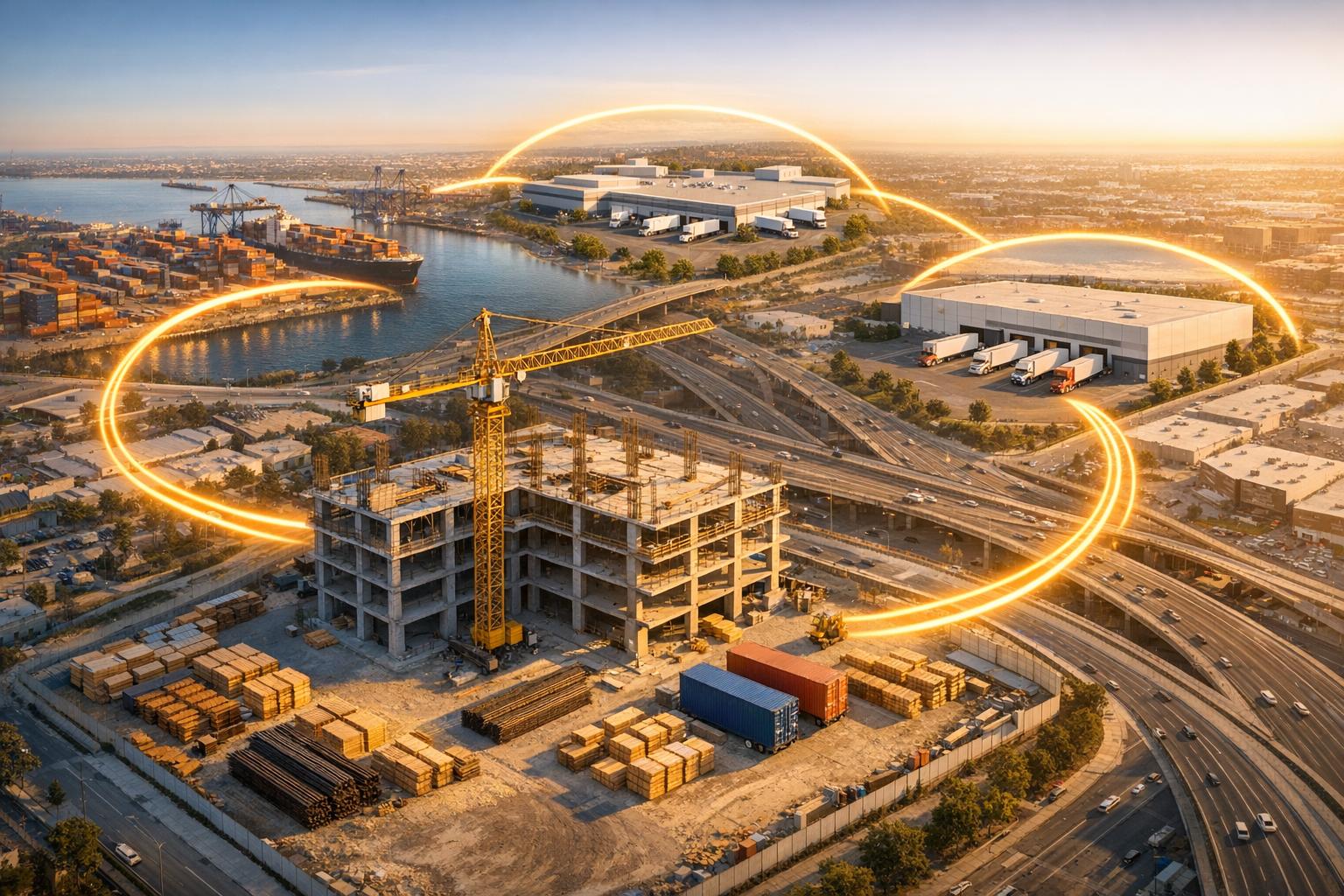
Construction projects face major risks when supply chains falter. Delays, cost overruns, and missed deadlines are common outcomes of disruptions in materials, labor, or equipment delivery. Between April 2020 and February 2021, material costs like diesel fuel (+114%), lumber (+62%), and steel (+20%) surged, highlighting the volatility of supply chains. Events like labor strikes, extreme weather, and geopolitical tensions now disrupt supply chains every 3–4 years, making risk management a critical focus for contractors.
Key takeaways:
- Types of Risks: Technical (design flaws, poor materials), Organizational (miscommunication, weak planning), and External (strikes, natural disasters).
- Risk Management: Use frameworks like ISO 31000 to identify, assess, and mitigate risks.
- Technology: Tools like AI analytics, real-time tracking, and supplier mapping enhance decision-making.
- Solutions: Build strong supplier relationships, diversify sourcing, and use predictive tools to anticipate issues.
To keep projects on track, construction leaders must shift from reacting to disruptions to preparing for them. This guide explains how.
Resilience Lessons from Construction Supply Chains
sbb-itb-99d029f
Main Types of Construction Supply Chain Risks

Three Main Categories of Construction Supply Chain Risks and Their Impacts
Construction supply chain risks can be grouped into three main categories: technical, organizational, and external. Understanding these categories helps project stakeholders craft targeted strategies to manage risks effectively throughout the project lifecycle.
Technical Risks
Technical risks arise from design flaws, poor material quality, and equipment malfunctions. For instance, when materials fail to meet project specifications, the consequences can extend well beyond simple rework. Defective steel or wiring, for example, can pose immediate safety threats and jeopardize the long-term integrity of a structure. Similarly, equipment failures can bring work to a standstill, leaving crews idle and delaying project timelines.
Material waste is another significant concern, accounting for 10–20% of total material costs in construction [3]. Additionally, price fluctuations in key materials can severely impact contractors without escalation clauses, forcing them to absorb rising costs and shrinking profit margins on active projects.
Long-lead items are another technical hurdle. Specialized components like electrical switchgear or custom HVAC units often require over 30 weeks for delivery. If these items aren’t identified and ordered during the preconstruction phase, bottlenecks can form later, compressing installation timelines. This often results in trade stacking, where multiple crews work in the same area, leading to reduced productivity.
Technical risks are often compounded by internal mismanagement, further complicating project timelines.
Organizational Risks
Organizational risks stem from poor communication, inadequate planning, and weak supplier oversight. Construction supply chains typically involve multiple tiers of suppliers, and problems often originate at lower tiers (Tier-2 or Tier-3), where visibility is limited. By the time a missing component is identified, deadlines may already be in jeopardy.
Issues like delayed vendor payments, unclear specifications between architects and suppliers, and misaligned project team coordination can grind progress to a halt. For example, when materials arrive on-site but can’t be installed due to missing components or mismanaged schedules – resulting in an installable backlog – labor costs rise, and productivity suffers. Addressing these challenges requires robust systems and clear accountability.
When technical and organizational risks coincide, external factors like economic shifts and extreme weather can amplify the strain on project delivery.
External Risks
External risks are driven by factors beyond direct control, such as economic instability, regulatory changes, geopolitical events, and environmental disruptions. These challenges tend to surface every three to four years [2], making proactive risk planning a necessity.
For example, natural disasters can cause both immediate and long-term disruptions. In October 2024, Hurricane Helene damaged critical infrastructure like roads and ports, resulting in extended delays and material shortages [1]. Similarly, labor strikes or port closures can completely halt material shipments, requiring weeks of recovery even after operations resume.
Regulatory changes add another layer of unpredictability. Updates to building codes, environmental compliance rules, or permit processes can delay projects and force mid-course design revisions. Tariffs and trade restrictions further complicate matters, limiting sourcing options and driving up the cost of imported materials.
| Risk Category | Specific Examples | Primary Impact |
|---|---|---|
| Technical | Design flaws, poor material quality, equipment failures, long-lead items | Rework, safety risks, structural issues, schedule delays |
| Organizational | Vendor miscommunication, slow payments, hidden supplier tiers | Project delays, trade stacking, lost productivity, installable backlog |
| External | Geopolitical conflicts, strikes, extreme weather, regulatory changes | Budget overruns, halted projects, missed deadlines, rising costs |
Risk Assessment Methods and Tools
When it comes to identifying and evaluating risks in the construction supply chain, structured methods and specialized software are essential. Without a consistent approach, teams might rely on gut feelings instead of data, potentially overlooking critical threats. By pairing solid frameworks with advanced tools and real-time analytics, risk management becomes a proactive strategy rather than reactive problem-solving. One such framework, ISO 31000, offers a clear, step-by-step guide for assessing and managing risks effectively.
ISO 31000 Risk Management Framework

After identifying the main risks in the supply chain, applying a structured framework like ISO 31000 can make all the difference. This six-step process is particularly well-suited to construction supply chain challenges. It starts with Communication and Consultation, ensuring all stakeholders are involved. Next, the Scope, Context, and Criteria step defines the risk appetite and supply chain goals.
The third step focuses on assessing risks by identifying potential threats – such as material shortages – analyzing their likelihood and impact, and prioritizing responses. Risk Treatment follows, introducing measures like supplier diversification or pre-purchasing essential materials. The Monitoring and Review phase ensures ongoing tracking of supplier stability or market conditions, while Recording and Reporting documents outcomes for accountability and future use [5].
For construction-specific needs, firms should map the entire supply chain, including suppliers, subcontractors, and logistics providers, to identify regional vulnerabilities like natural disasters or political instability [1]. Projects that adopt integrated risk management practices can see significant benefits, including cost savings of up to 15% and time reductions of up to 30% compared to industry norms [6]. Cormac O’Connor, Head of Casualty for Construction and Infrastructure at Aon, highlights this shift:
"Instead of buying an insurance product to manage your risks, you are now provided with a solutions-based approach for the project" [4].
Risk Scoring and Prioritization
Risk scoring turns subjective assessments into clear, comparable numbers, often using a 1–5 scale where 1 represents low risk and 5 indicates high risk [7]. These scores help categorize risks into zones: Green (1.0–2.0) for low-risk scenarios, Yellow (2.1–3.0) for moderate risks, Orange (3.1–4.0) for significant concerns, and Red (4.1–5.0) for high-priority issues requiring executive attention.
To make risk matrices more effective, companies can apply weighted categories based on their priorities. For example, financial stability might carry a 25% weight, project complexity 20%, and schedule constraints 15%. This ensures that risks with the greatest potential impact get addressed first. Regularly updating these scores – such as through quarterly reviews – helps refine predictions by comparing them with actual project outcomes [7].
The pandemic highlighted the urgency of such methods. A staggering 94% of Fortune 1000 companies faced supply chain disruptions during this period [9]. Moreover, 68% of supply chain leaders anticipate increased risk exposure in the near future, with logistics disruptions alone costing about $184 billion annually [8].
Integrating these methods with specialized software can take risk visibility and decision-making to the next level.
Software Tools for Risk Assessment
Modern risk assessment in construction increasingly depends on software that offers real-time dashboards and predictive analytics. Tools like Primavera Risk Analysis excel in analyzing complex, multi-risk environments and modeling schedule impacts [6]. Meanwhile, Procore integrates real-time risk tracking, safety management, and financial forecasting [2]. Other tools, such as Safran Risk and ConstructConnect, enhance quantitative risk analysis and provide procurement insights to anticipate supply chain disruptions [6].
AI-powered platforms like Resilinc, Prewave, and Everstream Analytics monitor vast data sources, including news, social media, and government reports, to deliver timely alerts on disruptions caused by geopolitical events or natural disasters. Additionally, solutions like Interos and Continuity2 go beyond Tier 1 suppliers, mapping deeper supplier networks to uncover hidden dependencies and vulnerabilities. Tools like Building Information Management (BIM) also play a role by creating 3D models that detect material waste or design conflicts before construction begins [2].
Reflecting the growing focus on proactive planning, nearly 80% of supply chain executives are now investing in digital tools to enhance visibility across the entire supply chain [8]. This shift underscores the move from occasional risk assessments to continuous, structured risk management.
How to Reduce Construction Supply Chain Risks
Once you’ve assessed supply chain risks, the next step is finding ways to minimize them. The construction sector, especially in the UK, faces high insolvency rates [10], and globally, major project failures rank as the 7th biggest risk in the industry [4]. These numbers highlight how critical it is to take proactive steps to manage risks – it’s about keeping projects on track and avoiding costly setbacks.
Shifting from reactive problem-solving to strategic prevention involves three key steps: strengthening supplier relationships, broadening your supplier network, and using technology for smarter planning. Each of these targets specific weaknesses in the supply chain, and together, they create a multi-layered defense against disruptions.
Building Strong Supplier Relationships
Reducing supply chain risks starts with treating suppliers as true partners. This means moving beyond transactional relationships to a collaborative approach where both sides share responsibility for a project’s success.
One crucial tactic is involving suppliers early in the process, even during the design phase. This gives them a chance to flag potential material shortages, regional limitations, or alternative options before these issues derail your timeline. For example, a U.S. airport authority in April 2024 secured $800 million in builders risk coverage for a major remodeling project. By maintaining open communication with brokers and insurers and taking preventative measures after a previous flood loss, they kept the project on schedule despite challenging conditions [4].
Sticking to payment schedules is another way to maintain strong partnerships. Late payments can strain relationships and slow down projects. Contracts that reward timely deliveries and outline clear penalties for delays help ensure accountability on both sides.
Digital tools and custom reporting can also streamline supplier interactions. Platforms that track compliance and performance reduce administrative burdens, while post-disruption reviews with suppliers can identify what went wrong and how to improve resilience for the future.
But strong relationships alone aren’t enough – you also need to avoid over-reliance on any single supplier.
Diversifying Supply Sources
Relying on one supplier is risky. As Al Hall, President and CEO of Wolverine Assemblies, explains:
"A single point of failure can halt an entire production line, leading to millions in lost revenue and severe reputational damage" [13].
Given that materials typically account for 25–35% of construction project costs [3], supply disruptions can have a massive financial impact. To avoid this, diversify your supplier base geographically to reduce the impact of localized disruptions.
Instead of keeping backup suppliers on standby, maintain active relationships with them. Allocate 20–30% of your orders to secondary vendors so they stay familiar with your processes and can step in quickly during a crisis [13]. This "just-in-case" model has replaced the outdated "just-in-time" approach, which left many projects exposed during recent global supply chain issues [12][13].
Diversification not only mitigates risk but can also lead to cost savings. Strategic procurement and disciplined supplier selection can reduce costs by 5–15% [3]. Start by identifying which materials are single-sourced and carry the highest revenue impact, then qualify geographically diverse alternatives for those critical components [13].
Technology can take these efforts even further.
Using Technology for Better Planning
Technology helps shift supply chain management from reactive fixes to proactive strategies. Tools like IoT, GPS, and RFID tracking provide real-time visibility into material locations and conditions, enabling contractors to anticipate delays and reroute shipments before they disrupt production. This is particularly important for materials like structural steel or HVAC units, which often have lead times of 8–12 months.
AI-driven real estate analytics tools can analyze historical and real-time data to forecast costs, highlight potential bottlenecks, and recommend solutions before problems arise. Over half of organizations already use automation for supply chain visibility, with many focusing on building risk resilience [11][14].
Automation also simplifies compliance. For instance, Thomson Reuters tracked over 450,000 restricted-party list updates in a single year to support global trade compliance [11] – a task that would be nearly impossible without software. Automated systems can screen suppliers against watchlists and monitor expiration dates for insurance and safety certifications, reducing the risk of legal issues on-site.
Amy David, Clinical Professor of Management at Purdue University, emphasizes:
"Technology has improved tracking, forecasting and security across supply chains" [12].
Advanced tools like Building Information Management (BIM) software can create 3D digital models that include material data, helping optimize designs and cut down on waste before construction even begins. With logistics disruptions costing an estimated $184 billion annually [14], these tech investments can save both time and money by preventing delays and improving resource allocation.
Using Real-Time Analytics with CoreCast

Real estate professionals need a platform that combines construction data with portfolio and investment decisions. CoreCast is designed to meet this need, offering a real estate intelligence platform that integrates underwriting, pipeline tracking, portfolio analysis, and stakeholder reporting. This streamlined approach supports better decision-making, especially when managing risks in the construction supply chain.
CoreCast stands out by delivering real-time analytics, helping connect data insights directly to operational strategies.
Portfolio Insights for Supply Chain Visibility
CoreCast provides a centralized view of procurement data to benchmark real estate portfolios effectively, serving as a single source of truth for tracking stock levels, delivery schedules, and quality status [13]. Instead of replacing existing systems, it overlays inventory positions and supplier commitments with property performance metrics and competitive landscape data, all accessible through an integrated map.
This comprehensive visibility allows you to detect patterns that may go unnoticed when examining individual projects. For instance, you might realize that multiple developments are heavily dependent on the same supplier for structural steel, creating a potential concentration risk. With CoreCast’s real-time analytics, these dependencies become apparent early on, enabling you to adjust procurement strategies before issues arise. This process is often supported by scenario analysis for real estate portfolios to model potential outcomes. Additionally, the platform’s ability to track data across various asset types means you can apply lessons learned from one project to another, improving decision-making across your portfolio.
Pipeline Tracking for Supplier Dependencies
Building on portfolio-level insights, CoreCast’s pipeline tracking aligns supplier performance with project timelines. The platform monitors deals through various stages, extending its capabilities to track supplier performance and dependencies. It maps multi-tier supplier relationships, going beyond direct vendors to uncover risks deeper in the supply chain [15]. This is particularly valuable for specialized components like custom facades or HVAC systems, which can take months to procure [3].
By linking supplier data to your pipeline tracker, you can work backward from installation dates to ensure materials are available when needed for each construction phase. Real-time updates notify you of delivery issues or financial red flags with suppliers, giving you time to engage backup vendors and avoid delays. This proactive approach is essential, especially since global shipping disruptions can require four to six weeks of recovery for every week of work stopped [1].
AI-Driven Risk Prediction and Forecasting
CoreCast enhances traditional risk management with AI-powered tools that predict disruptions before they occur. Using both historical and real-time data, the platform’s AI forecasts supply chain issues that could impact your schedule. As Deloitte highlights:
"Intelligent toolkits and platforms, such as AI, have already demonstrated their potential to significantly increase productivity (by up to 30%) which will ultimately mitigate delivery risk" [15].
CoreCast’s AI features also provide real-time insights into a project’s financial health, tracking expenses and forecasting future costs to help you stay within budget [2]. This is especially helpful for materials with volatile pricing, like steel or timber. The system can pinpoint ideal ordering windows, allowing you to lock in prices early and shift escalation risks away from your project [3]. By integrating financial forecasting with supply chain analytics, CoreCast enables proactive decisions – such as early material purchases to avoid delays – rather than reactive problem-solving after disruptions have already occurred [2].
Conclusion
Construction supply chain risks, fueled by factors like extreme weather and pandemics occurring every 3 to 4 years [2], are unavoidable. The key is preparation. As Al Hall, President and CEO of Wolverine Assemblies, aptly states:
"Proactive defense against disruption is no longer a strategic option; it has become a core competitive necessity" [13].
The shift from reacting to crises to proactively planning for risks is no longer optional. Recent disruptions have shown that even minor delays can snowball into lengthy recovery periods [1]. This is why steps like diversifying suppliers, keeping strategic buffer stocks, and fostering strong partnerships are essential. These measures help avoid single points of failure that could derail entire projects, causing delays and budget overruns.
Modern technology plays a pivotal role in addressing these risks. Tools like real-time monitoring, AI-driven forecasting, and centralized visibility platforms allow businesses to spot vulnerabilities before they turn into major problems. With 70% of organizations prioritizing supply chain visibility and resilience as top technological investments [14], the industry is clearly embracing data-driven approaches to decision-making.
The strategies outlined in this guide – such as ISO 31000 frameworks, real-time analytics, and multi-tier supplier mapping – work best when woven into everyday operations rather than treated as occasional tasks. Proactive logistics management not only helps cut logistics costs by up to 20% [16] but also safeguards your reputation. In today’s market, where 73% of customers are likely to reduce spending with companies they don’t trust [16], maintaining reliability is crucial.
FAQs
What are the earliest warning signs of a supply chain disruption on my project?
In construction, spotting the early signs of supply chain trouble can save a lot of headaches down the road. Some red flags include delays in material deliveries, shortages of essential supplies, or problems with transportation. You might also notice rising costs, longer lead times, or unreliable communication from suppliers.
Catching these issues early gives project managers the chance to make adjustments – whether that means tweaking schedules or finding alternative suppliers. Taking action quickly can help keep delays and budget overruns in check.
How do I prioritize supply chain risks using a simple scoring method?
To effectively address supply chain risks, start by pinpointing potential trouble spots. These could include supplier challenges, transportation hiccups, or external influences like economic shifts or natural disasters. Once identified, evaluate each risk by assigning a score for both its likelihood and impact on a scale (e.g., 1 to 5). Multiply these two numbers to get a total risk score.
The higher the score, the more attention that risk demands. These are the ones that could disrupt operations the most. Make sure to revisit and update these scores regularly to stay ahead and keep your risk management strategy responsive to new developments.
What data should I track in real time to prevent material and equipment delays?
To keep material and equipment delays at bay, it’s essential to track real-time data on supply chain challenges such as port strikes, transportation hiccups, and natural events. Pay close attention to shipping updates, delivery timelines, inventory stocks, and supplier lead times. It’s also important to stay on top of customs clearance processes, transportation routes, and potential logistical bottlenecks. Leveraging digital tools for real-time tracking can provide better visibility and help you tackle delays before they disrupt your project schedule.