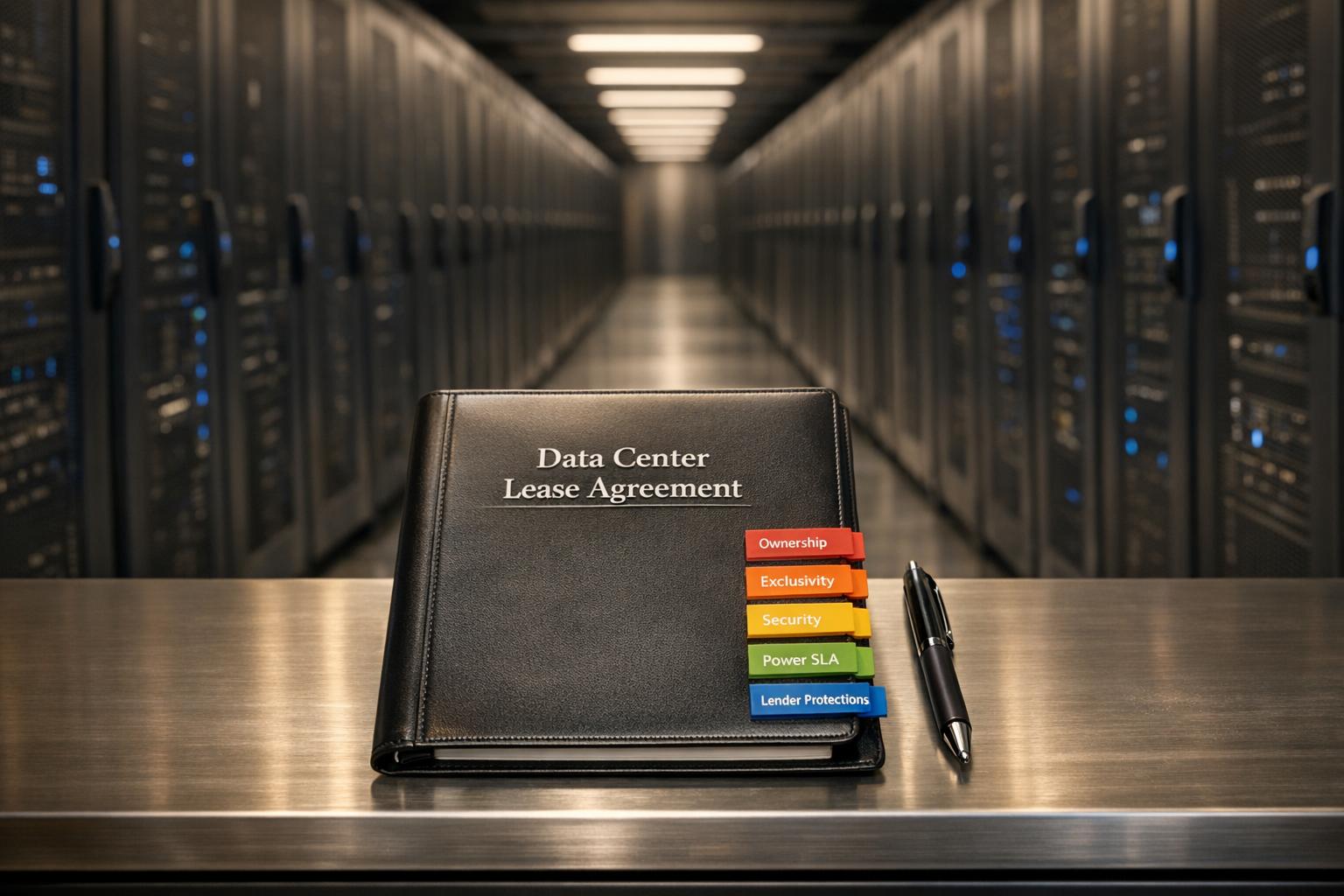
Data center leases are not your typical real estate contracts. They combine real estate terms with technology service provisions, making them complex agreements that require careful planning. Here’s what you need to know:
- Ownership clarity is critical. Clearly define who owns what – generators, cooling systems, and IT equipment – to avoid disputes. Include waiver clauses to protect tenant-installed infrastructure.
- Exclusivity and flexibility matter. Protect your operations by securing exclusivity clauses and ensuring assignment rights for subleasing or licensing space.
- Security and privacy are non-negotiable. Leases must address physical access, data privacy, and cyber protections, especially with AI-driven operations.
- Power reliability is a top priority. Uptime guarantees (like 99.999%) and redundancy systems are essential to prevent operational disruptions.
- Lender protections ensure stability. Non-disturbance agreements and recorded lease memoranda safeguard both tenant investments and property value.
These leases demand precise terms to ensure smooth operations, protect investments, and maintain service reliability. Avoid generic templates and focus on detailed agreements tailored to data center needs.
$85 vs $150 Per kW: Why Data Center Deals Don’t Compare Anymore
sbb-itb-99d029f
Ownership and Improvements in Data Center Leases

Data Center Lease Ownership Models: Wholesale vs Powered Shell vs Net Lease
When it comes to data center lease agreements, one of the trickiest legal hurdles is defining who owns what. Unlike a standard office lease, where ownership boundaries are relatively simple, data centers often blur the lines between permanent building fixtures and tenant-installed equipment. For instance, a cooling unit bolted to the floor can spark debates about whether it’s a landlord fixture or tenant property.
Define Ownership of Fixtures and Equipment
The key to avoiding disputes lies in how well the lease defines the ownership boundaries. Often, this "demarcation point" is set at the Power Distribution Unit (PDU) or Remote Power Panel (RPP). Everything downstream – like power distribution systems, networking equipment, racks, and IT gear – typically falls under tenant ownership. Upstream infrastructure, such as electricity substations and main cooling systems, usually remains the landlord’s responsibility.
Ownership models differ depending on the lease type:
- Wholesale Co-location: The landlord owns most of the facility infrastructure.
- Powered Core and Shell: Ownership is shared between landlord and tenant.
- Net Lease: Tenants may own the facility infrastructure outright.
To avoid confusion, the lease must clearly outline which assets – like generators, batteries, cooling systems, and fiber connections – belong to the tenant versus the landlord. Without this clarity, disputes over whether tenant-installed equipment can be removed at the end of the lease are almost guaranteed. Mayer Brown highlights this issue:
If the Tenant owns any of the facility infrastructure the Landlord will need to ensure the Tenant follows an appropriate maintenance schedule[3].
These distinctions are especially important because they lay the groundwork for waiver clauses that protect tenants’ critical investments in technology.
Draft Waivers and Asset Protection Clauses
Given the high costs involved, tenants need ironclad protections for their equipment. This is where waiver clauses come in. These clauses ensure the landlord waives any claim to tenant-owned trade fixtures or IT equipment, even when such items are integrated into the building’s systems.
A well-crafted waiver clause also guarantees tenants the right to remove valuable equipment at the lease’s end. For tenants investing in cutting-edge infrastructure – such as replacing air cooling with direct-to-chip liquid cooling – the lease should include provisions that allow for upgrades without requiring a full renegotiation.
Kendall K. Murphy, Associate at ArentFox Schiff, underscores the need for precision:
A well-defined lease without ambiguous language is vital for safeguarding all parties involved[2].
Additional protections might include:
- Separate metering for tenant-owned equipment to track power usage and reinforce ownership claims.
- Documenting structural or energy-efficiency improvements in separate agreements, specifying whether tenants are entitled to rent adjustments or removal rights.
- Pre-approved maintenance schedules for tenant-owned infrastructure to address landlord concerns about safety while preserving tenant control.
Exclusive Use and Assignment Rights
Data center tenants face the challenge of maintaining operational flexibility while safeguarding their competitive edge. This involves carefully managing building occupants and sublease arrangements. Much like ensuring clear asset ownership and securing waiver protections, exclusivity and flexible assignment rights are key to reducing risk and maintaining smooth operations. Decisions around these elements directly affect both security and revenue streams.
Secure Post-Construction Exclusivity
Keeping control over building occupants is critical to minimizing operational risks. As Mayer Brown highlights:
The risk of natural disasters needs to be minimised both by location of the building in a low risk area (including controlling other users in the building if applicable) and the design of the building itself [3].
For example, if a landlord leases adjacent space to a competitor or a tenant with weak security practices, it can compromise the integrity of your operations. This is where post-construction exclusivity clauses come into play. These provisions protect your investment by restricting landlords from introducing competing businesses after you’ve made significant infrastructure investments. Such clauses should clearly outline the types of businesses that are not allowed to occupy nearby spaces. For instance, if you run a wholesale co-location operation, you might want to ensure that direct competitors cannot lease space on adjacent floors or sections.
Connectivity exclusivity is another critical area. Tenants must secure the ability to establish circuits and cross-connects throughout the facility without facing additional costs or restrictions. Kendall K. Murphy, Associate at ArentFox Schiff, emphasizes:
Lessees should have the ability to establish circuits and cross-connects throughout the data center, including within their leased space, without incurring additional costs [2].
It’s also important to negotiate any "preferred carrier" agreements ahead of time to avoid limitations on fiber carrier options. While exclusivity is crucial, it’s equally important to retain flexibility in transferring or licensing space.
Allow Assignment and Sublease Flexibility
In addition to exclusivity, having clear assignment and sublease provisions is essential for integrated real estate platforms for efficient operations. Many operators lease space to co-location customers, and standard commercial lease terms often require landlord consent for each sublease. This can create unnecessary delays and complications. To avoid this, lease agreements should differentiate between a full assignment of the lease and routine licensing for racks, cages, or power.
Without these distinctions, tenants may find themselves needing landlord approval for routine activities, which can disrupt operations. Additionally, the lease should allow tenants the freedom to update the "Data Center Rules and Regulations" – covering areas like security, maintenance, and cabling – without needing constant landlord approval. This flexibility is vital to keeping pace with evolving technology and compliance requirements for various sub-tenants.
Landlords might worry about risks if a few large sub-tenants account for a significant share of your revenue. However, these concerns can be addressed by offering transparency into your customer base while ensuring you retain the ability to run your business without excessive oversight.
Security, Access, and Data Privacy Protections
When it comes to data center leases, security and privacy protocols aren’t just important – they’re essential. Unlike standard commercial leases, data center agreements must include detailed safeguards to protect sensitive data and prevent unauthorized access. Without these measures, tenants face risks like outages, breaches, and even regulatory fines. As Kendall K. Murphy, Associate at ArentFox Schiff, explains:
Outages can stem from factors such as power loss, fluctuations in power quality, temperature or humidity deviations, unauthorized access, or human errors [2].
The stakes are even higher with the rise of AI-driven data scraping. Food & Water Watch warns:
Any public information not behind a paywall may be devoured by AI companies, including voter registration data, social media profiles, passport photos, and even credit card numbers [6].
Add to this the fact that less than 25% of global electronic waste is recycled, and it’s clear that improperly discarded servers and chips could expose sensitive data if disposal isn’t handled securely [6]. These challenges highlight why leases must cover both physical and digital security in detail.
Restrict Landlord Entry
One of the most important aspects of a data center lease is limiting landlord access. Unlike typical leases, data center agreements should bar landlords from entering the premises without strict protocols. For example, landlords should only access the space when accompanied by a tenant-approved escort – even in emergencies [3]. This minimizes the chance of service disruptions caused by human error and ensures the physical security of your equipment.
To further protect your servers, leases should require secured cages or racks for all equipment, making unauthorized physical contact nearly impossible [3]. Including a detailed "Data Center Rules and Regulations" exhibit in the lease is also crucial. This document should outline security policies, fire detection systems, and maintenance schedules [3]. Additionally, the lease must clearly define where the landlord’s security responsibilities end and the tenant’s begin, particularly when distinguishing between facility-level and rack-level security [3].
It’s equally important to specify the conditions under which landlords can enter and the security steps they must follow. As Ankit Shrivastava of ArentFox Schiff puts it:
A well-defined lease without ambiguous language is vital for safeguarding all parties involved [4].
Include Confidentiality and Privacy Provisions
Beyond physical security, leases must address data privacy and cyber protections. For instance, landlords and third parties should be explicitly prohibited from using tenant data for AI training or any secondary purposes [6]. The lease should also require landlords to uphold strong defenses against cyber-attacks, comply fully with local privacy laws [3], and follow secure disposal practices for outdated hardware to prevent breaches through discarded components [6].
To ensure reliability, consider using frameworks like the "tier" system (1–4) or the "series of nines" (e.g., 99.999%). These standards not only define uptime expectations but also set measurable benchmarks for security infrastructure performance [2]. Having such clear metrics removes any guesswork and ensures both physical and digital protections are up to par.
Utilities and Service Reliability
When it comes to data centers, power isn’t just important – it’s everything. Even a brief power outage can lead to devastating financial losses and damage a company’s reputation, especially for AI-driven operations [1]. By 2025, data centers are expected to consume about 4.4% of global electricity, and in the U.S., that demand might double or even triple over the next decade [8]. With stakes this high, utility provisions become one of the most critical aspects of any data center lease. That’s why uninterrupted power and robust backup systems are non-negotiable.
Require Redundancy and Backup Power Systems
Power reliability isn’t optional – it’s essential. The industry relies on two key frameworks to measure this reliability: the "tier" system (Tiers 1–4) and the "series of nines", which refers to uptime percentages. For instance, the widely recognized "five nines" (99.999%) uptime guarantee has become the baseline standard for power and cooling [7]. To put it in perspective, a 99.9% uptime results in significantly more downtime than 99.999% – a difference that can be catastrophic for operations [2].
To ensure this reliability, data centers need both primary and backup utility feeds, ideally sourced from separate substations, along with onsite generators and battery systems [2]. Keep in mind that upgrading power supplies to meet data center demands can take three to four years, so it’s crucial to secure these arrangements early in the leasing process [3]. Also, make sure the lease specifies adherence to ASHRAE standards for cooling and humidity – an especially important factor for AI servers, which generate significant heat [2]. Finally, clarify exactly where the landlord’s responsibility for power delivery ends (usually at the Power Distribution Unit or Remote Power Panel) and where the tenant’s begins [3].
Add Service Interruption Clauses
Even with the best redundancy systems, outages can still happen. That’s why it’s essential to include strong service interruption clauses in your lease. These clauses should outline specific Service Level Agreements (SLAs) that guarantee uptime, define acceptable power quality metrics, and set environmental tolerances [3]. By addressing these details upfront, you can protect your operations and reduce the risk of legal disputes if service issues arise.
Financial safeguards, like "service credits", can offer compensation when the landlord fails to meet agreed performance standards. However, Andrew Lipman of Bingham McCutchen LLP cautions:
Service levels should be backed by credits for failures in performance, but even the most liberal credits are seldom enough to compensate for a single failure that causes a network outage [5].
To further protect your operations, include self-help rights in the lease. These rights allow you to secure replacement power during unscheduled outages [8]. Your SLA should also address not just complete outages but any degradation in power quality [4]. Additionally, pre-agreed troubleshooting windows can help minimize downtime, while audit rights let you verify that maintenance routines and operational standards are being upheld [3]. These measures ensure your data center remains resilient, even in the face of unexpected challenges.
Lender Protections and Financial Viability
Data centers have become a hot commodity for investors, offering yields up to 150 basis points higher than top-tier modern logistics assets [3]. But with these high returns come distinct risks that demand meticulous legal planning. Unlike typical commercial properties, a data center’s worth is deeply tied to its operational performance – think power reliability, cooling systems, and uptime guarantees. Because of this, lenders pay extra attention to lease agreements, ensuring their investment is safeguarded against potential setbacks. This shifting risk landscape calls for precise legal protections within these agreements.
Include Non-Disturbance Agreements
A non-disturbance agreement (NDA) is a vital safeguard for both tenants and lenders. If the property owner defaults on their mortgage and the property goes into foreclosure, an NDA ensures the tenant’s lease remains intact under the new owner. Without this agreement, a foreclosing lender could terminate the lease, leading to operational chaos. For data center operators who have poured substantial resources into custom infrastructure and are bound by critical contracts, an NDA is not just useful – it’s necessary.
From the lender’s perspective, NDAs are equally important. They help ensure that rental income continues uninterrupted, even if ownership changes hands. Since data center valuations lean heavily on Service Level Agreements (SLAs) that guarantee service availability, any disruption to these agreements could trigger financial penalties, directly affecting cash flow [3]. By securing an NDA early in the lease negotiation process, both operational continuity and the property’s market value are better protected.
Record Lease Memoranda and Financing Provisions
Beyond foundational legal protections, additional documentation can further safeguard tenant investments and lender interests. Recording a lease memorandum with local land records publicly establishes tenant rights, ensuring the lease remains enforceable against future property owners. This step is particularly crucial for data center leases, where tenants often make substantial investments in infrastructure that need legal backing beyond a standard contract. As Mayer Brown highlights:
legal issues and risks unique to this asset class… need to be appropriately managed by due diligence and robust documentation [3].
Alongside recording lease memoranda, including detailed financing provisions strengthens lender confidence. These provisions should outline key operational metrics like Power Usage Effectiveness (PUE), as well as agreements for power purchase, maintenance, and other critical services. Lenders place significant weight on PUE metrics, as poor energy efficiency can render a facility financially unviable. Comprehensive lease documentation not only safeguards current operations but also enhances the property’s attractiveness for future financing opportunities.
For real estate professionals, tools like CoreCast (https://corecastre.com) simplify this process. CoreCast offers a streamlined platform for underwriting, tracking, and analyzing lease agreements, ensuring critical provisions are consistently managed to support both operational stability and lender trust.
Conclusion
Data center leases demand a level of legal precision that goes beyond standard contracts. As Kendall K. Murphy from ArentFox Schiff points out:
A well-defined lease without ambiguous language is vital for safeguarding all parties involved [2].
The stakes are high, and leaving important terms vague can result in costly disputes or even operational breakdowns.
A strong lease covers critical areas like power redundancy, security protocols, and carrier-neutral connectivity. It also includes provisions for financial protection, such as non-disturbance agreements and financing terms that secure both tenant investments and lender interests. These components are essential for creating a lease that balances operational needs with financial stability.
Instead of relying on generic commercial lease templates with "as-is" clauses, tenants should push for detailed terms. This includes specific performance metrics, liquidated damages for service failures, and separate power metering for accurate billing. Tenants should also maintain the right to conduct regular audits and establish clear exit strategies to ensure smooth transitions when needed [9][5].
To navigate these complexities, platforms like CoreCast offer tools for underwriting, tracking lease provisions, and analyzing portfolio performance across multiple data center assets. Such resources are invaluable for managing the intricate details of data center leasing.
FAQs
Where should the ownership “demarcation point” be set in a data center lease?
The ownership "demarcation point" is essentially the line that marks where the property owner’s responsibility starts. Usually, this point is located beyond the separately metered electrical and network systems, which are billed according to actual usage. Having clear boundaries like this ensures everyone knows who is responsible for installation and maintenance, promoting transparency and reducing potential conflicts.
How can a lease allow customer rack/cage licensing without landlord consent delays?
When time is of the essence, structuring your agreement as a license instead of a lease can save you from landlord consent delays. A license grants personal permission to use the space, bypassing the lengthy approval processes often tied to leases. This approach ensures quicker access to data center racks or cages, keeping your operations moving without unnecessary hold-ups.
What remedies should an SLA include if power quality or uptime falls short?
An SLA should clearly define remedies for power quality or uptime issues, focusing on specific performance metrics and compensation options. Typical solutions include liquidated damages or service credits, which are designed to address downtime or subpar power quality. These measures promote accountability and help reduce potential disruptions.