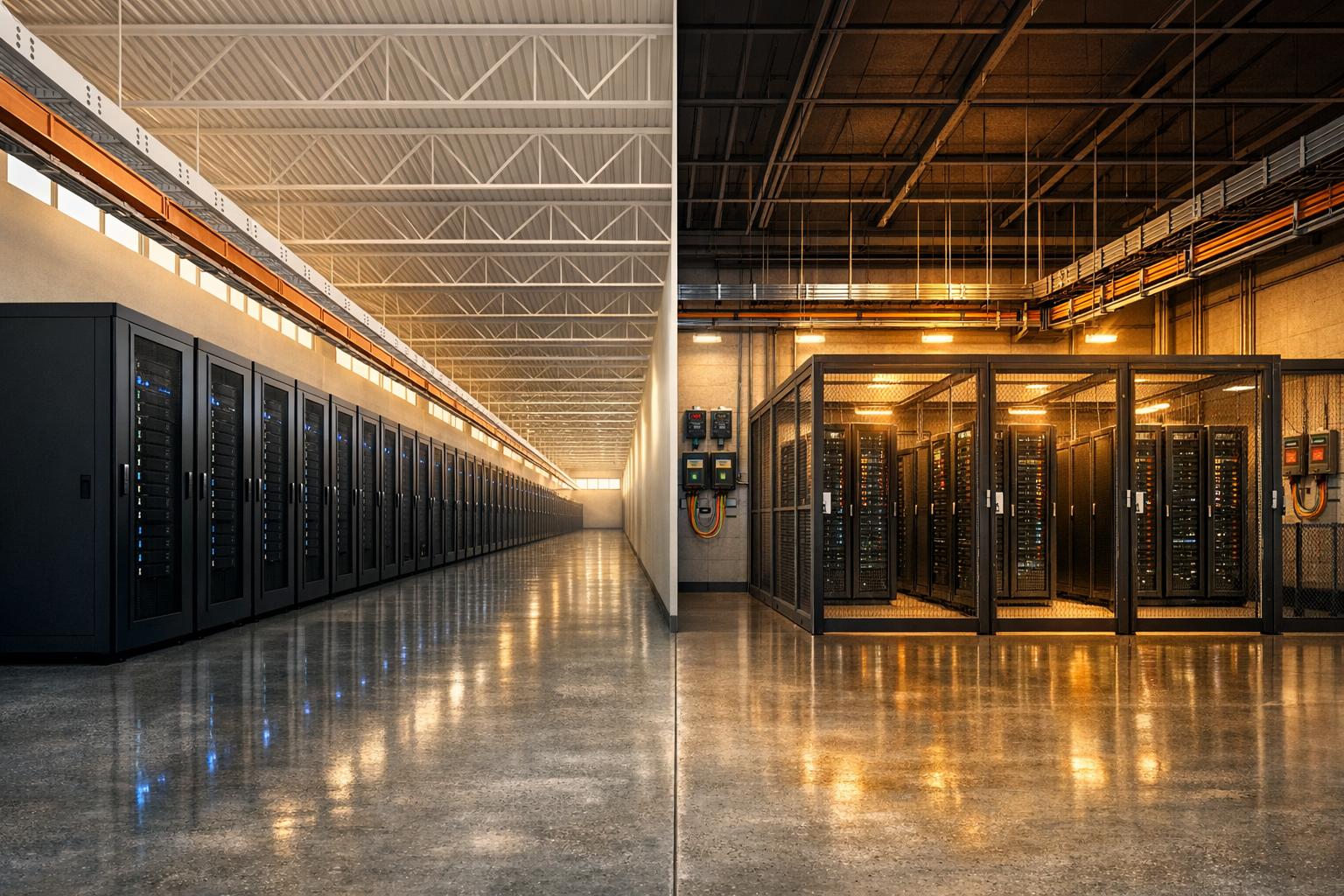
Hyperscale and colocation data centers are fundamentally different assets within the data center market. Hyperscale facilities cater to single tenants like AWS or Google, requiring massive investments ($100M–$1B+) and offering long-term leases (10–20 years) with stable returns. Colocation centers serve multiple tenants, demand lower upfront costs ($10M–$200M), and generate diversified revenue streams but involve higher management complexity.
Key Takeaways:
- Hyperscale Data Centers:
- Built for single tenants (e.g., AWS, Meta).
- High upfront costs but predictable, long-term revenue.
- Efficiency-focused with best-in-class PUE (1.1–1.2).
- Risk: Reliance on one tenant.
- Colocation Data Centers:
- Serve multiple tenants with lower initial investment.
- Revenue comes from diversified, shorter leases (3–7 years).
- Higher operational complexity.
- Risk: Tenant turnover and active sales efforts.
Quick Comparison:
| Feature | Hyperscale | Colocation |
|---|---|---|
| Capital Investment | $100M–$1B+ | $10M–$200M |
| Revenue Model | Long-term leases (10–20 years) | Diversified leases (3–7 years) |
| Efficiency (PUE) | 1.1–1.2 | 1.58 |
| Risk | Single-tenant dependency | Tenant turnover |
| Management | Automated | Active tenant management |
Investors often use scenario analysis to balance portfolios with 60–70% colocation for diversification and 30–40% hyperscale for growth potential. Both models require clear strategies, tracking portfolio performance effectively, and specialized expertise to succeed.

Hyperscale vs Colocation Data Centers: Investment Comparison
1. Hyperscale Data Centers
Capital Investment
Building hyperscale data centers is no small feat, requiring $500 million to over $1 billion per project in established markets [1]. In regions with less developed infrastructure, costs rise by nearly 40% per megawatt due to additional challenges [1]. The top six hyperscalers alone – companies like AWS, Google, and Meta – spend a staggering $180 billion annually on capital investments [7].
Take Meta’s Eagle Mountain data center in Utah as an example. Initially announced in 2018 with a $750 million investment, the project grew to over $1 billion, covering 800 acres and 970,000 square feet. This expansion was made possible through a virtual power purchase agreement with Rocky Mountain Power [1]. Fast forward to 2026, and Equinix, in collaboration with PGIM Real Estate, committed $600 million to develop SV12x, its first xScale hyperscale facility in Silicon Valley [2]. These projects highlight how hyperscale investments often compete for resources with large-scale energy and transportation networks [4].
Revenue Stability
The revenue stream for hyperscale data centers is remarkably dependable, thanks to tenants like AWS, Google, and Meta. These tech giants operate workloads with high switching costs, making reductions in usage almost unheard of [4]. Leases typically span 10 to 20 years and include inflation-linked escalations or fixed annual increases of 2–3%, offering protection against inflation [6]. Stabilized assets in primary markets trade at 4.5% to 6.5% cap rates, while developers aim for 7% to 10% stabilized yields on new builds [6]. This long-term stability is a cornerstone of hyperscale valuation models, though it also brings unique operational challenges.
Operational Complexity
A significant portion – 60% to 70% – of a hyperscale project’s costs goes toward mechanical and electrical infrastructure, such as power distribution and cooling systems [3]. These facilities are incredibly efficient, achieving Power Usage Effectiveness (PUE) ratings of 1.1 to 1.2, compared to the industry average of 1.58 [3]. However, this level of efficiency comes with added complexity. For example, hyperscale sites often need dedicated high-voltage transmission lines and utility capacity, which can take over five years to establish in areas like Northern Virginia [6]. The rise of AI workloads is also pushing power density from 5–10 kW to over 40 kW per rack, necessitating liquid cooling and other advanced designs [3].
Market Access
Access to the right market can make or break a hyperscale project. Power availability often outweighs land costs when selecting a site [6]. Developers are now using AI tools to analyze power grid data, fiber routes, and utility capacity, reducing site screening time from weeks to days [6]. Hyperscalers aim for power costs between $0.04 and $0.06 per kWh [6]. In water-scarce areas like Arizona and Texas, lenders impose additional premiums of 25–75 basis points where water rights are less secure [3]. Secured power capacity is increasingly seen as a form of collateral, shielding operational sites from new competition [5]. Understanding these factors is critical for accurately assessing the value of hyperscale assets within a broader investment portfolio benchmark.
sbb-itb-99d029f
2. Colocation Data Centers
Capital Investment
Colocation facilities generally require an investment ranging from $10 million to $200 million [3]. This relatively lower upfront cost enables investors to adopt a phased development strategy, aligning capital spending with tenant commitments to minimize initial financial risk [1]. However, when looking at per-unit costs, the economics shift. Small and regional data centers typically cost around $50,000–$80,000 per rack, compared to $35,000–$50,000 for hyperscale facilities [9]. A significant portion – 40–60% – of these costs goes toward mechanical and electrical infrastructure [3]. Additionally, lenders often demand 25–40% sponsor equity for colocation projects, which is higher than the 20–35% required for hyperscale projects due to the added risk of managing multiple tenants [3].
A notable example is Equinix’s 2018 acquisition of the Dallas Infomart for $800 million. Equinix demonstrated a scalable approach to capital deployment by expanding the multi-tenant environment incrementally. They added new data halls and upgraded power capacity while continuing operations for over 100 existing technology companies and network providers [1]. This strategy highlights how colocation investors can reduce risks by matching capital investments with tenant demand, avoiding the pitfalls of overbuilding in uncertain markets.
These financial dynamics lead directly into the discussion of revenue stability.
Revenue Stability
Once capital is deployed, colocation facilities use a different revenue model compared to hyperscale. Stability comes from diversified leases that typically span 3–7 years and include annual escalators of 2.5–5%, providing a hedge against inflation [3][8]. Unlike hyperscale facilities, which often rely on a single large tenant, colocation centers diversify their revenue streams across hundreds of customers with varying contract terms [1]. This model contributes to the projected growth of the colocation services market, which is expected to reach $136 billion by 2028 [1]. Additionally, colocation vacancy rates in North America are impressively low, averaging below 2%, with some Tier 1 markets reporting vacancy rates under 1% [8].
"The deflationary environment that defined the 2010s has given way to a supply-constrained seller’s market with significant pricing power." – datacenterHawk [8]
However, this diversification comes with challenges. Providers face absorption risk, which refers to the difficulty of attracting and retaining multiple tenants. To mitigate this, lenders often require 40–60% of planned capacity to be pre-leased before construction funding is approved [3]. Unlike hyperscale facilities, which are frequently pre-leased or custom-built for a single tenant, colocation centers must actively market and sell their capacity.
Operational Complexity
Running a colocation facility is far more intricate than managing a hyperscale center. These facilities operate like specialized office buildings, requiring constant tenant management, technical service delivery, and active sales efforts [1]. Unlike the uniform environment of hyperscale data centers, colocation facilities must accommodate diverse client needs, including complex security partitioning and varying technical specifications [1]. This complexity is heightened by the growing demand for AI workloads, which require specialized cooling systems and power configurations. On average, colocation facilities have a Power Usage Effectiveness (PUE) of about 1.58, compared to the 1.1–1.2 range seen in top-tier hyperscale facilities [3].
To handle these challenges, institutional investors often maintain separate operational teams and acquisition strategies for colocation and hyperscale assets [1]. This hands-on management approach contrasts sharply with the more automated operations of hyperscale facilities.
Market Access
Colocation providers also have a distinct edge when it comes to market access. They often secure prime sites and establish power agreements 12–24 months before hyperscale operators enter the market [1]. For example, in Southeast Asia, colocation providers typically build smaller 2–5 MW phases to test market demand and develop utility relationships before committing to larger expansions [1]. This strategy allows them to gain a foothold in emerging markets where infrastructure is still developing.
Today, site selection is increasingly driven by power availability and strong utility partnerships rather than land costs [8]. The rise of "neo-cloud" providers and AI-focused companies has created stiff competition for colocation capacity, making it harder for traditional enterprise users to secure 2–4 MW deployments [8]. As a result, investment is shifting toward secondary markets like Denver, Charlotte, and Johannesburg, where power is more accessible than in overburdened primary hubs [1][8]. With limited availability in major markets, data center users are advised to extend their capacity planning timelines from one year to three or more years [8].
Hyperscale Data Center Evolution: Power & Development Shifts
Advantages and Disadvantages
Hyperscale and colocation data centers have distinct strengths and weaknesses, making them suitable for different investment strategies and operational approaches. Grasping these trade-offs is crucial for effective portfolio management, as they directly impact valuation and forecasting strategies – key areas of focus for CoreCast‘s real estate intelligence platform.
Hyperscale facilities excel in economies of scale and operational efficiency, offering top-tier PUE (Power Usage Effectiveness) performance. They provide revenue stability through long-term contracts (spanning 10–20 years) with highly reliable tenants like Microsoft, Amazon, and Meta [1][8]. PeerSense captures this advantage perfectly:
"A 100 MW hyperscale facility leased to Microsoft on a 20-year NNN lease is, from a lender’s perspective, essentially a Microsoft corporate bond with a building attached" [3].
But these benefits come at a price. Hyperscale facilities demand massive upfront investments ranging from $100 million to over $1 billion, with development timelines stretching 18–36 months [3]. Additionally, the reliance on a single tenant introduces significant risk – if the tenant exits, the entire revenue stream is at stake.
Colocation centers, on the other hand, naturally diversify risk by hosting hundreds of tenants, which minimizes the impact of any single tenant leaving. These centers require lower initial capital investments ($10 million to $200 million) and can generate immediate cash flow from existing operations [3]. Their multi-tenant model also fosters valuable interconnectivity, as seen in Equinix’s Dallas Infomart, which supports over 100 technology companies and network providers [1]. However, colocation centers face challenges like higher operational complexity, requiring constant tenant management and sales efforts [1]. They also tend to have less favorable per-unit costs compared to hyperscale facilities [9].
Here’s a side-by-side comparison of the two models:
| Feature | Hyperscale Advantages | Hyperscale Disadvantages | Colocation Advantages | Colocation Disadvantages |
|---|---|---|---|---|
| Capital Efficiency | Lower per-unit costs ($35,000–$50,000/rack) | High upfront capital ($100M–$1B+) | Phased investment aligned with demand | Higher per-unit costs ($50,000–$80,000/rack) |
| Revenue Model | Long-term stability (10–20 year leases) | Single-tenant concentration risk | Diversified across hundreds of tenants | Absorption risk; continuous sales required |
| Operations | Automated, industrial-style management | 18–36 month development timelines | Immediate cash flow from existing assets | High operational complexity |
| Efficiency | Best-in-class PUE (1.1–1.2) | Significant execution risks | High interconnection value | Standard PUE (1.6–2.2) |
| Market Position | Purpose-built for specific workloads | Limited flexibility for tenant changes | Flexible for diverse client needs | Active tenant management required |
These distinctions guide institutional investors in crafting the right asset mix for balancing stability and growth. Many leading investors now have separate teams for acquiring and operating these data center types, recognizing their unique success factors [1]. A typical balanced portfolio might allocate 60–70% to colocation for stability and 30–40% to hyperscale for growth [1]. Understanding these trade-offs is critical for valuing assets and managing risk in data center portfolios through compliant appraisal practices.
Conclusion
Hyperscale and colocation data centers are two distinct types of assets, each with its own investment needs and valuation strategies.
For portfolio managers, aligning strategy with investment goals and operational expertise is key. Hyperscale facilities provide long-term stability, often featuring 15–20 year triple-net leases backed by major tech companies like Microsoft or AWS. These leases offer steady, predictable returns but come with the risk of relying on a single tenant [3]. On the other hand, colocation centers spread risk across hundreds of tenants, require less capital upfront, and generate immediate cash flow. However, they demand hands-on operational teams to manage tenant relationships effectively [1][3]. Many institutional investors aim for a portfolio mix of roughly 60–70% colocation and 30–40% hyperscale to achieve a balance between stability and growth [1].
Operational expertise must align with the asset type. Hyperscale investments call for experience in infrastructure finance and large-scale project execution. Colocation investments, by contrast, require strong property management skills akin to those used in specialized commercial real estate. Misapplying the wrong approach to either model often results in poor performance [1]. Success hinges on matching the right operational capabilities with the specific characteristics of each asset type.
FAQs
How do I decide between hyperscale and colocation for my investment goals?
Choosing between hyperscale data centers and colocation assets comes down to your investment goals, risk appetite, and overall strategy. Hyperscale facilities promise massive scalability and strong growth opportunities but demand a hefty upfront investment and come with operational challenges. On the other hand, colocation assets are known for their steady income streams, lower capital requirements, and operational ease, making them ideal for investors prioritizing stability. Weigh these factors carefully to see which option aligns best with your objectives.
What metrics matter most when valuing hyperscale vs. colocation assets?
When evaluating hyperscale and colocation assets, certain metrics stand out as critical. These include scale, operational efficiency, power capacity, tenant concentration, and long-term contractual commitments.
Each of these factors plays a vital role in shaping the overall risk profile of the asset. They also influence valuation benchmarks and serve as a foundation for crafting informed investment strategies. Understanding these metrics helps investors and stakeholders make decisions that align with both current market dynamics and long-term goals.
How do power constraints and AI workloads impact underwriting assumptions?
Power demands and AI workloads are changing how underwriting assumptions are made. There’s now a growing need for higher power densities – think 40 to over 100 kW per rack – and stronger infrastructure, like substations and large land purchases. This shift puts power availability and cooling efficiency ahead of older priorities like location.
Lenders are adjusting their focus to include factors like power capacity, water rights, fiber connectivity, and the financial stability of tenants. As a result, they’re approaching costs, risks, and scalability with a more cautious outlook.