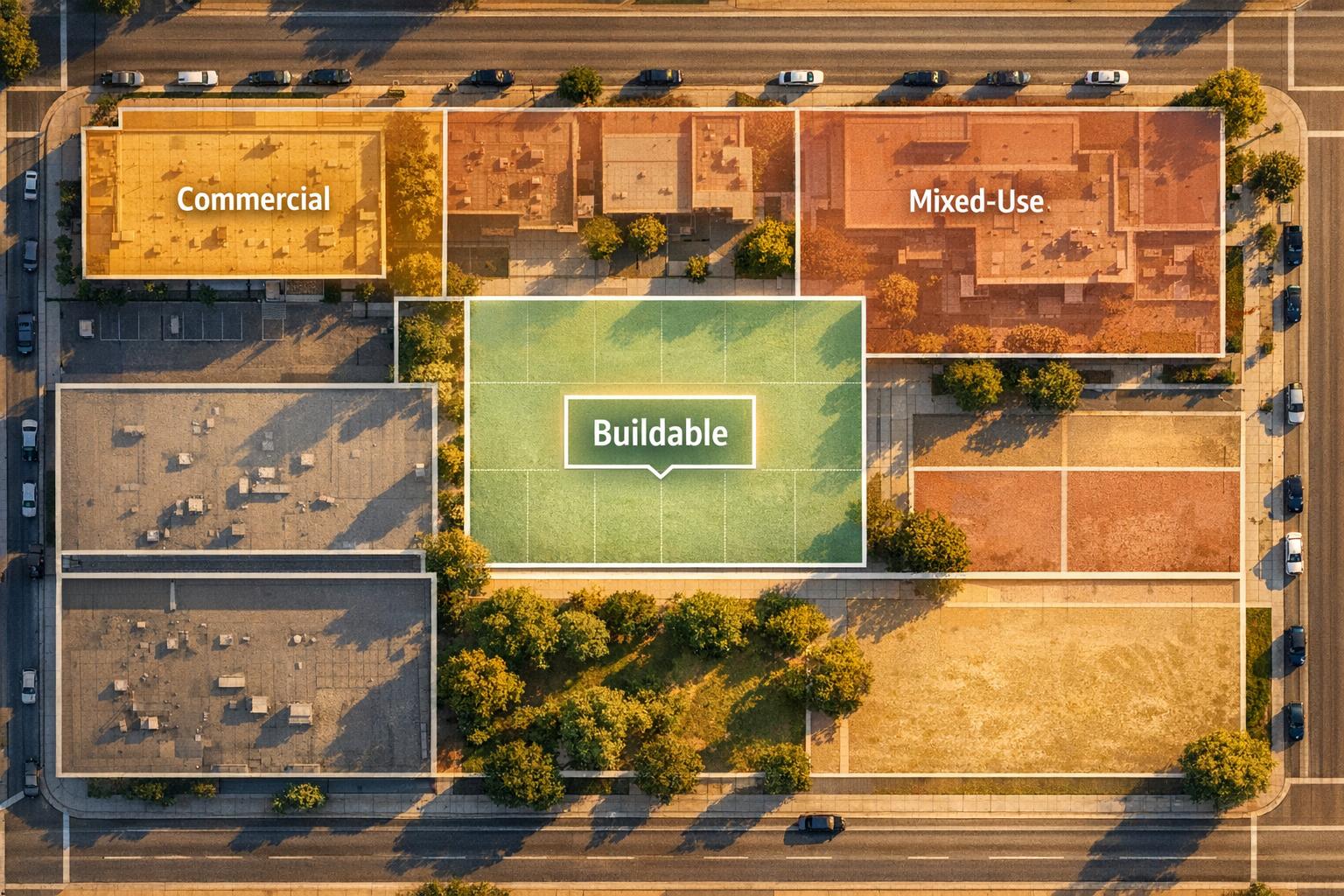
Zoning maps are critical tools for real estate site selection. They define how land can be used, detailing rules like building heights, setbacks, and permitted uses. By analyzing zoning maps, you can:
- Avoid costly mistakes, like legal disputes or project delays.
- Identify risks such as overlay districts for historic preservation or flood zones.
- Spot opportunities by comparing zoning maps with Future Land Use Maps (FLUM).
These maps help determine what can be built "by right" and reveal limits like Floor Area Ratio (FAR) or density rules. Using digital tools like CoreCast simplifies the process, saving time and reducing errors by integrating zoning data with compliance checks and market analysis. For developers, understanding zoning maps ensures smarter, faster decisions and fewer surprises during site selection.
Zoning Maps: What They Are and How They Work
What Are Zoning Maps?
A zoning map is a legal tool that visually divides a municipality into specific districts, assigning every parcel of land a particular designation that dictates its use [1][6]. Unlike maps that focus on current conditions or future plans, zoning maps reflect the law as it exists today.
In the United States, there are around 39,000 general-purpose local governments, each with its own zoning ordinance and map [6]. This means rules vary widely from one city, town, or county to another, making local research critical. As the Zoneomics Research Team puts it:
While zoning codes define what can be built and how properties can be used, the zoning map shows exactly where those rules apply [2].
Here’s a closer look at how zoning maps organize and regulate land use.
Key Elements of Zoning Maps
Zoning maps rely on a combination of alphanumeric codes, color-coding, and overlay districts to clearly communicate land use designations:
- Alphanumeric codes: These codes categorize land into types like Residential (R), Commercial (C), Industrial (I or M), Mixed-Use (MU), Agricultural (A), and Planned Development (PD). For example, R-1 typically refers to single-family residential areas, while C-2 might indicate general commercial zones [2][4].
- Color-coding: Colors help distinguish between zones. Residential areas are often marked in yellow to brown (with darker shades showing higher density), commercial zones appear in red or orange, and industrial zones are shaded purple or gray [1]. However, color schemes can vary, so always check the map’s legend [1].
- Overlay districts: These add an extra layer of rules on top of the base zoning. They might include requirements for historic preservation, environmental protections, or flood zone regulations [1][5].
Together, these elements ensure zoning maps provide a clear picture of land use regulations.
How Zoning Maps Guide Site Selection
Zoning maps are an essential tool for evaluating potential sites using a real estate deal analysis tool. They help identify entitlement risks, such as project denials, delays, or the need for costly rezoning [5]. By showing what’s permitted "by right" versus what requires special approval, they help you spot potential hurdles early.
These maps also define your buildable envelope – the physical limits of what can be constructed – through rules like setbacks, height restrictions, and Floor Area Ratio (FAR). For instance, a FAR of 2.0 on a 10,000-square-foot lot allows for up to 20,000 square feet of total floor area [1][6]. Understanding these limits upfront can save time and money by reducing the need for design changes.
Comparing a zoning map with a Future Land Use Map (FLUM) can also reveal long-term opportunities. FLUMs show where a community plans to grow over the next 10–20 years [1], which can highlight areas ripe for rezoning applications if the city’s vision aligns with higher-density development.
sbb-itb-99d029f
How To Guide: Planning and Zoning Map
How to Use Zoning Maps for Site Selection
Zoning maps are not just tools for understanding land use – they’re essential for selecting the right site for your project. Here’s a step-by-step guide to make the most of them.
Step 1: Find and Access Zoning Maps
Most municipalities provide zoning maps through their GIS (Geographic Information System) portals. To locate them, search for terms like "[City/County Name] GIS viewer" or "[City/County Name] zoning map." Larger cities often have specialized platforms, such as New York City’s "ZoLa" (Zoning & Land Use Map) [7], Los Angeles’s "ZIMAS" (Zone Information and Map Access System) [8], and Portland’s "PortlandMaps" [9].
When looking up a property, it’s best to use the Assessor’s Parcel Number (APN) instead of the address. As GatherGov explains:
The APN is the most reliable identifier because it’s unique to the parcel and doesn’t change with property transfers. [1]
You can find the APN on your tax bill or through your county assessor’s website. If online maps aren’t clear, reach out to your local planning department for assistance.
Also, make sure the map you’re using is up to date. Static PDF maps can quickly become outdated, so cross-check with live GIS data whenever possible [1].
Once you’ve accessed the map, familiarize yourself with the zone classifications.
Step 2: Read Zoning Classifications
After pinpointing your property on the map, check the base zoning classification. These alphanumeric codes tell you what the land can be used for. For instance, "R-1" often means single-family residential, while "C-2" typically indicates general commercial zoning. Use the map’s legend to decode these classifications.
For a deeper understanding, review the zoning ordinance tied to the classification. This document outlines details like lot coverage limits, accessory uses, and other restrictions. It also clarifies whether your intended use is allowed outright or requires conditional approval, which might involve additional reviews or public hearings.
Step 3: Review Zoning Restrictions
Zoning restrictions set the physical and financial boundaries of what you can build. Some key factors to consider include:
- Floor Area Ratio (FAR): Determines the total floor area you can build relative to the lot size.
- Setbacks: Define the minimum distance between your structure and the property lines.
- Height Limits: Place caps on how tall your building can be.
- Density Rules: Regulate the number of dwelling units allowed per acre.
Parking requirements can also significantly impact costs. For example, building structured parking in urban areas can range from $30,000 to $60,000 per space [1]. Additionally, look for overlay districts, as they may impose further restrictions or requirements.
Step 4: Use Geospatial Tools for Analysis
GIS tools can provide deeper insights by layering zoning data with spatial analysis. Here are some ways to use them:
- Isochrone Mapping: Visualize travel times within 10-, 20-, or 30-minute drive zones [11].
- Weighted Overlay Analysis: Score potential sites by factoring in market demand, costs, and zoning constraints.
- Hotspot Analysis: Identify areas with high concentrations of your target demographics [11].
- Buffer Analysis: Map surrounding properties to meet legal notice requirements [10].
Comparing the zoning map with the Future Land Use Map (FLUM) can also provide valuable insights. If the FLUM suggests a higher-intensity use than the current zoning allows, it may indicate political support for rezoning in the future [1].
Once you’ve gathered these insights, move on to confirm compliance and assess risks.
Step 5: Confirm Compliance and Identify Risks
Before finalizing a site, ensure your project aligns with all applicable codes. Use GIS tools to check for pending rezoning applications or amendments to the comprehensive plan in the area. These changes could signal upcoming shifts in neighborhood dynamics [1].
Be proactive about identifying historic preservation requirements, as they can add two to six months to your timeline and increase material costs [1]. Similarly, confirm if the site is in a flood zone, as this could raise construction costs and insurance premiums. Affordable housing overlays are another factor to check – they might offer density bonuses of 20% to 35% above base limits [1].
Document your findings and flag potential challenges early. By addressing risks upfront, you can save time and money, adjust your plans, or explore alternative sites before committing to detailed designs.
Benefits of Using Zoning Maps in Real Estate Development

Manual vs Digital Zoning Research Comparison
Better Decision-Making
Zoning maps lay out the rules for what can legally be done with a piece of land. They detail permitted uses, building setbacks, height restrictions, lot coverage, and Floor Area Ratio (FAR) [1]. This transparency eliminates guesswork during site selection, ensuring developers know what’s allowed before committing resources.
Additionally, zoning maps highlight overlay districts, such as areas designated for historic preservation, environmental conservation, or transit-oriented development. These overlays often come with extra regulations or incentives [1]. Spotting these early helps developers avoid costly surprises and delays. By offering clear regulatory guidance, zoning maps streamline the research process and support informed decision-making.
Save Time and Money
On top of regulatory insights, digital zoning maps make the search process faster and more efficient. These tools allow users to filter parcels by zoning codes instantly, cutting down the time spent on manual property screening [3].
For instance, manually analyzing 50 parcels might take a team of two analysts two full weeks, while AI-enabled digital workflows can complete the same task in just hours [12]. Consider a case from December 2025: a regional builder uncovered an expanded setback requirement from a prior rezoning, reducing the buildable area and slashing lot yield by nearly 15% [3]. Catching such issues early through a thorough zoning map review prevents expensive redesigns and reduces wasted time and effort.
Reduce Legal and Regulatory Risks
Zoning maps don’t just guide development – they’re legally binding documents [1]. They clarify what can be built “by right” versus what requires additional approvals, such as conditional use permits that involve public hearings and uncertain outcomes [1].
Understanding these distinctions upfront can help developers sidestep legal challenges and avoid delays. For example, a historic preservation review might extend a project’s timeline by 2 to 6 months, while an environmental conservation overlay could add six-figure costs [1]. By identifying such requirements early, developers can adjust their plans and budgets – or decide to walk away from a site before investing too much. Comparing manual and digital zoning research highlights the advantages of modern integrated platforms in mitigating these risks.
Manual vs. Digital Zoning Research
Comparison Table
| Aspect | Manual Zoning Research | Digital Zoning Research |
|---|---|---|
| Speed | Weeks (e.g., 2 weeks for 50 parcels) [12] | Hours [12] |
| Data Source | Scattered portals, PDFs, and physical maps [3] | Unified, multi-layer digital platforms [3] |
| Consistency | Prone to human error [12] | Applies uniform criteria to all parcels [12] |
| Search Method | Evaluating properties one at a time [3] | Filtering parcels by zoning criteria [3] |
| Risk Detection | Often identified late in the process [3] | Flags constraints early on [3] |
| Data Integration | Layers often don’t align [12] | Automatically checks for inconsistencies [12] |
Using CoreCast for Zoning and Site Analysis

CoreCast’s Zoning and Mapping Features
CoreCast brings zoning data to life by layering classifications, restrictions, and compliance details onto interactive maps, giving users instant insights into properties. It pulls together a mix of data sources – zoning info, property details, competitive landscapes, demographic stats, and infrastructure proximity – into a single, comprehensive view. You can filter parcels by zoning type (like residential, commercial, or industrial) and see crucial constraints such as setback requirements, density limits, or Floor Area Ratio (FAR) restrictions. Regular updates from local jurisdictions ensure the information stays current, helping users flag potential issues, like flood zones or historic preservation areas, before they become costly roadblocks. This streamlined approach makes site selection and analysis far more efficient.
Simplify the Site Selection Process
CoreCast’s advanced mapping tools take the hassle out of site selection by integrating zoning checks directly into the deal process. For example, you can evaluate a multifamily site’s height limits while simultaneously exploring nearby comparables and traffic flow patterns. This level of integration slashes research time, letting professionals assess potential deals in minutes instead of weeks. Plus, with real-time updates shared on a centralized platform, teams can stay aligned and work off the same accurate data, minimizing errors or miscommunication.
Make Data-Driven Decisions with CoreCast
CoreCast goes beyond simple mapping by enabling portfolio-wide zoning analysis. It helps forecast property value based on rezoning potential and compares projects against market benchmarks. The platform’s Stakeholder Center produces branded, interactive reports that combine zoning maps with compliance summaries, keeping everyone in the loop in real time. By using CoreCast, real estate teams can ensure compliance while making smarter, faster decisions that give them a competitive edge in site selection.
Conclusion
Zoning maps play a crucial role in making smart real estate decisions. They provide insights into land use classifications, density rules, and compliance standards, helping developers avoid costly setbacks before committing resources. Knowing what’s legally allowed on a property isn’t just helpful – it’s a must for aligning with your development goals.
Modern digital zoning platforms take this process to the next level. By offering real-time, integrated data, they replace outdated static maps and eliminate the need for time-consuming manual research, significantly reducing errors.
CoreCast goes even further by merging zoning maps with tools for underwriting, pipeline tracking, and portfolio analysis. This platform enables users to check site compliance, analyze nearby properties, and create branded reports for stakeholders – all within a single system. The result? Analysis that used to take weeks can now be completed in hours, with potential regulatory issues flagged early on. For real estate professionals, this means finding suitable sites faster and making real-time, data-driven decisions. In a field where timing can make or break a deal, having instant access to zoning intelligence ensures you’re ready to act on prime opportunities rather than watching them slip away.
FAQs
What can I build “by right” on a parcel?
When a property is zoned for a specific use, you have the ability to develop “by right.” This means you can proceed with any project that aligns with the current zoning classification for the parcel – no need for variances, special exceptions, or additional approvals. As long as your plans stick to the established zoning rules, you’re good to go.
How do I check for zoning overlays like flood or historic districts?
When researching zoning overlays like flood zones or historic districts, detailed zoning maps are your go-to resource. These maps often feature additional layers marked with specific symbols or colors to highlight overlay districts. You can usually find them on local government websites or through GIS-based zoning tools, which help interpret these layers effectively. Using these tools makes it simpler to spot any restrictions or designations that might impact your site selection.
When does a Future Land Use Map suggest rezoning potential?
A Future Land Use Map serves as a guide for identifying areas that might be rezoned in the future. It outlines spaces designated for development or changes in land use, signaling potential opportunities to adjust zoning regulations. These changes aim to accommodate new projects or better align with the shifting needs of the community.