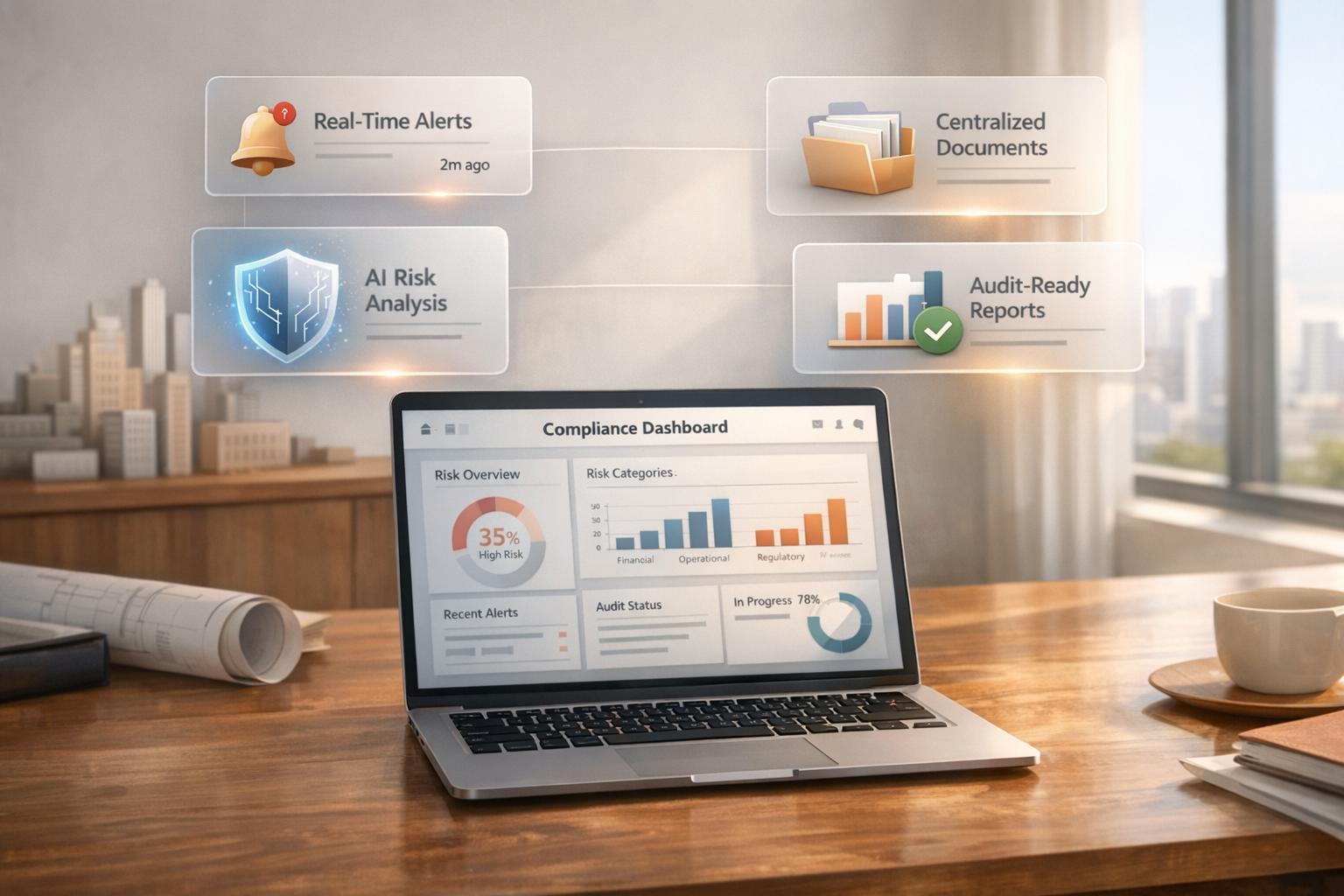
Compliance risk assessment platforms help real estate professionals manage complex regulatory requirements efficiently. With increasing penalties for non-compliance, automation is no longer optional. These platforms reduce errors, save time, and provide centralized tools to handle licenses, permits, insurance, and disclosures. Key features include:
- AI-Powered Automation: Extracts data with up to 99% accuracy, reducing manual work.
- Real-Time Alerts: Notifies teams of compliance gaps or expiring documents.
- Centralized Document Management: Stores and organizes compliance records for quick access.
- Regulation Updates: Automatically adjusts workflows to reflect new laws.
- Customizable Workflows: Tailored processes for multi-jurisdiction portfolios.
- Risk Analytics: Identifies critical issues and prioritizes resolution.
- Audit-Ready Dashboards: Tracks compliance status and creates verifiable audit trails.
- Secure Access Controls: Protects sensitive data with encryption and role-based permissions.
- Third-Party Integrations: Syncs with property management and accounting tools.
These platforms streamline compliance, reduce risks, and offer significant time and cost savings. For example, users often save 60-80% of the time spent on compliance tasks, with many platforms paying for themselves within 12-18 months. With increasing regulatory complexity and risks like ransomware breaches, adopting compliance technology is essential to protect operations and avoid costly penalties.

10 Essential Features of Compliance Risk Assessment Platforms for Real Estate
1. CoreCast

CoreCast integrates risk management directly into underwriting and portfolio oversight, offering real-time insights into critical financial metrics like DSCR (Debt Service Coverage Ratio), breakeven occupancy, and valuation precision. By leveraging its unified data system, CoreCast minimizes errors caused by manual data entry.
The platform connects seamlessly with top property management systems, eliminating the need for repetitive manual inputs. As Jared Stoddard from CoreCast explains, once you link your data source, the platform automatically pulls in historical and lease data for analysis [4].
Its AI-driven document parsing takes efficiency up a notch, extracting data from PDFs, Excel sheets, and even images. This information is then mapped to standardized underwriting models, creating a thorough audit trail across diverse asset types – from standard multifamily units to more specialized properties like RV parks and cold storage facilities. Tasks that once took hours can now be completed in seconds.
CoreCast also features a stakeholder portal with customizable, permission-based access. Lenders can track compliance and financial metrics in real time, while limited partners access data tailored to their specific investments. Stoddard highlights:
"Lenders see compliance, debt coverage, and valuation… Permissions are fully customizable. Presentation is polished. Updates are live." [4]
The platform’s Output View keeps users informed with live risk updates, sending alerts through Slack, email, or in-app notifications. This ensures timely responses to potential issues before they escalate.
2. Automated Compliance Monitoring
Keeping up with compliance manually is a massive time sink and a recipe for costly mistakes. Property management teams, for instance, spend 15–20 hours each week just tracking Certificates of Insurance (COIs) [7]. Automation changes the game by introducing advanced data extraction techniques that streamline this process.
AI-powered tools can pull data from PDFs, Excel files, and even images with up to 99% accuracy, achieving 85% straight-through processing [7]. These systems handle everything from T-12 statements to rent rolls and insurance certificates, drastically cutting down on manual data entry. Considering that errors plague nearly 90% of spreadsheets, this shift significantly reduces inaccuracies. Plus, AI-driven lease abstraction and insurance verification process information 70–90% faster than traditional manual efforts [7].
With continuous monitoring, compliance becomes more than just a checklist – it evolves into real-time assurance. Automated systems track expiration dates for licenses, permits, and insurance certificates, sending out alerts through multiple channels and escalating unresolved issues to senior management. Some platforms even take it a step further by blocking work orders or vendor payments if critical documentation is missing or expired, effectively eliminating human error at critical points [2][7]. This kind of enforcement not only ensures compliance but also leaves a clear, verifiable audit trail.
Logan Anderson, Director of Strategy & Growth at Re-Leased, highlights the significance of automation in compliance:
"Automation closes these gaps. Leading solutions combine AI-powered data extraction, automated alerts, and centralized reporting so you maintain continuous compliance without manual rework" [7].
The result? A digital log of every interaction, which is invaluable for proving due diligence during audits or legal challenges. By catching issues early, automated systems turn compliance into a proactive safeguard rather than a last-minute scramble.
3. Real-Time Regulatory Update Integration
Regulations are constantly evolving, and compliance platforms must keep pace. In the real estate industry, where compliance demands are becoming increasingly intricate, 85% of organizations say these requirements have grown tougher over the past three years [6]. When laws shift – whether at the federal, state, or local level – integrated platforms with real-time regulatory integration automatically adjust their internal settings. This ensures users are alerted to any compliance gaps before they escalate into costly legal issues. By staying synchronized with regulatory changes, businesses can adapt their practices smoothly as new standards emerge.
Take the SEC’s May 2024 decision to shorten the broker-dealer settlement cycle from T+2 to T+1 as an example [3]. Firms relying on automated compliance platforms were able to update their protocols instantly, avoiding disruptions and penalties. Without this real-time capability, teams would have faced the daunting task of manually tracking changes, revising spreadsheets, and retraining staff – a process prone to errors and delays.
Modern platforms take this a step further by connecting directly to regulatory databases and using AI-driven tools to extract and apply key data from new laws and policies. For instance, if a new Fair Housing Act requirement or zoning regulation is enacted, these platforms can quickly map the changes to your specific properties and workflows. Within minutes, updated checklists and compliance requirements are rolled out across all impacted locations [2].
This technology moves the industry away from outdated, static snapshots of compliance. Instead, it introduces continuous monitoring, which ensures controls are tested and validated against current standards on a recurring basis. This proactive approach helps catch regulatory drift early and initiates immediate corrective actions, building confidence in compliance practices [6].
The stakes for non-compliance are high. Violating the Fair Housing Act, for example, can result in civil penalties of up to $150,000 in cases pursued by the Justice Department [3]. In 2023, a property management company in San Diego paid $40,000 to settle a case after failing to meet Fair Housing requirements for reasonable modifications. Modern platforms now prevent such costly oversights by flagging missing documentation in real time as regulations change [3].
When evaluating compliance platforms, it’s essential to ask vendors how frequently updates are integrated and which regulatory frameworks are supported. This ensures the tool can grow with your portfolio, adapting to different jurisdictions and providing comprehensive risk management [6].
4. Centralized Document and Evidence Management
Centralized document management takes the efficiency of real-time monitoring and automated alerts to the next level. Trying to manage compliance documents without a unified system often leads to disarray. Nearly 90% of spreadsheets used for manual tracking contain errors [2], and scattered records like leases, regulatory filings, or vendor certifications can delay audit responses for days. A centralized system eliminates these headaches by housing all compliance documents in one secure, organized repository.
With this approach, the chaos of fragmented document management is replaced by a single source of truth. All compliance-related materials – like Fair Housing training certificates or zoning approvals – are stored in a secure, searchable location. Advanced platforms go a step further by linking these documents directly to compliance workflows. For instance, if a vendor’s insurance certificate expires, the system can automatically block work orders until the issue is resolved [2][7]. This integration ensures every document is tied to the appropriate workflow, execution evidence, and audit trail [5].
Modern platforms also stand out with features like version control and immutable audit trails. Every action – whether someone views, edits, or approves a document – is permanently recorded with a timestamp. Monika Stando, Marketing & Growth Lead at Hicron Software, highlights the importance of this transparency:
"A digital audit trail provides a permanent, time-stamped record of all actions taken within the system, which is critical for proving due diligence during legal disputes or regulatory inspections" [2].
This level of detail becomes crucial when regulators need to know who approved a specific disclosure or when a policy change was implemented.
The time savings are enormous. Organizations using automated compliance platforms report spending 82% less time on framework and attestation-related audits [6]. Logan Anderson, Director of Strategy & Growth at Re-Leased, emphasizes:
"When all evidence lives in one place with timestamps and access logs, you can answer auditor requests within minutes instead of days" [1].
Advanced search and metadata tagging further boost efficiency. Teams can locate specific documents across hundreds of properties or jurisdictions in seconds – tasks that would otherwise take days of manual effort.
AI-powered tools also simplify evidence collection. Technologies like Optical Character Recognition (OCR) and Natural Language Processing (NLP) extract data from PDFs and images with 99% accuracy and 85% straight-through processing for property-related documents [7]. This automation eliminates the need for manual data entry, ensuring consistent and reliable evidence capture across activities like lease renewals and vendor onboarding.
5. Customizable Multi-Jurisdiction Workflows
Managing real estate portfolios across multiple states can be a logistical headache. Each state has its own maze of regulations – fair housing laws, rent control rules, security deposit limits, and disclosure requirements. Trying to handle all this manually often leads to bottlenecks and costly compliance mistakes [3]. That’s where platforms with jurisdiction-specific workflows come in, helping streamline compliance while adhering to corporate policies.
Modern platforms tackle this complexity by offering tailored workflows. For example, they allow users to create a core policy framework and then layer in local requirements as needed [1]. Logan Anderson, Director of Strategy & Growth at Re-Leased, sums it up well:
"Multi‐state portfolios need consistent policy with local flexibility" [1].
With this approach, companies can save an impressive 60–80% of the time they’d otherwise spend on compliance tasks [1].
One standout feature is conditional logic, which automatically adjusts workflows based on factors like location, asset type, or transaction details. For instance, if a lease is signed in a specific jurisdiction, the platform can automatically trigger the required municipal disclosures and vendor checks. And if regulations change – say, a city introduces a new commercial disclosure form – a single update can be applied across all affected workflows in just minutes [2]. This eliminates the need to manually update dozens of property-specific checklists and ensures compliance stays seamless.
Another powerful tool is portfolio-level dashboards that consolidate localized compliance data into one place. These dashboards offer a clear, comprehensive view of risks. Companies using predefined workflows have reported a 70% boost in efficiency and an 80% reduction in the time needed for compliance assessments [10]. Features like severity-based alerts add an extra layer of protection, ensuring that critical issues, such as a life-safety code violation, are prioritized over less urgent administrative lapses [1].
6. Risk Identification and Assessment Analytics
Modern compliance platforms are designed to catch risks before they turn into costly problems. Using rule-based scoring, these platforms highlight issues like inadequate coverage limits or missing additional insured clauses, ranking them by urgency. This allows teams to zero in on critical problems instead of wasting time on minor administrative tasks [1].
These systems also excel at spotting anomalies that manual reviews might miss. By digging into historical data, they can flag unusual trends – like sudden drops in occupancy, unexpected increases in operating expenses, or year-over-year growth patterns. Such insights can reveal hidden compliance or financial risks [4]. For example, if a vendor’s certificate of insurance expires during a project, the platform can issue alerts and even halt work orders until the problem is resolved [7].
Real-time dashboards pull all this data into one easy-to-navigate view. They highlight "risk hotspots" across your portfolio, letting you drill down into specific issues by property, vendor, or location [7]. Logan Anderson, Director of Strategy & Growth at Re-Leased, sums up the value:
"AI-enabled reporting gives real-time oversight and auditability that manual processes can’t match, transforming decision speed and reliability for real estate operators." [7]
The benefits are huge. AI-powered document extraction achieves near-perfect accuracy for compliance checks [7]. Considering that a single missed expiration could result in six-figure liabilities, having tools that prioritize key risks is a game-changer [7]. These analytics not only identify risks but also integrate directly with operational systems.
For example, they can automatically block non-compliant transactions at the point of service, ensuring problems are addressed before audits even start [7]. This seamless integration keeps operations smooth and reduces risk exposure.
sbb-itb-99d029f
7. Alert and Escalation Systems
A compliance platform falls short if critical issues don’t reach the right people in time. That’s where alert and escalation systems step in. Think of them as your team’s early-warning radar, ensuring deadlines are met and violations are avoided. These systems direct notifications based on severity, task ownership, and response timelines.
Modern platforms allow you to set customizable thresholds that trigger alerts when certain conditions are met. For instance, you can configure the system to notify a compliance lead if overdue control reviews exceed 10% in a specific business unit [5]. This proactive approach helps prevent minor oversights from spiraling into major problems. Notifications are sent through various channels – email, in-app alerts, mobile push notifications, and even tools like Slack or Microsoft Teams – so hybrid and remote teams stay connected no matter where they are [5]. These alerts build on the automated monitoring discussed earlier, ensuring timely action without anything slipping through the cracks.
To avoid overwhelming your team with unnecessary notifications, severity-based rules come into play. Issues are categorized as low, medium, or high priority, so the most critical problems – like an expired certificate of insurance or a missed Fair Housing Act requirement (which could lead to civil penalties of up to $150,000 [3]) – get immediate attention. Meanwhile, lower-priority tasks are grouped together for review during regular check-ins [1].
Automation also plays a key role in escalation. If a task remains unresolved, the system automatically reassigns it to the next person in the chain. For example, if a vendor doesn’t respond to a compliance questionnaire within 48 hours, the task might be escalated to a supervisor or senior manager [5][1]. This task-chain logic ensures that every step in the process triggers the next, creating a seamless, self-sustaining compliance workflow [5].
More advanced platforms go beyond basic time-based reminders, introducing risk-based triggers. These systems analyze data patterns and scenario analysis for real estate portfolios to provide smarter alerts. For example, instead of just flagging a missed deadline, the system might notify you if a vendor’s risk score jumps by 25% quarter-over-quarter or if unusual patterns appear in your portfolio [5]. If tasks remain unresolved past a set threshold – like a vendor failing to respond within 48 hours – the system escalates the issue and uses risk trends to predict potential regulatory violations. This shift from merely tracking status to forecasting risks allows teams to act before small issues escalate into regulatory headaches.
Every alert, notification, and escalation is timestamped and logged, creating a detailed audit trail. This ensures your organization is prepared for inspections and can demonstrate compliance with confidence [1][2].
8. Audit-Ready Reporting and Dashboards
When auditors or regulators show up, the last thing you want is to be scrambling through disorganized files and email threads. Audit-ready reporting turns compliance from a stressful, last-minute scramble into a structured, manageable process. Modern platforms can automatically generate detailed documentation, complete with immutable audit trails. These trails record every interaction, document version, approval, and access timestamp [2]. By building on the automated monitoring systems mentioned earlier, these tools create a permanent record of "who did what and when", offering the legal protection your organization needs during inspections.
With centralized dashboards, you gain real-time insight into compliance across your portfolio. Forget manually combing through spreadsheets – these dashboards let you pinpoint bottlenecks, track risks, and quickly spot missing documents [2][3]. They act as a gatekeeper, ensuring no transaction moves forward unless all critical compliance documents – like Certificates of Insurance or required signatures – are in place [2]. Since the dashboard connects directly to your document repository, every data point you report is backed by solid, verifiable evidence. This feature works hand-in-hand with real-time monitoring, offering a clear, consolidated view of compliance across your operations.
Consider recent cases like the FTC fining Invitation Homes $48 million in 2024 for lacking transparency on hidden tenant fees or the CFPB penalizing a non-bank mortgage company $1.75 million in 2023 for violating the Real Estate Settlement Procedures Act [3]. These examples underscore how crucial clear and automated compliance documentation has become.
Stakeholder portals take transparency a step further by replacing outdated, manual PDF reports with live dashboards that update in real time [4]. Automated alerts ensure you’re notified when key documents are missing or incomplete, keeping your dashboard consistently in an audit-ready state [2][3].
9. Secure Data Privacy and Access Controls
Compliance platforms manage some of your most sensitive information – tenant records, financial data, investor details, and proprietary deal structures. Weak security measures can leave your firm vulnerable to data breaches, hefty fines, and damage to your reputation. In 2024, the real estate sector faced 553 ransomware breaches, with an average cost of $4.8 million per incident [3][11]. To combat this, 256-bit encryption – both for data at rest and in transit – has become the industry standard, ensuring your information remains secure at every stage [1].
Encryption alone isn’t enough; access controls play a critical role in safeguarding data. Role-Based Access Control (RBAC) is a key feature, limiting who can view or modify specific compliance documents. For instance, frontline staff might only need access to tenant-related files, while senior managers handle policy approvals or investor-level financials. This kind of granular control minimizes the risks of sensitive data being shared through unsecured methods. When combined with Multi-Factor Authentication (MFA) and Single Sign-On (SSO), RBAC creates a multi-layered defense against unauthorized access.
Top-tier platforms also undergo rigorous third-party audits to earn certifications like SOC 2 Type II and ISO/IEC 27001. These certifications confirm that the platform complies with key frameworks such as GDPR, CCPA, SEC, and FINRA. Logan Anderson, Director of Strategy & Growth at Re-Leased, emphasizes:
"Prioritize privacy-by-design with encryption, access controls, and third-party certifications to protect sensitive data" [1].
Another critical feature is the use of immutable logs, which record every user action – who accessed data, when it was accessed, and what changes were made. These logs are tamper-proof, offering regulators verifiable proof of your data governance practices. Some advanced platforms take it a step further by providing private sandbox environments for each client, eliminating the risk of cross-client data exposure. When evaluating vendors, always request their latest SOC 2 or ISO 27001 audit reports to validate their security measures [1].
10. Third-Party Integrations
Using isolated compliance platforms can lead to inefficiencies and errors. Chances are, your real estate firm already relies on tools like property management systems, accounting software, market data platforms, and communication tools. Manually transferring data between these systems not only wastes time but also increases the risk of mistakes. A better approach is to use a compliance platform that integrates smoothly with your existing tech stack through APIs and pre-built integrations. This connectivity ensures that compliance processes operate efficiently and align with your broader operational goals.
Key integrations to look for include:
- Property Management Systems: Tools like Yardi, AppFolio, RealPage, Entrata, and Buildium allow automatic syncing of leases and rent rolls.
- Accounting and ERP Systems: These ensure trust accounting and financial data remain consistent across platforms.
- Insurance Carrier and Broker Connections: Automating Certificate of Insurance (COI) updates and document ingestion can save property teams 15-20 hours per week previously spent on manual tracking [8].
- Market Data Platforms: Integrations with sources like CoStar and RealPage provide live benchmarking capabilities [4].
- Communication Tools: Connectors for Slack, Microsoft Teams, and Outlook ensure compliance alerts reach the right people in real time [1][4].
These integrations help unify your systems as a central source of truth, keeping compliance workflows seamless and reducing errors.
Advanced platforms also offer automated triggers that can block work orders if vendor insurance has expired or prompt updates when there are changes in employee policies. Leslie Watson-Stracener, a Partner at Grant Thornton Advisors LLC, highlights the value of embedding compliance technology into daily operations:
"When compliance technology is embedded into daily workflows, it transforms the back-office compliance program into a more visible, manageable function and provides front-office teams with timely, actionable insights" [9].
Before committing to a compliance platform, take inventory of your current systems and confirm integration compatibility. It’s a good idea to test integrations with actual property data to ensure two-way synchronization and avoid creating new silos [1]. Also, remember that clean, accurate data in your source systems is critical – poor data quality can derail even the most advanced compliance automation processes.
Conclusion
A well-designed compliance platform redefines how real estate professionals handle regulatory demands. By automating monitoring, providing real-time updates, centralizing document management, and securing access controls, these tools eliminate the inefficiencies of manual processes. The shift to automation is an obvious choice when you consider the time lost and errors caused by outdated methods.
Beyond reducing risks, these platforms deliver measurable operational benefits. Teams often save significant time on compliance-related tasks, and many software solutions pay for themselves within 12 to 18 months through avoided fines and improved efficiency [1]. The financial risks of non-compliance – whether from Fair Housing Act violations or undisclosed fees – can be steep, but the right platform helps you sidestep these costly pitfalls [3].
Modern compliance tools offer advantages across your entire property portfolio. Features like real-time dashboards ensure instant visibility into compliance status, while AI-driven document extraction achieves up to 99% accuracy with 85% straight-through processing. Automated alerts further protect against lapses, addressing potential issues before they escalate [7]. As Logan Anderson, Director of Strategy & Growth at Re-Leased, explains:
"Manual compliance breaks under portfolio scale. Spreadsheets and inboxes can’t handle changing regulations, rising data privacy expectations, and vendor risk" [1].
Choosing the right platform starts with understanding your specific needs. Look for software that integrates smoothly with your existing property management systems, scales as your portfolio grows, and provides audit-ready documentation to satisfy regulators and lenders. Start by identifying your most pressing challenges and testing the platform on a smaller scale before expanding its use across your operations [7].
With 553 ransomware breaches reported in the real estate sector in 2024 alone, it’s no longer a question of whether to adopt compliance technology – it’s about how quickly you can implement it to protect your operations, reputation, and financial health [3].
FAQs
How can compliance risk assessment platforms simplify managing portfolios across multiple jurisdictions?
Compliance risk assessment platforms streamline the challenge of managing portfolios across multiple jurisdictions. By automating the tracking of regulatory requirements in various regions, these tools help ensure compliance obligations are met consistently, cutting down on the chances of errors or missed deadlines. They also centralize critical documentation and audit trails, making it much simpler to handle regulatory inquiries and keep accurate records.
On top of that, these platforms offer real-time monitoring with alerts for potential issues, giving teams the ability to address problems before they escalate. Integration with existing tools and systems allows for smoother workflows and the creation of customized compliance frameworks, minimizing the need for manual oversight. The result? Improved risk management and greater operational efficiency for even the most intricate portfolios.
How do AI-driven tools improve compliance management?
AI-powered tools play a key role in simplifying compliance management by taking over repetitive tasks and minimizing the chances of human error. These tools can track regulatory updates, handle documentation, and quickly identify potential issues, ensuring everything is completed correctly and on schedule.
On top of that, AI processes large datasets in real-time, delivering predictive insights to spot risks early and guide better decision-making. This forward-looking approach is especially useful in industries like real estate, where regulations are constantly evolving. By refining workflows and boosting precision, AI tools help organizations stay compliant and keep operations running smoothly with less effort.
Why is it important for compliance platforms to include real-time regulatory updates?
Keeping up with ever-changing laws and regulations is no small task, especially for businesses navigating complex compliance landscapes. That’s where real-time regulatory updates come into play. These updates ensure that businesses have the most current information at their fingertips, allowing them to maintain accurate risk assessments and reduce the likelihood of falling out of compliance.
By integrating real-time updates, teams can act swiftly when new requirements emerge. This agility not only cuts down on legal and operational risks but also simplifies compliance workflows. The result? Businesses save time and resources while staying confident in their adherence to the latest regulations.