Operating a data center comes with high stakes. Regulatory fines can reach millions, and compliance failures can damage your business in ways that go beyond financial penalties. To stay on the right track, here’s what you need to know:
- ISO 27001: Focuses on security management with updated controls for 2022. Transition deadline: October 31, 2025.
- SOC 2: Evaluates internal controls over security, availability, and privacy. Type II reports are preferred for sustained compliance.
- PCI DSS: Essential for handling payment card data. Non-compliance can cost $5,000–$100,000 per month.
- HIPAA: Protects healthcare data with strict technical, physical, and administrative safeguards. Fines can reach $1.5M annually.
- GDPR: Governs EU personal data handling. Violations can cost up to €20M or 4% of annual revenue.
Actionable Steps:
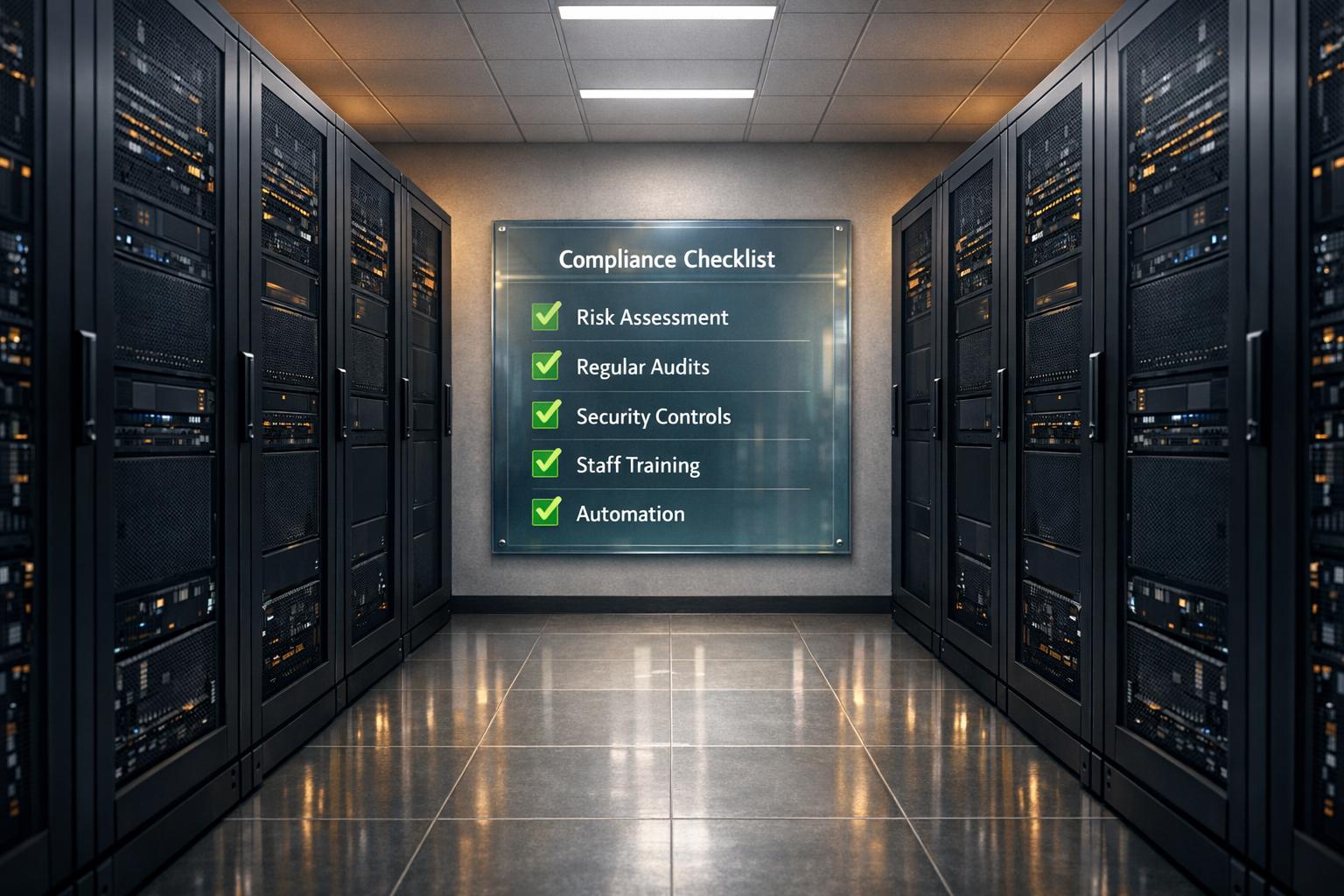
- Conduct regular risk assessments to identify and ensure compliance in data center appraisals.
- Schedule internal and external audits to ensure readiness.
- Strengthen physical and technical security controls like encryption and multi-factor authentication.
- Train staff regularly to minimize errors.
- Use automated tools for documentation and compliance monitoring.
Key Takeaway: Compliance isn’t optional – it’s your defense against fines, downtime, and lost trust. Proactive measures and the right tools can protect your operations and reputation.
Privacy Regulations and Impacts on Data Center Environment
sbb-itb-99d029f
Major Regulatory Standards for Data Centers

Data Center Compliance Standards: Requirements and Penalty Ranges
Data centers operate under a maze of compliance frameworks. While there isn’t a universal standard that applies to every facility, various regulations come into play depending on the type of data handled and the industries served. Navigating these requirements is essential to avoid penalties and ensure uninterrupted operations.
Some standards are voluntary and help build trust, while others are mandatory and come with severe consequences for non-compliance. As technology analyst Christopher Tozzi explains:
"There are no major compliance standards that focus on data centers specifically. But that doesn’t mean data centers have no role to play in compliance."[4]
The specific rules your facility must follow depend on the regions you operate in and the industries you support. Below are key frameworks that outline crucial compliance measures and the risks of falling short.
ISO 27001: Information Security Management
ISO 27001 provides a structured approach to managing security risks through an Information Security Management System (ISMS). The 2022 update outlines 93 controls, covering areas like policies, training, physical security, and technological defenses[11]. Key steps include conducting risk assessments, securing physical access, and implementing strong network protections[7][5].
Though ISO 27001 is voluntary, it has become a standard expectation for serious players. By 2022, over 70,000 certifications were issued across 150 countries[11]. Organizations already certified must transition to the 2022 version by October 31, 2025[11]. Similarly, SOC 2 addresses overlapping concerns through its evaluation of internal controls.
SOC 2: Trust Service Criteria
SOC 2 evaluates internal controls based on five trust service criteria: security, availability, processing integrity, confidentiality, and privacy[5][8]. This framework examines both environmental controls, like backup power systems, and logical controls, such as firewalls and network segmentation[5].
SOC 2 reports come in two types. Type I reports capture a moment-in-time evaluation, while Type II reports assess compliance over 6–12 months[9][10]. Most customers prefer Type II reports because they demonstrate sustained adherence. Meeting SOC 2 standards not only builds confidence but also reduces the risk of financial repercussions.
PCI DSS: Payment Card Industry Data Security Standard
If your data center processes, stores, or transmits payment card data, PCI DSS compliance is non-negotiable. The standard demands measures like network segmentation, AES-256 encryption for stored data, TLS 1.2+ for transmitted data, and file integrity monitoring[5].
Failure to comply can be costly. Payment processors may impose fines ranging from $5,000 to $100,000 per month[10].
HIPAA: Health Insurance Portability and Accountability Act
For facilities managing electronic protected health information (ePHI), HIPAA compliance is critical. This includes adhering to technical, physical, and administrative safeguards[5][12]:
- Technical controls: Encryption protocols (TLS/SSL) and intrusion prevention systems[5]
- Physical controls: Biometric locks, CCTV monitoring, and restricted server access[5]
- Administrative measures: Role-based access controls (RBAC) and detailed audit trails[5]
HIPAA violations can lead to steep penalties, with fines ranging from $100 to $50,000 per violation[8]. The HITECH Act adds further requirements, such as real-time anomaly detection through Security Information and Event Management (SIEM) systems[5].
GDPR: General Data Protection Regulation
U.S.-based data centers that handle EU personal data must comply with GDPR. This regulation emphasizes privacy-by-design, data minimization, and strict cross-border data transfer controls, such as Standard Contractual Clauses (SCCs)[5][4].
The financial risks of non-compliance are immense. GDPR violations can result in fines of up to €20 million or 4% of global annual revenue[10]. For instance, Amazon was fined $888 million in 2020, and British Airways faced a $230 million penalty in 2019 for data security lapses[10].
| Standard | Primary Focus | Key Requirement Example | Penalty Range |
|---|---|---|---|
| ISO 27001 | Information Security Management | ISMS deployment and risk tracking[7] | Reputational damage; lost contracts |
| SOC 2 | Trust Service Criteria | Multi-factor authentication and encryption[5] | Customer attrition; contract cancellations |
| PCI DSS | Payment Card Security | Network segmentation of cardholder data[5] | $5,000–$100,000/month[10] |
| HIPAA | Healthcare Data Privacy | Biometric locks and CCTV access controls[5] | Up to $1.5M/year[10] |
| GDPR | Personal Data Protection | Privacy-by-design and data minimization[5] | Up to €20M or 4% of revenue[10] |
How to Find and Fix Compliance Gaps
Ensuring your data center meets regulatory requirements requires constant vigilance and a systematic approach. Regular evaluations – both internal and external – are essential to catch and address issues before they escalate into violations. This ongoing process sets the stage for targeted audits and timely corrections.
Conduct Regular Risk Assessments
Frequent risk assessments are your first line of defense against potential violations and fines. Start by identifying the regulations that apply to your operations, such as HIPAA or PCI DSS. The goal is to compare your current controls against these requirements to uncover gaps. Be sure to revisit these assessments whenever you expand your facilities, install new equipment, or face regulatory updates[3].
Evaluate the potential impact of each identified risk. For example, consider what could happen if a vulnerability were exploited. Prioritize issues based on both their likelihood and potential severity. A high-probability threat that could lead to a $1.5 million HIPAA fine should obviously take precedence[3]. Then, audit your existing controls to pinpoint gaps in documentation, vulnerabilities, or outdated procedures[3].
Some common compliance gaps include:
- Missing audit trails for physical access
- Expired or untested emergency lighting systems
- Inadequate motion sensor coverage in critical areas
On the technical side, you might encounter issues like unpatched operating systems, unencrypted data at rest, or log timestamps that aren’t synchronized with Network Time Protocol (NTP) servers[5].
Regular self-audits can help you address these problems before external evaluations uncover them[1]. Once you’ve identified internal gaps, structured audits become the next logical step for ensuring compliance.
Schedule Internal and External Audits
Internal audits serve as a proactive tool to catch problems before regulators step in. Many organizations conduct these audits monthly or quarterly, and some even use surprise drills to test their readiness[10]. These self-assessments help reinforce compliance and reduce the risk of fines.
External audits, on the other hand, offer an unbiased validation of your compliance efforts. These reviews, often conducted by third-party firms, are crucial for certifications like SOC 2 or ISO 27001. They also carry significant weight with clients and regulators. For instance, Microsoft Azure has achieved compliance with over 90 regulatory frameworks worldwide through annual readiness assessments[10].
Schedule external audits at regular intervals or after major changes, such as new processing agreements, facility expansions, or regulatory updates[3]. Before these audits, conducting a pre-audit gap analysis using a compliance scorecard can help you measure your readiness against the relevant framework[10].
When choosing external auditors, look for firms that specialize in data center operations and have a strong grasp of your jurisdiction’s regulatory landscape[13]. Their expertise can make a significant difference in ensuring your compliance efforts are both thorough and effective.
Practical Methods to Prevent Fines
After identifying compliance gaps through audits and assessments, the next step is implementing safeguards to ensure your data center meets regulatory standards. Below are practical steps to help protect your operations and avoid costly penalties.
Install Strong Security Controls
Combining physical and technical security measures is crucial to safeguarding your facility from breaches and unauthorized access. Start by installing biometric locks on server racks and deploying CCTV systems throughout the premises. Require multi-factor authentication (MFA) for all personnel accessing sensitive areas – this adds an essential layer of protection against unauthorized entry [5].
On the technical side, encrypt all data at rest with AES-256 and secure data in transit using TLS 1.2 or higher [5]. Use network segmentation to isolate sensitive environments, such as those handling cardholder data, by setting up dedicated VLANs. Configure firewalls with "deny-by-default" rules to minimize risks if a system is compromised [5].
To monitor and respond to potential threats, implement SIEM (Security Information and Event Management) and FIM (File Integrity Monitoring) tools [6]. Keep tamper-evident audit trails with timestamps synchronized via NTP servers – these logs are often critical for investigations. Ensure you retain logs as required by regulations like PCI DSS and HIPAA [6].
Create and Test Incident Response Plans
A well-documented and regularly tested incident response plan is essential for regulatory compliance under frameworks like HIPAA, GDPR, and DORA [5][2][12]. Your plan should outline clear steps for identifying, containing, investigating, and reporting incidents [5]. Including a RACI model (Responsible, Accountable, Consulted, Informed) can clarify roles during a crisis, ensuring smooth coordination [6].
Test your protocols through failover drills to confirm power and cooling systems can switch seamlessly. Similarly, test your backup restoration process to ensure data can be recovered when needed [5][6]. Use SIEM and SOAR tools to automate alerts for deviations, allowing quicker responses [6].
The financial risks of non-compliance are steep. Meta paid €1.2 billion for GDPR violations, Amazon faced a €746 million fine, and Heartland Payment Systems incurred $145 million in penalties after a PCI DSS failure [1]. A robust incident response plan, supported by detailed audit trails that document "who changed what, when, and why", not only proves compliance but can also reduce penalties if violations occur [5][6]. Staff training further enhances these efforts, ensuring everyone knows their role in maintaining compliance.
Train Staff on Compliance Requirements
Human error is one of the most common causes of compliance violations. Regular training – ideally on a quarterly basis – helps your team stay informed about evolving regulations and reduces the risk of costly mistakes [15]. Tailor training to specific roles to address unique operational needs [14].
Short, interactive modules of 5–10 minutes can fit seamlessly into daily workflows, making it easier for employees to stay engaged. Use real-world scenarios, such as responding to a data breach or handling an access request, to make the training practical and relatable. This approach has been shown to improve user adoption and accelerate compliance readiness.
Automate recertification processes to send reminders for refresher training before certifications expire. If deadlines are missed, consider temporarily revoking access to critical systems to enforce accountability [14]. Keep timestamped digital records of all training completions and policy acknowledgments – these records serve as valuable proof of compliance during audits [14][12].
Using Technology to Support Compliance
Relying on manual processes to track compliance can slow down audits and increase the likelihood of missing critical documentation. Modern software platforms help shift compliance from a last-minute scramble to an ongoing process by automating telemetry pipelines across your entire infrastructure – covering physical, network, compute, and storage elements [6]. This automation ensures you’re prepared with audit-ready evidence daily, removing the chaos when regulators show up. It also simplifies reporting and vendor management.
Centralize Documentation and Reporting
Today’s platforms can gather data from badge access logs, CCTV footage, rack sensors, and environmental readings, mapping all of it to frameworks like NIST 800-53 or ISO 27001 [6]. Instead of juggling spreadsheets, file folders, and scattered documents – like cable labels or incident response plans – you can consolidate everything into one centralized repository [4]. This is especially helpful when proving compliance across multiple standards at the same time.
Take CoreCast as an example. It centralizes compliance documentation, audit trails, and reporting into a single platform tailored for data center operations. For real estate professionals managing data center assets, it offers tools to track regulatory compliance alongside property performance metrics. You can create branded reports for stakeholders and maintain a unified repository for all compliance-related materials. This integrated approach eliminates the need for separate tools for tasks like asset tracking, portfolio analysis, and compliance oversight.
Platforms using machine-readable formats like OSCAL (Open Security Controls Assessment Language) can automatically generate evidence packages, reducing the need for manual input [6]. For instance, PCI DSS requires one year of logs with three months instantly accessible, and HIPAA mandates retaining six years of documentation [6]. Automated systems handle these requirements seamlessly, minimizing human error. Additionally, policy-as-code integrates compliance checks directly into your infrastructure builds, identifying configuration issues in real-time and logging any deviations [6].
Manage Vendor and Stakeholder Compliance
Centralized documentation also strengthens vendor management, a critical part of maintaining compliance. Third-party vendors can introduce risks that you’re still accountable for. Standards like SSAE 18 and the EU’s Digital Operational Resilience Act (DORA) emphasize strict monitoring of vendor controls and require prompt breach disclosures [12][2]. Technology platforms allow you to evaluate vendors – whether cloud providers or hardware suppliers – against service-level agreements to ensure they meet the same rigorous standards as your own operations [5].
Automated compliance dashboards provide real-time updates on your compliance status and measure your maturity levels [5]. When deviations occur, these platforms can trigger workflows through SOAR (Security Orchestration, Automation, and Response) or ticketing systems, immediately assigning issues to the appropriate team [6]. Built-in tools like a RACI model (Responsible, Accountable, Consulted, Informed) clarify who oversees telemetry, owns controls, and gets notified about changes [6]. This structure eliminates confusion during incidents and speeds up responses.
"Automating compliance monitoring prevents scrambling during audits and shifts effort toward meaningful risk reduction." – Advantage Technology [6]
For data center operators tasked with meeting sustainability requirements, these platforms can also track metrics like Power Usage Effectiveness (PUE) and Water Usage Effectiveness (WUE) automatically, aligning with the EU’s Energy Efficiency Directive [2]. By combining operational and compliance data into one system, you reduce administrative tasks while improving accuracy.
Conclusion
Staying compliant isn’t just about avoiding penalties – it’s about protecting your business from costly mistakes. The best operators make compliance a continuous effort by conducting regular risk assessments, running internal mock audits, and maintaining strong security measures. Centralizing documentation for policies, access logs, and incident response plans also plays a key role in staying prepared.
Non-compliance is expensive, with potential fines running into millions.
"In today’s complex regulatory environment, compliance is not just a requirement – it’s a competitive advantage."
- CDA News Team, Cyber Defense Advisors [10]
To keep up with evolving regulations, companies need integrated technology solutions. Automated tools help identify potential violations and prevent compliance drift, ensuring readiness for newer challenges like AI governance transparency and sustainability metrics such as Power Usage Effectiveness (PUE) and Water Usage Effectiveness (WUE). Clear accountability frameworks, like RACI models, further ensure that every team member knows their responsibilities.
FAQs
What steps should I take to transition to ISO 27001:2022 before the 2025 deadline?
To meet the ISO 27001:2022 transition deadline of October 31, 2025, the first step is conducting a gap analysis. This process helps pinpoint the differences between your current compliance framework (likely ISO 27001:2013) and the updated standard. Pay special attention to any new clauses, controls, and adjustments required to align with the revised requirements.
Once the gaps are identified, develop a transition plan with a detailed timeline. This plan should cover tasks like updating documentation, revising policies, implementing any newly required controls, and training your team on the changes. Internal audits are also essential to verify your organization’s readiness and ensure everything is on track.
The final step is scheduling and completing a transition audit with your certification body. This must be done before the deadline to maintain your certification. Starting early gives you enough time to address gaps and ensures a smooth transition without risking your compliance status.
What’s the best way to conduct audits in data center operations?
Auditing in data centers plays a crucial role in maintaining compliance, ensuring security, and optimizing operations. Here’s how to approach both internal and external audits effectively.
For internal audits, start by establishing a well-defined governance framework. This framework should outline roles and responsibilities clearly, ensuring everyone knows their part in maintaining compliance. Leverage automated tools to monitor compliance in real time, align with standards like NIST or ISO, and efficiently gather evidence. Regularly review audit findings to identify gaps, update policies as needed, and provide training to staff to address any weaknesses.
When it comes to external audits, preparation is key. Keep all documentation and policies current with the latest regulations. Conduct pre-audit assessments to identify and resolve potential issues before the formal audit begins. Work with third-party auditors who have expertise in industry standards, and maintain detailed records of compliance activities to ensure transparency and facilitate a smoother audit process.
By integrating automation, staying proactive with reviews, and keeping meticulous documentation, data centers can simplify the audit process, reduce risks, and avoid penalties.
What are the key advantages of automating compliance monitoring in data centers?
Automating compliance monitoring in data centers offers some clear advantages. For starters, it ensures consistent adherence to regulatory standards without relying heavily on manual checks. This not only reduces the likelihood of costly fines but also simplifies the audit process, saving time and effort.
With automation handling these essential tasks, data center operators can shift their focus to more strategic initiatives. It’s an effective way to stay ahead of regulatory requirements while making better use of resources.