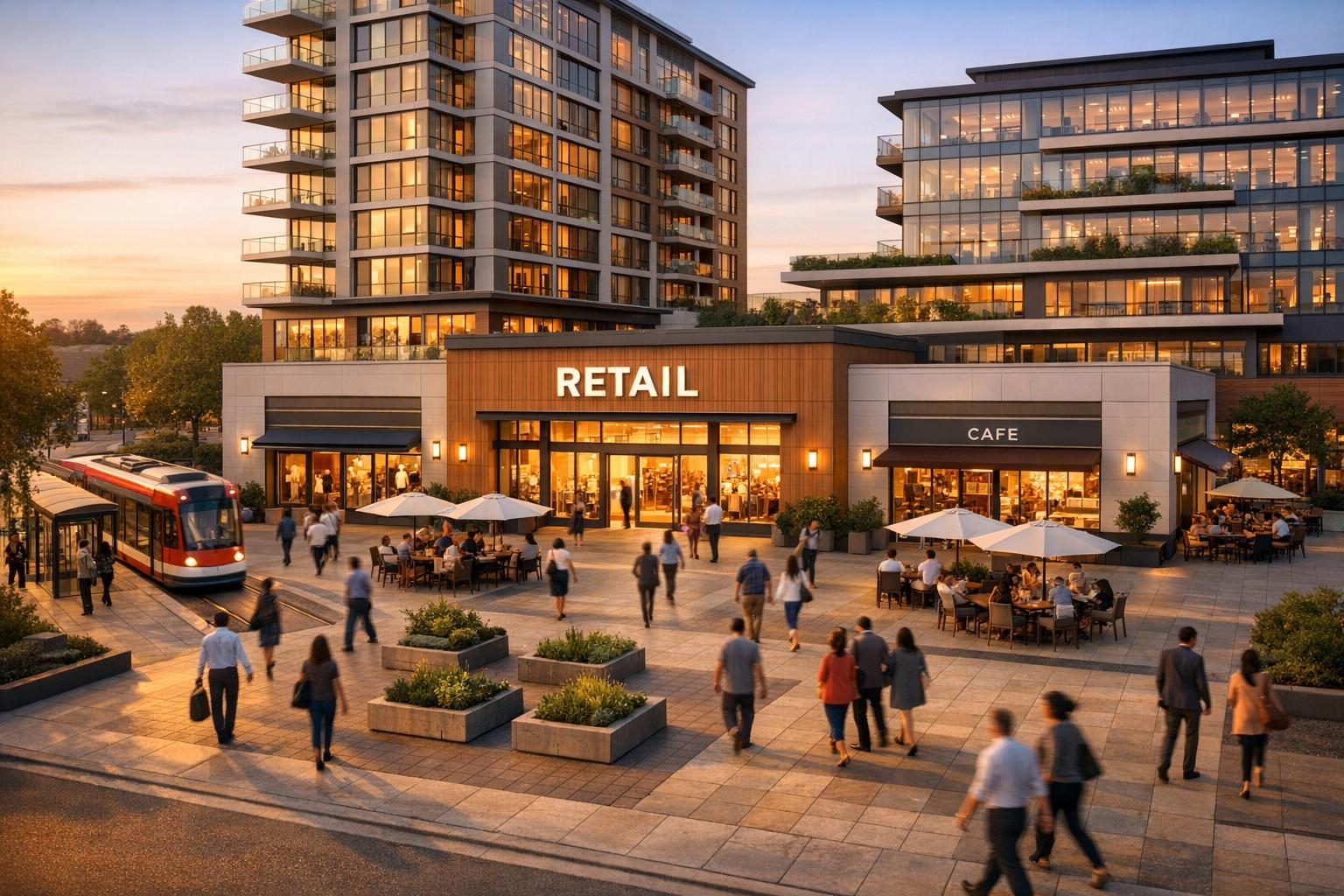
Mixed-use developments combine residential, commercial, and retail spaces, creating communities where people can live, work, and shop in one place. Retail has become a key driver in these projects, offering more than just shopping – it builds foot traffic, supports local economies, and integrates with daily life.
Key Points:
- Retail’s Growth: Valued at $3.03 trillion in 2026, retail is now the second-largest commercial real estate sector after multifamily housing.
- Demand Drivers: Post-pandemic, walkable neighborhoods and experience-focused retail spaces are in high demand, with retail vacancy rates hitting record lows (4.08% in 2024).
- Shifting Trends: E-commerce has reshaped physical stores into hubs for experiences like dining, events, and interactive shopping.
- 15-Minute Cities: Urban planning prioritizes walkable access to essentials like groceries and healthcare, boosting retail’s role in mixed-use spaces.
- Performance Metrics: Mixed-use retail spaces outperform standalone retail, with rents averaging 74% higher in vibrant districts and vacancy rates consistently lower.
Retail in mixed-use projects isn’t just thriving – it’s reshaping how communities interact, live, and shop.
Urban Retail Boom: How Mixed-Use is Redefining Miami’s Thriving Urban Core – Jonathan Rosen
sbb-itb-99d029f
What Drives Retail Demand
Grasping what fuels retail demand is key to understanding its evolving role in mixed-use developments.
How E-Commerce Changed Retail Space Needs
E-commerce hasn’t replaced physical retail; it’s reshaped it. Instead of competing on product availability, brick-and-mortar stores in mixed-use projects now focus on offering experiences that online platforms can’t replicate. This shift has led to "phygital" engagement – a mix of physical and digital interactions like augmented reality (AR) displays, in-store events, and personalized shopping experiences. These innovations particularly appeal to younger consumers who value meaningful connections with brands [2].
While some retailers are scaling back, others are doubling down on prime locations. For example, in January 2025, Uniqlo purchased part of its massive 91,000 sq. ft. flagship at 660 Fifth Avenue in New York City for $350 million, ensuring long-term control of the space [5][6]. That same year, investment in high-street retail properties surged 82%, hitting its highest point since 2015 [5]. Physical stores are no longer just places to shop – they’re brand hubs where companies connect with customers and gather data. These changes align with shifting consumer habits, particularly post-pandemic.
Consumer Behavior After the Pandemic
The pandemic redefined how people interact with their local neighborhoods. With hybrid work becoming the norm, consumers are spending more time closer to home, increasing demand for retail that integrates into their daily lives rather than serving as occasional destinations.
"Retail now anchors mixed-use ecosystems that combine commerce with community and culture" [2].
This shift is evident in spending habits. Gen Z and Millennials are driving retail growth in 2025, with 33% of Gen Z and 30% of Millennials citing dining as a key part of their shopping experiences [4]. Food and beverage (F&B) establishments have taken over from traditional department stores as the primary anchors for foot traffic. In fact, apparel and F&B accounted for over 50% of global leasing activity in the first half of 2025 [2]. Retailers are responding by designing spaces where shopping, eating, and socializing blend effortlessly. These behavioral shifts also align with urban planning models like the 15-minute city, which further boost retail demand. Understanding these shifts is essential to benchmark real estate portfolios against changing market standards.
The 15-Minute City Concept
Urban design that clusters daily necessities within walking or biking distance is another major driver of retail demand. The 15-minute city concept, once an urban planning idea, is now becoming a reality. Retail in these walkable districts acts as "neighborhood infrastructure," offering more than just products – it meets everyday needs [9]. Developers are prioritizing essential anchors like grocery stores, pharmacies, and urgent care facilities, which can command up to a 110% premium in bustling mixed-use areas [4].
This approach has significant financial benefits. For instance, the $4 billion Riverwalk San Diego project, planned for October 2025, illustrates this trend. It includes 4,300 homes, 150,000 sq. ft. of retail space, and 1 million sq. ft. of office space in a transit-friendly, walkable environment [2]. With the U.S. retail market currently short by about 200 million sq. ft. – roughly 5% of total stock – these walkable, mixed-use spaces are becoming increasingly valuable [4].
Market Data and Performance Metrics

Retail Vacancy Rates and Rent Performance by Development Type
The retail sector is undergoing a measurable transformation, with market data highlighting its growing prominence. Retail has emerged as a key anchor in real estate, offering better risk-adjusted returns than office or residential properties [1]. In 2024, the national retail vacancy rate dropped to a five-year low of 4.08%, while the average time to finalize a retail lease hit an all-time low of just eight months [1]. These trends reflect strong tenant interest and increased landlord confidence.
Growth in Mixed-Use Development
Investors are pouring resources into mixed-use retail projects at an impressive rate. High-street retail saw an 82% surge in investment by 2025, reaching its highest level in a decade [6]. Simultaneously, asking rents in prime urban locations climbed by 10% between 2024 and 2025 [6]. This shift highlights retail’s expanding role in mixed-use developments.
Developers are increasingly opting for horizontal layouts over traditional vertical designs to reduce costs and improve adaptability [1]. For instance, in October 2025, MCB Real Estate adopted a "two over two" condominium format for "The Shops at Fairway Village" in Maryland. This approach met rising demand without the delays often associated with vertical construction [1]. The growing focus on mixed-use projects underscores the mutually beneficial relationship between population density and retail success.
How Residential Density Supports Retail
Residential density provides a built-in customer base that enhances retail activity. Mixed-use developments extend operating hours from the typical 8-hour workday to nearly 24/7, creating more opportunities for foot traffic and sales [7]. This convenience-driven audience supports demand for essential and service-oriented retail, such as grocery-anchored centers [8][11].
The numbers tell the story. Retail rents in Vibrant Mixed-Use districts, which combine prime office spaces, urban housing, and walkable retail, average a 74% premium over Prime Business districts and a 110% premium over Non-Prime Business districts [4]. Even with 17% of new retail supply located in these districts, availability rates have tightened over the past decade [4]. For example, Live-Work-Play (LWP) districts feature some of the highest rents in the U.S., with New York averaging $91.40 per sq. ft., followed by Boston at $47.33 and Washington, D.C. at $46.21 [11].
Phoenix serves as a prime example of this trend. Rapid population growth in the region has fueled retail expansion, with over 2 million sq. ft. of retail space absorbed by the end of 2021 [8]. Chris Corso, VP at Kidder Mathews, remarked:
"The growth just hit the accelerator in Maricopa County… retail followed the rooftops" [8].
Retail Vacancy Rate Comparison
The table below illustrates the performance differences between mixed-use and standalone retail formats. Mixed-use developments are consistently outperforming their standalone counterparts. While the national retail vacancy rate increased slightly to 5.9% in Q1 2026 [13], shopping malls continue to struggle with vacancy rates exceeding 9.0% [12]. In contrast, retail in dense suburban clusters has maintained a much lower average availability rate of 5.0% since 2009, compared to 7.0% for the broader market [4].
| Retail Format/District | Vacancy/Availability Rate | Rent Performance |
|---|---|---|
| Vibrant Mixed-Use | Compressed over 10 years | 110% premium over non-prime districts |
| Dense Suburban Clusters | 5.0% (since 2009) | 2.6% CAGR rent growth |
| National Average | 5.9% (Q1 2026) | 2.1% CAGR rent growth |
| Shopping Malls | >9.0% | Falling |
High-street and urban mixed-use corridors have shown the strongest recovery since 2022, outperforming other retail formats [4]. The U.S. retail market is currently undersupplied by about 200 million sq. ft., which accounts for roughly 5% of the total stock [4]. This supply gap, combined with the advantages of residential density in mixed-use projects, positions these developments to continue outpacing standalone retail properties.
Benefits of Retail in Mixed-Use Projects
Mixed-use projects create a dynamic interplay between residential, office, and retail spaces, enhancing overall performance through shared resources and cross-promotion. Let’s explore how this setup boosts retail success.
Built-In Customer Base
Having residents and office workers on-site provides retail tenants with a steady and dependable stream of customers, reducing the need to depend solely on outside foot traffic. Michael Gold, President of Cullinan Properties, highlights how consumer preferences have evolved:
"Consumers, residents and office workers want everything on demand – from coffee to fitness to doctor’s appointments, they want it at their front door" [14].
A prime example of this concept is the Rock Run Collection in Joliet, Illinois. Spanning 310 acres, this development by Cullinan Properties integrates over 1,000 residential units with 500,000 square feet of retail and entertainment space. It even includes a casino set to open in 2025, creating an all-encompassing "stay-on-site" experience for consumers [14].
Steady Foot Traffic
Mixed-use developments keep communities active throughout the day, from morning coffee runs to late-night entertainment. This near-constant activity extends business hours and increases foot traffic. Winter Park Village in Florida is a standout example. Redeveloped by CASTO Southeast Realty Services, the site boasts an average visitor dwell time of 2.5 hours – well above the typical shopping center average. Enhancements like curbless walkways with 13-inch raised streets and a new park system contribute to its appeal, which now includes 360,000 square feet of retail and 117,000 square feet of office space [14].
This continuous activity also improves neighborhood safety by keeping "eyes on the street" for longer periods. Additionally, municipalities gain from increased local sales tax revenue, as Brett Hutchens, President of CASTO Southeast Realty Services, explains:
"Municipalities like mixed-use because the capture rates of sales tax from citizens go up; they are not losing sales to other areas" [14].
Tenant Synergies
The real strength of mixed-use retail lies in its ability to create synergy between different property types. Retail spaces often provide strong returns, balancing the longer payback periods associated with residential and office components. This diversification reduces overall project risk, as Brett Hutchens notes:
"From a lending standpoint, we find that the lenders like the diversity of uses within one site" [14].
Property managers also capitalize on shared spaces by hosting events like product launches, pop-ups, and tech demos. These events generate additional revenue and attract more visitors. Starr Cumming, Retail Director at Hines, emphasizes:
"You can’t just rely on the fact that the residents, retailers or office tenants will be your only traffic. You’ve got to bring additional traffic, and you do that with experiential events" [14].
The Yard 56 project in East Baltimore is a great example of tenant synergy in action. Developed by MCB Real Estate, this $200 million project transformed a brownfield into a vibrant community hub featuring 100,000 square feet of retail, 227 multifamily units, and a 222,342-square-foot medical office building. The mix of residents and daytime workers sustains retail activity, while financial incentives like New Market Tax Credits and Enterprise Zone property tax credits made the project viable [1]. These synergies highlight how retail serves as a key driver in mixed-use developments, especially when paired with tools that monitor performance in real-time.
Tools for Tracking Retail Demand
Why Real-Time Data Matters
Market conditions are constantly shifting. Changes like the rise of remote work and evolving consumer habits have redefined what people want and need from retail spaces. Relying on outdated data can lead to costly mistakes, especially in mixed-use developments where residential, office, and retail components interact in complex ways.
Using real-time data allows developers to move beyond static models, helping them align tenant mixes with the specific needs of local communities and adapt to changing behaviors [2][10]. Consider this: 92% of global business leaders report measurable results from data analytics investments. Big data analytics have boosted market forecasting accuracy by 15.2%, and 60% of retail buyers have seen improvements in demand forecasting and inventory management thanks to AI-powered tools [15]. On the flip side, poor data quality can be expensive – costing organizations an average of $15 million annually. As Ted Friedman, VP and Analyst at Gartner, points out:
"Poor data quality is a major contributor to a crisis in information trust and business value, negatively impacting financial performance" [15].
Real-time analytics also help reduce financial risks. They allow stakeholders to zero in on high-performing assets that can offset the slower returns often seen in office or residential sectors [1]. For instance, ultra-low vacancy rates and quick lease signings have given landlords strong pricing power in today’s market. Platforms like CoreCast provide real-time insights to help capitalize on these trends.
Using CoreCast for Retail Forecasting

CoreCast takes the importance of real-time data to the next level by offering advanced analytics tailored for retail forecasting. This platform uses AI and machine learning to analyze consumer metrics such as age, income, spending habits, lifestyle choices, and shopping behaviors [15]. What sets CoreCast apart is its ability to turn complex data into actionable insights, enabling users to:
- Underwrite retail assets
- Manage deal pipelines
- Visualize properties and competitive landscapes on an integrated map
- Conduct detailed portfolio analyses
This all-in-one system addresses a major challenge in the industry: over half of retail and grocery businesses struggle to share data across departments, leading to gaps in market analysis [15].
CoreCast goes beyond traditional radial studies by incorporating drive-time analysis, which accounts for real-world barriers to ensure more accurate market assessments. Users can also set investment criteria based on key data points like vacancy rates, average lease terms, and neighborhood growth trends – helping them avoid overvalued properties [15]. As Dmytro Tymofiiev, Delivery Manager at SPD Technology, explains:
"Retail is all about understanding your customers and anticipating their needs… We’re not just talking about numbers; we’re talking about turning those numbers into an actionable checklist" [15].
Currently, CoreCast is priced at $50 per user per month during its beta phase, with a planned increase to $105 per month after launch [15]. The platform also provides granular insights, such as tracking vacancy rates for specific property types – open-air centers at 4.5% versus malls at 9.0% [12] – and monitoring performance in Live-Work-Play districts. For example, New York retail spaces in these districts command an average rent of $91.40 per square foot [11]. This level of detail helps investors make smarter decisions about tenant strategies and uncover growth opportunities in mixed-use developments.
Conclusion and Future Outlook
Main Takeaways on Retail Demand
Retail has evolved from being a secondary feature to becoming the centerpiece of mixed-use developments. Today, it’s seen as the driving force behind these projects, a shift underscored by the sector’s impressive $3.03 trillion valuation and historically low vacancy rates. The most resilient retail formats are anchored by essential services – like grocery stores, pharmacies, fitness centers, and medical offices – that consistently attract foot traffic, even during economic downturns.
Mixed-use developments take this a step further by boosting foot traffic by 20% to 30% and achieving 10% to 20% higher rent premiums compared to standalone retail spaces [16]. With the residential and office components providing a built-in customer base, these spaces maintain occupancy rates of 90% to 95%, significantly outperforming the 80% to 85% rates seen in traditional retail properties [16]. These strong fundamentals set the stage for continued evolution and growth in the retail sector.
Future Opportunities
The future of mixed-use developments points toward even more opportunities for retail innovation. The global mixed-use property market is expected to grow at a 5.80% compound annual growth rate (CAGR), reaching $3.0 billion by 2033 [17]. This growth aligns with global urbanization trends, as the World Health Organization predicts that 70% of the world’s population will live in cities by 2050 [16]. This shift will sustain demand for walkable, amenity-rich environments that minimize reliance on cars.
In response to rising construction costs, developers are increasingly favoring horizontal multi-building layouts over traditional vertical designs, particularly in suburban areas. This approach offers more flexibility and reduces complexity while still meeting the convenience needs of modern consumers [1].
Retail tenant mixes are also shifting toward experience-focused concepts. Food and beverage operators now make up as much as 60% of tenant rosters in newer developments [3]. Meanwhile, digitally native brands are opening physical flagship stores to act as customer acquisition hubs. Tools like CoreCast enable developers to stay ahead of trends by analyzing vacancy patterns, tracking rent growth in specific areas, and spotting emerging opportunities before they become overcrowded. With 33% of Gen Z and 30% of Millennials prioritizing dining as part of their shopping experience [4], the future of retail lies in creating spaces that combine convenience, community, and curated experiences into one seamless destination.
FAQs
What retail tenants perform best in mixed-use projects today?
Retail tenants that are thriving in mixed-use developments today include necessity-based retailers, wellness-focused businesses, grocery-anchored stores, and service-oriented tenants. These types of businesses draw strong foot traffic, offer convenience, and tend to provide long-term stability, making them a natural fit for these types of projects.
How much residential density is needed to support on-site retail?
Residential density typically needs to range between 20 to 30 units per acre to support on-site retail effectively. That said, this isn’t a one-size-fits-all rule. Market conditions and the unique traits of a neighborhood can shift these numbers. Elements such as local demographics and shopping habits also heavily influence whether retail in the area will thrive.
What real-time data should I track to forecast mixed-use retail demand?
To predict retail demand in mixed-use developments, monitoring real-time data is crucial. This includes tracking point-of-sale (POS) transactions to identify sales patterns, keeping an eye on inventory levels, and sharing transaction data with trade partners for a broader perspective.
Don’t overlook external influences like seasonal changes, promotional campaigns, and larger economic trends, as these can significantly impact demand. By integrating this data with advanced tools such as IoT sensors and machine learning, professionals can achieve more precise forecasts. This approach allows real estate experts to better anticipate shifts in demand and make informed planning decisions.