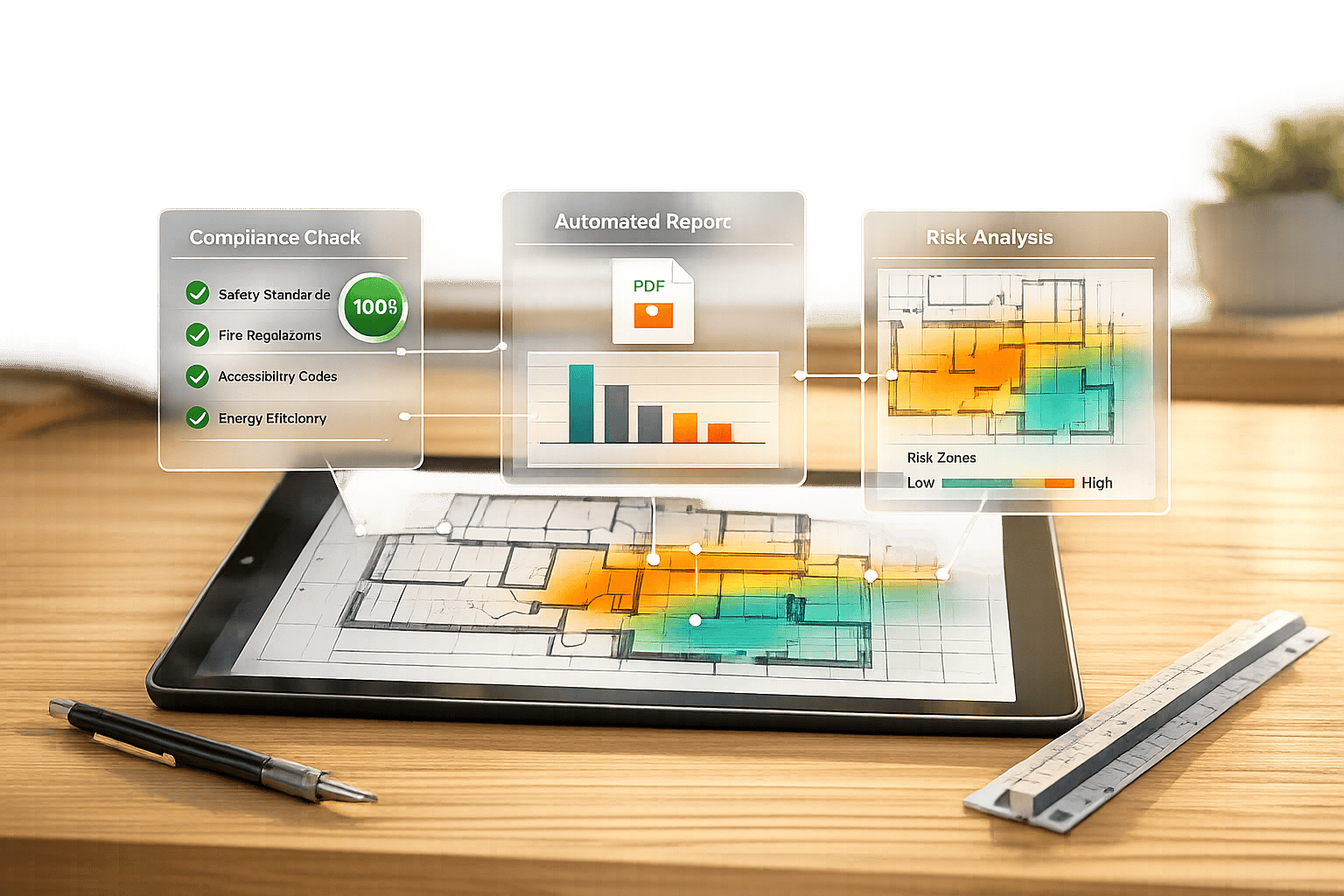
AI is transforming how building code compliance is handled – making it faster, more accurate, and less prone to errors. Compliance officers, architects, and inspectors can now rely on AI tools to simplify complex regulations, reduce delays, and improve project outcomes. Here’s how:
- AI converts dense legal text into machine-readable formats, allowing real-time compliance checks during the design phase.
- Inspectors can use voice-to-text tools for hands-free documentation, while AI links findings to specific regulations and generates detailed reports instantly.
- AI platforms provide instant access to updated codes, cutting research time and ensuring jurisdiction-specific accuracy.
- Predictive analytics identify potential compliance risks based on historical data, helping teams act early to avoid violations.
- Integration with real estate analytics tools streamlines workflows, enabling compliance checks in seconds while improving decision-making.
Key Benefits:
- Cuts documentation time by 50-80%.
- Reduces rework by 28%.
- Improves inspection turnaround times and training efficiency.
- Boosts deficiency detection rates by 15-25%.
AI compliance tools are reshaping the real estate industry by addressing inefficiencies, reducing costs, and ensuring adherence to ever-changing regulations.

AI Code Compliance Tools: Key Benefits and Impact Statistics
Automated Inspection Documentation and Reporting
Real-Time Data Collection During Inspections
Imagine being able to conduct inspections without the hassle of juggling notebooks or devices. Today, inspectors can dictate their findings hands-free using voice-to-text technology. AI then steps in to transcribe those notes, link them to relevant code sections, and even attach photos automatically. This means inspectors can focus entirely on the inspection itself, while the AI takes care of the paperwork.
Take the City of Fremont in 2025, for instance. Under Inspector Dustin Cardwell’s leadership, they faced a 40% increase in permit volume but managed to handle it without adding staff. Their secret? The Ichi AI tool. By enabling instant code lookups and smart documentation, the team maintained a 48-hour inspection turnaround time while slashing the training period for new staff from 18 months to just 8 months [5]. As Cardwell put it:
"Ichi has been an incredibly valuable tool that I would hate to lose access to. It’s like having an experienced inspector looking over your shoulder, ready to answer any question instantly." [5]
Modern AI tools like this aren’t just limited to areas with strong internet connectivity. They store essential code databases locally, ensuring smooth operation even in basements, rural locations, or steel-framed buildings where signals falter. This offline capability ensures real-time data collection no matter the environment, laying the groundwork for creating accurate and thorough compliance reports.
Creating Detailed Compliance Reports
The moment an inspection wraps up, AI gets to work drafting compliance reports – often before the inspector even leaves the site. Using OCR (Optical Character Recognition) and NLP (Natural Language Processing), these systems can scan documents, convert them into text, and extract enforceable rules and thresholds. Findings are then automatically matched with the appropriate regulatory framework, whether it’s the International Building Code (IBC), NFPA standards, or local amendments.
This automated process doesn’t just save time – it transforms efficiency. AI tools reduce documentation time by 50-80%, saving inspectors 15-30 minutes per inspection while increasing deficiency detection rates by 15-25% [5]. And they tackle a major pain point: incomplete records. According to audits, 41% of building code violations stem from preventable documentation issues like missing signatures or incomplete forms – problems AI eliminates with mandatory fields [7].
But speed isn’t the only advantage. As Fire Marshal Gage Schlice highlighted, having instant access to precise information can make all the difference in high-pressure situations:
"When you’re in a meeting with a developer and they ask about sprinkler requirements, you need the answer NOW – not ‘I’ll get back to you.’ With Ichi, I can pull up the exact code section with our local amendments in seconds." [5]
AI-powered tools are proving to be game-changers, not just in terms of efficiency but also in ensuring accuracy and confidence during critical moments.
sbb-itb-99d029f
AI-Powered Code Research and Regulatory Updates
Instant Access to Updated Building Codes
Gone are the days of flipping through endless PDFs or outdated reference books to track building codes. With AI-powered platforms, professionals now have instant access to databases that are continually updated. Some of the top tools out there maintain over 5 million code sections spanning more than 1,700 state and city codes, with approximately 7,000 sections updated monthly[4]. That’s an overwhelming amount of regulatory information – far beyond what anyone could realistically manage manually.
These platforms simplify the complexity of local regulations by turning dense legal jargon into structured, searchable data. For example, professionals can input plain-English queries like “What’s the maximum travel distance to an exit?” and receive precise, code-cited answers in seconds[4]. This level of accessibility doesn’t just save time – it completely changes how research is done.
Reducing Research Time for Real Estate Professionals
AI tools take the convenience of instant access a step further by cutting research time significantly. Instead of juggling multiple documents for hours, real estate professionals can now get precise answers almost instantly. What’s more, these tools don’t just provide generic information – they use jurisdiction-specific logic to account for local amendments and adoption cycles[2][4]. So, rather than delivering a general building code, they present the exact version adopted by a specific locality, complete with any unique modifications.
The accuracy of these tools is worth noting, too. One AI-powered assistant demonstrated its capabilities by scoring 74% on ARE 5.0 practice questions and up to 88% on Commercial Building Inspector practice exams[4]. That’s on par with seasoned professionals. Additionally, AI systems monitor regulatory changes in real time, keeping tabs on municipal portals and council votes to catch updates as they happen[2]. Instead of relying on outdated information or manually checking government websites, professionals can set up alerts – like “Notify me when insulation R-value requirements change” – to stay informed without feeling overwhelmed[9].
This shift from reactive research to proactive monitoring empowers real estate teams to stay ahead, ensuring better compliance and smoother project management throughout the entire lifecycle.
Predictive Analytics for Compliance Monitoring
Identifying Risk Patterns Using Historical Data
AI leverages historical permit data to anticipate future compliance challenges. By examining past permit records within specific jurisdictions, these platforms can pinpoint which types of applications are more likely to face rejection and the reasons behind it. For instance, if Accessory Dwelling Units in a particular city are often denied due to obscure drainage or setback rules, the system highlights these risks during the due diligence phase[2].
AI also compiles inspection reports across various projects to spot recurring code violations. This approach strengthens early detection by linking repeated issues to historical trends[2][3]. Here’s a key takeaway: 73% of commercial building compliance violations can be avoided with earlier detection[11].
Real-time monitoring takes this a step further by analyzing building system data. Logs from fire panels, HVAC sensors, sprinkler inspections, and elevator load tests are fed into machine learning models. These models identify patterns linked to potential failures, offering 6–8 weeks of advance warning on average[11]. Such predictive insights empower teams to take timely, precise actions to avoid violations.
Taking Action to Maintain Code Adherence
Once a risk is flagged, AI suggests specific, actionable steps. By assigning live risk scores – ranging from Low to Critical – AI helps prioritize maintenance efforts. Portfolios using these tools often achieve a 91% audit pass rate, compared to 58% with manual tracking, and avoid average penalties of $42,000 per missed inspection[11]. For example, if an annual backflow preventer test is nearing its deadline, and the system knows contractor lead times are typically four weeks, it alerts the team early enough to schedule the work without last-minute stress.
This improvement is reflected in the words of an industry leader:
"AI compliance monitoring augments your compliance team – it does not replace professional judgment or licensed inspection work." – Oxmaint[11]
AI’s predictive accuracy also improves over time, climbing from 70–78% in the first year to over 91% by Year 3[11]. This progress is driven by human-in-the-loop feedback, where compliance officers correct errors and refine the system’s algorithms for better extraction and prediction[6][12].
Integration with Real Estate Intelligence Platforms
Streamlining Compliance in Real Estate Workflows
AI compliance tools work best when seamlessly integrated into real estate platforms that professionals already use daily. Through AI data connectors and APIs, these tools can scan regulatory documents and transform them into structured formats like JSON or CSV. This eliminates the need for manual data transfers or switching between systems, making workflows more efficient[6].
With effective integration, compliance checks can be completed in as little as 30 seconds. For example, when embedded in BIM software like Revit, AI tools can verify building codes in real time as designs are developed. Managers can then track compliance trends and identify violations through centralized web portals, simplifying oversight[8].
A standout example is CoreCast‘s real estate intelligence platform, which combines automated code checks with broader investment analytics. As CoreCast expands to include construction management features, compliance data will integrate seamlessly with underwriting analysis, pipeline tracking, and portfolio management. This unified system allows teams to monitor code adherence while simultaneously evaluating a property’s position in the deal pipeline and analyzing market competition.
This level of integration not only simplifies compliance processes but also lays the groundwork for more informed and strategic decision-making.
Better Decision-Making Through Centralized Data
Streamlined workflows are just the beginning – centralizing compliance data alongside other real estate information significantly enhances decision-making. AI agents can extract key details, such as height restrictions or material requirements, from dense regulatory documents. By converting legal jargon into actionable checklists, these tools reduce the manual effort and errors that often plague compliance officers[6].
Modern AI platforms are capable of managing over 380 building codes and standards at once[10]. They can even apply location-specific amendments automatically, taking into account a property’s jurisdiction. When compliance data is combined with financial forecasts, market trends, and communication channels, teams can quickly evaluate how regulations impact timelines, budgets, and returns on investment.
The push for platform consolidation is gaining momentum. For instance, in April 2025, Procore acquired Datagrid, a company specializing in AI-driven document automation and code extraction. This acquisition underscores the growing importance of integrating compliance tools into broader real estate platforms[6].
The Future of AI in Building Code Compliance
Key Benefits of AI-Enhanced Compliance Tools
Switching from manual compliance reviews to AI-powered systems has brought measurable improvements to the construction industry. For instance, AI can boost construction productivity by up to 20%, cut costs by as much as 15%, and shorten project delivery times by up to 30%. These advancements signal a major shift in how compliance is managed in real estate.
AI platforms are also far more effective at identifying issues. They can catch 50% more relevant problems compared to traditional manual reviews[13]. This means fewer unexpected delays or expenses during inspections. On top of that, AI tools significantly reduce rework – some report cutting it down by 28%, which translates to substantial time and cost savings.
One of the standout advantages of AI is its consistency. Unlike human reviewers, who may miss details due to fatigue or the complexity of regulations, AI systems maintain a steady level of accuracy. They provide consistent results and always reference specific code sections. As Marian Pulford from Kestrel Labs puts it:
"AI translates building code into structured logic that can be evaluated directly against the model"[1].
These benefits not only streamline compliance but also open the door to further advancements in AI-driven tools.
What’s Next: AI Compliance Innovations
Looking ahead, the next wave of AI compliance tools will focus on continuous, model-based checks throughout the design process. By 2026, Gartner predicts that 40% of enterprise applications will include task-specific AI agents[13].
These specialized agents are expected to capture a market worth over $10.9 billion by 2026 and contribute between $2.6 trillion and $4.4 trillion to the global GDP by 2030[3][13]. For real estate professionals, this means access to a suite of advanced tools tailored for specific needs – like safety, zoning, or environmental considerations. This evolution not only sharpens compliance processes but also integrates them into broader strategic decisions through real estate intelligence.
Companies like CoreCast are already weaving AI compliance tools into larger real estate management systems. As construction management tools evolve, compliance data will seamlessly integrate with underwriting, pipeline tracking, and portfolio management. This unified approach ensures that code compliance becomes a natural part of decision-making, starting from the earliest stages of a project.
The AI market in construction is on track to grow from $1.08 billion in 2025 to $5.22 billion by 2032. Additionally, all surveyed large enterprises plan to expand their use of task-specific AI by 2026[13].
CodeComply Get Faster Building Approvals using AI

FAQs
How accurate are AI code compliance tools in real projects?
AI code compliance tools have demonstrated impressive accuracy in real-world projects, but they aren’t without flaws. For instance, research indicates that tools such as GitHub Copilot and ChatGPT can produce inaccuracies 54% and 35% of the time, respectively. This highlights the importance of human oversight to maintain compliance and dependability in actual use cases.
Can AI compliance tools work offline on job sites?
Most AI compliance tools are designed to operate with an internet connection, leveraging cloud-based features for their functionality. But what if you’re working in a location with no internet? Luckily, there are offline alternatives. For instance, some tools can run entirely from a USB drive, allowing you to use them on job sites or in remote areas where connectivity isn’t an option. These solutions ensure you can still access essential features, even when you’re off the grid.
How does predictive analytics prevent code violations?
Predictive analytics plays a crucial role in avoiding code violations by examining historical data alongside current project details. By identifying potential risks and compliance concerns early on, teams can address issues proactively, significantly lowering the chances of violations.