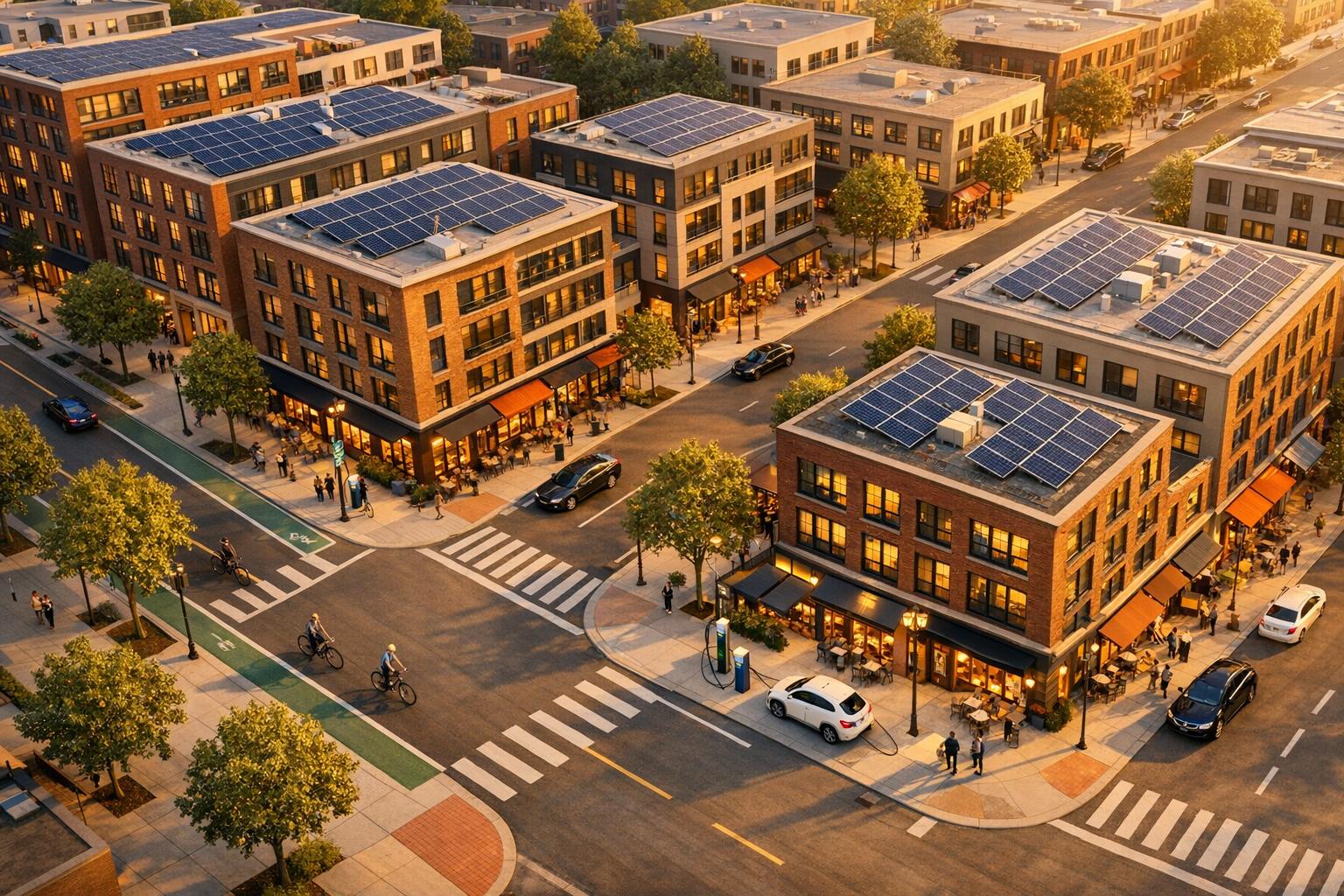
Zoning laws shape how cities grow and how buildings are constructed, making them a key tool for reducing carbon emissions and improving energy efficiency. Buildings account for 40% of U.S. carbon emissions and use 70% of its electricity, so modern zoning policies are evolving to support greener practices. Here’s how zoning helps:
- Encouraging renewable energy: Policies like New York City’s "City of Yes for Carbon Neutrality" remove barriers for solar panels and EV charging stations.
- Incentivizing eco-friendly designs: Developers can earn density bonuses for meeting certifications like LEED or adopting all-electric systems.
- Promoting walkable communities: Transit-oriented development (TOD) reduces car reliance and supports energy-efficient housing.
- Improving stormwater management: Rules for permeable surfaces and native landscaping help reduce runoff and urban heat.
Cities like Arlington, Los Angeles, and Buffalo have already implemented zoning reforms that prioritize green goals. These efforts show how zoning can align construction with environmental priorities while offering financial incentives to developers. Whether you’re planning new projects or retrofitting old ones, understanding local zoning codes is key to achieving both compliance and cost savings.

How Green Zoning Reduces Building Carbon Emissions and Energy Use
Green Zoning Basics and Core Principles
What Green Zoning Means
Green zoning uses local land-use rules to encourage environmentally friendly development, steering away from traditional zoning practices that often lead to urban sprawl and heavy car reliance. The main objectives? Reduce greenhouse gas emissions, cut energy use in buildings, and improve disaster resilience. This is achieved through features like permeable stormwater surfaces, native landscaping, and transit-oriented development[3].
For example, in December 2023, the New York City Council approved a zoning initiative called "City of Yes for Carbon Neutrality." This policy introduced several changes, such as:
- Removing coverage and setback restrictions for rooftop solar installations.
- Setting a 15-foot height limit for solar setups.
- Allowing a flat 5% floor area exemption for buildings meeting ultra-low energy Passive House standards.
- Permitting EV charging stations in commercial and manufacturing zones[2].
These steps highlight how zoning policies can be reimagined to support a more sustainable future.
How Zoning Shapes the Built Environment
Zoning regulations have become a powerful tool for driving greener construction practices. By eliminating outdated rules, green zoning clears the path for renewable energy systems and efficient building retrofits[2].
Take Paradise, California, for instance. After the devastating 2018 wildfire, zoning changes introduced new safety measures, such as requiring a five-foot noncombustible perimeter around buildings and banning railroad ties in landscaping. Additionally, a zoning overlay doubled commercial density in areas served by new sewer systems[3]. Similarly, in 2019, Somerville, Massachusetts, implemented a "Green Score" system. This tool measures the environmental impact of developments and enforces LEED standards for new projects[3].
These examples show how zoning can not only meet tough environmental goals but also enhance safety and community well-being.
sbb-itb-99d029f
Zoning Strategies That Support Green Building
Density Bonuses for Sustainable Design
Density bonuses allow developers to build taller buildings or add more units than typically permitted – but only if they include sustainable features. This extra building space helps offset the higher costs of green upgrades.
Unlike mandatory codes, density bonuses are completely voluntary. Developers might aim for LEED certification or opt for all-electric designs when the added market value of the extra space outweighs the cost of implementing sustainable measures[4][3]. Some cities even use tiered systems, granting more building space for higher levels of sustainability – like LEED Platinum versus LEED Silver[4].
This tool is particularly useful because it sidesteps the delays tied to updating state-level codes. Local governments can act faster, using density bonuses to push sustainability goals right away[4][3]. Beyond this, zoning strategies also tap into transit accessibility and stormwater management, further promoting green building.
Transit-Oriented Development (TOD) Zoning
TOD zoning focuses on clustering residential and commercial developments near public transit and walkable amenities. This setup directly reduces Vehicle Miles Traveled (VMT), helping cut greenhouse gas emissions[4]. As Sara Bronin, a Cornell University professor, explains:
"Making changes in residential development patterns can encourage even modestly more dense communities, which can reduce emissions because residents become less dependent on cars"[3].
Higher-density developments near transit hubs also encourage energy-efficient building designs. For example, multi-family housing consumes less energy per person compared to sprawling single-family homes[3]. Parking reforms play a big role here, too – getting rid of minimum parking requirements prevents the creation of large, heat-absorbing surface lots. Evan Manvel, Climate Mitigation Planner at Oregon’s Department of Land Conservation and Development, points out:
"Parking lots push buildings apart and make communities less walkable"[3].
TOD zoning also promotes "futureproofing" by requiring electric vehicle (EV) charging infrastructure in new developments. Since 80% of EV charging happens at home, ensuring residential zones are equipped for EVs is critical for reducing transportation emissions[3]. These transit-friendly strategies naturally align with other zoning measures, such as stormwater management, for a well-rounded approach to sustainable development.
Stormwater Management and Open Space Requirements
Zoning codes often include rules for permeable surfaces to manage stormwater and reduce urban heat[3]. Some areas use performance-based systems like "Green Scores", which measure a project’s impact on factors like air quality, runoff, and overall health for residents[4].
These requirements also encourage native plant landscaping, which lowers water use and helps cool the surrounding area[3]. Eliminating minimum parking mandates and promoting structured parking instead of sprawling lots further reduces heat-absorbing asphalt and improves walkability[3]. The Northeast Energy Efficiency Partnerships highlights the importance of these measures:
"Green zoning is an essential tool for achieving [carbon reduction] goals. It addresses the local context and specific community needs that building energy codes may not be able to address"[4].
How to Use Zoning Laws for Green Projects
Reviewing Local Zoning Codes
Start by visiting your local planning department’s website. Many cities and towns now provide interactive zoning maps where you can enter a property address to find its zoning designation, such as "R-3" or "C-2" [5]. Once you identify the designation, dive into the zoning ordinance to understand the permitted uses, density rules, and development standards.
Pay close attention to provisions like density bonuses, which allow for increased building capacity if sustainable features are included (as discussed earlier). Also, look for "permitted obstructions" in the zoning code that may allow green technologies, such as solar panels, to exceed typical height or lot coverage limits [2][6]. For example, New York City permits flat-roof solar installations to extend up to 15 feet in all zoning districts [2][6].
It’s also essential to review the comprehensive plan, which outlines the community’s long-term goals. As real estate expert Aaron Blake explains:
"The zoning ordinance is the primary legal tool used to implement the vision laid out in the comprehensive plan. The plan provides the ‘why,’ while the zoning code provides the specific, enforceable ‘how’" [5].
Once you understand the local codes, work with community stakeholders to ensure your project aligns with broader community goals.
Working with Key Stakeholders
Early collaboration with local officials, urban planners, and community members is crucial when pursuing zoning amendments for green projects. Engaging these stakeholders early in the process can help smooth the public review process. Arah Schuur from the Northeast Energy Efficiency Partnerships emphasizes that local, community-driven policies often lead to faster progress than state-level initiatives [3].
For example, in December 2023, the New York City Council approved the "City of Yes for Carbon Neutrality" zoning amendments. This initiative, championed by Mayor Eric Adams’ administration, emerged from a public review process involving community boards and borough presidents. The amendments removed building coverage limits for rooftop solar installations and allowed electric vehicle charging stations as-of-right in all commercial districts [6][2].
To address social equity concerns, consider including affordability measures in density bonus proposals to prevent displacement [4]. In areas prone to natural disasters, collaborate with local officials on temporary zoning changes, such as permitting RVs as interim housing, with the understanding that these measures will expire once permanent, resilient structures are built [3].
Once your project aligns with local goals, use technology to streamline compliance and track progress.
Using Real Estate Intelligence Tools to Track Progress
Keeping track of zoning compliance and measuring progress on green building initiatives can be challenging. Real estate intelligence platforms simplify this process by managing regulatory requirements, such as New York City’s Local Law 97. This law imposes greenhouse gas emissions caps on buildings over 25,000 square feet starting in 2024, with financial penalties for non-compliance [2].
Tools like CoreCast’s end-to-end platform can be invaluable. CoreCast allows professionals to underwrite projects, monitor deal stages on an integrated map, evaluate local incentives, and conduct portfolio analyses – all in one system. For example, the platform can identify areas offering density bonuses for meeting LEED standards [4], track floor area exemptions like New York City’s 5% exemption for ultra-low-energy Passive House designs [2], and calculate performance metrics such as "green scores", which assess factors like air quality, stormwater management, and landscape quality [7][4].
U.S. Zoning, Explained
Examples of Successful Green Zoning Programs
The following case studies highlight how different communities have implemented green zoning strategies to achieve environmental and community benefits.
Arlington County’s Green Building Incentive Program
Arlington County, Virginia, has been at the forefront of green zoning since 1999 with its Green Building Incentive Policy (GBIP). This program encourages developers to meet high sustainability standards by offering them bonus density – essentially allowing for increased Floor Area Ratio (FAR). For instance, a project certified as LEED v5 Gold can gain an additional 0.25 FAR, while a LEED v5 Platinum project can earn up to 0.45 FAR[8]. This approach effectively ties zoning incentives to sustainable building practices.
The program has seen substantial participation, with 108 projects totaling 37 million square feet taking advantage of these incentives – an average of 60% of eligible site plans[8]. In December 2025, Arlington became one of the first local governments to adopt LEED v5 standards, with the updated policy taking effect in March 2026. The revised program also expanded to include incentives for repurposing buildings, such as converting commercial spaces into residential units[8][9].
Paul Roman, the county’s Green-Building Program Manager, highlighted the program’s adaptability:
"Nothing is etched in stone. Items may be revised… [The education period] hopefully will curb the apprehension"[9].
To ease the transition, the county provides a six-month education period for developers to understand new requirements. Additionally, they offer multiple certification pathways, such as LEED, Phius (Passive House), EarthCraft Multifamily Gold, and Zero Carbon certifications, to accommodate various project types and budgets[8][9]. Arlington’s success demonstrates how targeted zoning reforms can align development with environmental goals.
Los Angeles’ Clean Up Green Up Initiative

Los Angeles introduced the Clean Up Green Up (CUGU) ordinance in June 2016, focusing on environmental justice in neighborhoods disproportionately affected by industrial pollution. The pilot Green Zones – Boyle Heights, Pacoima-Sun Valley, and Wilmington – were chosen because of their residents’ heightened risks for asthma, cancer, and heart disease due to nearby industrial activities[10].
The ordinance, passed unanimously by the LA City Council in December 2015, restricts new pollution sources from operating or expanding near sensitive areas like schools, parks, childcare centers, and senior facilities[10]. It also addresses cumulative health impacts by enforcing stricter building standards in areas where industrial sites, such as truck depots or refineries, are close to residential properties.
CUGU goes beyond regulations with its "Green Up" component, which provides businesses with an ombudsperson to guide them in meeting environmental standards, securing low-interest loans, and navigating the permitting process[10]. Manuel Pastor, a professor at the University of Southern California, praised the program:
"[Clean Up Green Up is] a model policy to protect community health and promote economic vitality"[10].
This initiative shows how zoning reforms can safeguard public health while supporting economic growth.
Buffalo’s Green Code
Buffalo, New York, adopted its Green Code in 2017, representing the city’s first comprehensive zoning update since 1953[12]. This form-based code combines zoning, subdivision, and public realm regulations into a single document, shifting the focus to the physical design of neighborhoods rather than just land use. The code emphasizes sustainability, including stormwater management, eco-friendly landscaping, and transportation demand management.
In designated green zones, such as the D-OG Green zone (civic greens and parks), building coverage is capped at 10%, and impervious surfaces are limited to 15% to enhance environmental health[11]. Reflective facade materials with a Visible Light Reflectance above 15% are also prohibited on principal buildings in these areas[11].
The Green Code has received significant recognition, including the 2019 Richard H. Driehaus Form-Based Codes Award and acknowledgment from the American Planning Association[12]. Local Form Studio described its impact:
"The Green Code… has resulted in a restructuring of the policies and regulations guiding the city’s physical development, including the first citywide land use plan since 1977, and the first comprehensive zoning rewrite since 1953"[12].
Buffalo’s Green Code demonstrates how modern zoning updates can integrate sustainability into urban planning effectively.
Conclusion
Zoning laws play a critical role in promoting green building practices and reducing carbon emissions. With buildings contributing nearly 40% of all U.S. carbon emissions[1], zoning strategies such as density bonuses, transit-oriented development, and stormwater management requirements are powerful tools for accelerating progress toward environmental goals. These approaches often deliver results more quickly than waiting for updates to state-level building codes[7].
Examples from Arlington County, Los Angeles, and Buffalo highlight how proactive engagement with zoning policies can lead to measurable outcomes. Updating outdated codes and utilizing incentives like density bonuses show that community-focused green zoning can drive real change.
Real estate professionals have a key role to play in this process. Staying informed about local planning and zoning amendments opens doors to new opportunities in sustainable development. As Sara Bronin, Professor at Cornell University, explains:
"Zoning dictates where and how nearly everything in the United States is built, so it has a significant impact on the environment"[3].
For developers, aligning with green zoning initiatives early not only protects investments but also helps avoid penalties tied to emissions caps while taking advantage of financial incentives.
Navigating these regulations can be complex, but tools like CoreCast provide valuable support. This platform offers an all-in-one solution for tracking zoning changes, analyzing portfolio performance against sustainability goals, and identifying low-carbon development opportunities. By integrating pipeline tracking, competitive analysis, and portfolio insights, CoreCast equips stakeholders to confidently adapt to the evolving green zoning landscape.
FAQs
What green zoning incentives can my project qualify for?
Green zoning incentives could open doors to benefits like faster permitting processes, tax breaks, and density bonuses for your project. These incentives, typically embedded in local zoning laws, aim to encourage sustainable development by easing restrictions or providing perks for projects that meet green building criteria. Take a close look at your local regulations to uncover opportunities that align with your project’s objectives and support larger environmental and climate-focused efforts.
How can I quickly find my property’s zoning rules and overlays?
To find your property’s zoning rules and overlays quickly, head to your city or county’s planning or zoning department website. Most of these sites provide online zoning maps or GIS tools where you can search using your address or parcel number. You can also use platforms like CoreCast, which combine property and zoning data, offering detailed insights to help you understand location-specific regulations with ease.
How can I use zoning to add solar panels and EV chargers legally?
To integrate solar panels and EV chargers into properties legally, zoning regulations must adapt to accommodate these technologies.
For solar panels, zoning codes should allow for flexibility in terms of size, setbacks, and lot coverage. This ensures homeowners and businesses can install panels without unnecessary restrictions.
For EV chargers, it’s important to include standards that address electrical capacity and conduit installation in new construction projects. These measures prepare properties for future EV infrastructure needs.
Streamlining the permitting process and designating solar- or EV-friendly zones can make installations easier and align with broader clean energy initiatives.