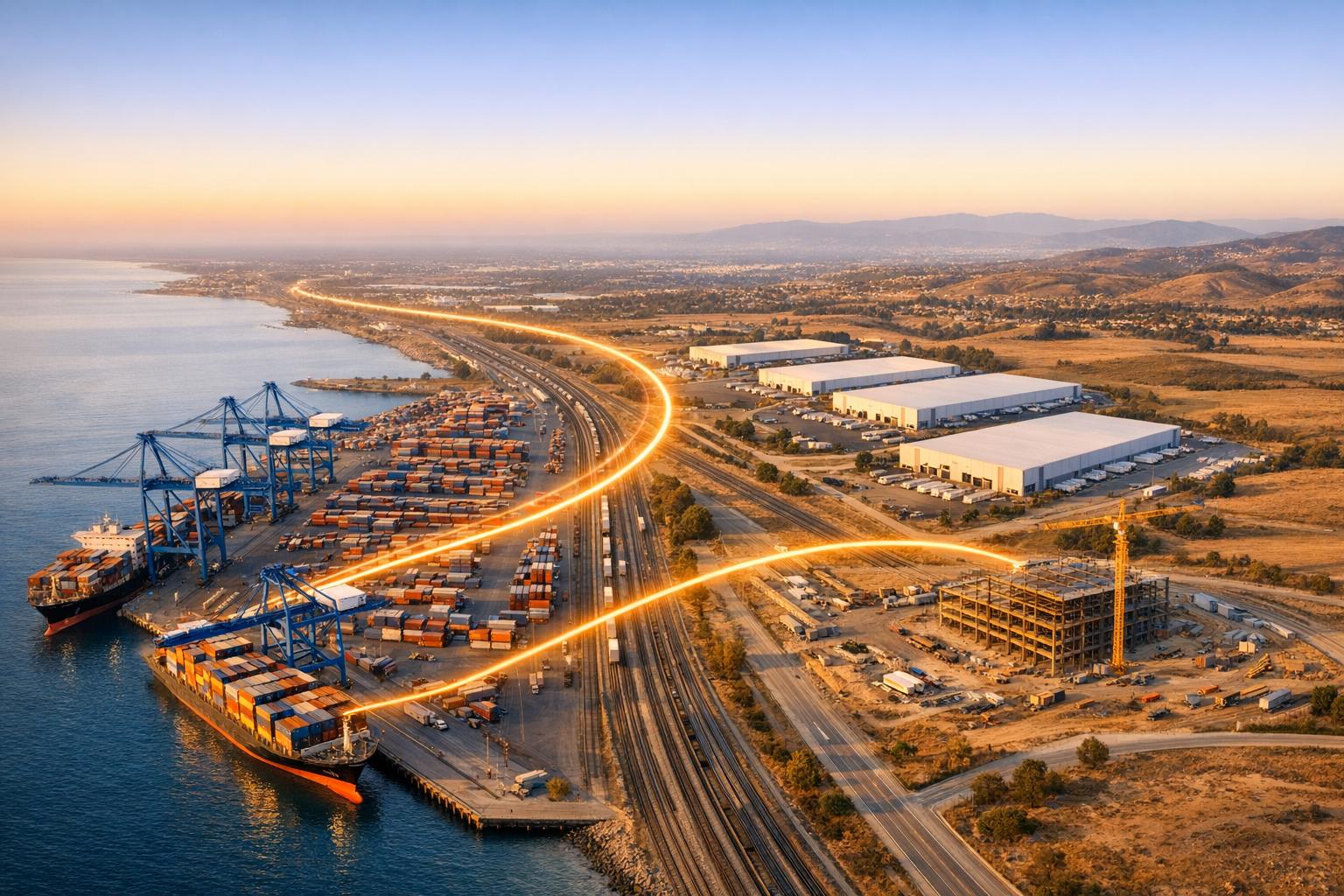
Trade agreements directly impact commercial real estate by influencing costs, investment flows, and business operations. Key takeaways:
- Tariffs drive up costs: In 2025, U.S. tariffs on steel, aluminum, and copper increased construction costs by 3-12%, leading to higher project abandonment rates.
- Shifts in business locations: Companies like Honda and Hyundai relocated manufacturing to the U.S. to avoid tariffs, boosting demand for industrial properties in the Midwest and Southeast.
- Foreign Trade Zones (FTZs): These zones reduce costs for businesses by deferring or eliminating duties, spurring growth in industrial real estate.
- Investment caution: Uncertainty in trade policies has delayed leasing and investment decisions , prompting firms to adopt AI for risk profiling, though some sectors, like grocery-anchored retail, are thriving.
- Inland growth: Coastal property demand is declining due to reduced imports, while inland markets like Columbus and Arizona are seeing increased activity.
Trade policies are reshaping the real estate landscape, emphasizing the importance of data-driven decisions and market awareness.
How Trade Agreements Shape Commercial Real Estate

How Tariffs Impact Construction Costs by Building Type in 2025
How Tariffs Change Construction Costs
Tariffs on construction materials have a direct impact on construction costs, squeezing profit margins. For instance, in June 2025, federal tariffs on steel and aluminum imports were raised from 25% to 50% [4][5]. Just two months later, a 50% tariff on copper was introduced, further driving up costs for critical systems like electrical and mechanical components [4].
These tariff hikes translated to noticeable cost increases across various building types:
- Wood-framed buildings: Costs rose by 3–5%.
- Poured-in-place concrete structures: Costs climbed by 5–8%.
- Structural steel buildings: Costs surged by 8–12% [4].
"Tariffs have increased costs by 3-5% for wood-framed buildings, 5-8% for poured-in-place concrete, and 8-12% for structural steel." – KOW Building Consultants [4]
Major manufacturers also felt the sting. Caterpillar reported $1.5 billion in added expenses due to new tariffs, while Deere & Company faced $600 million in additional costs by mid-2025 [4]. These pressures have had a ripple effect, contributing to a 66.5% rise in project abandonment rates since late 2024 [4].
To adapt, developers have turned to material substitutions – like opting for wood instead of steel – and have sought alternative supply chains in countries with more favorable trade terms [4]. These trends have also fueled growth in specialized trade zones, discussed in the next section.
Trade Zones and Industrial Real Estate Growth
Foreign Trade Zones (FTZs) are proving to be a game-changer for industrial real estate by offering significant cost-saving opportunities. These zones allow businesses to import, store, and manufacture goods without paying customs duties until the goods are officially entered into U.S. commerce. Additionally, duties on waste or scrap materials are entirely eliminated [7].
Beyond duty deferral, FTZs provide other financial advantages. Goods stored in these zones are often exempt from state and local inventory taxes, reducing carrying costs for companies managing large inventories [7]. The zones also offer operational flexibility, allowing activities like assembly, manufacturing, and testing to occur in the same location [7].
A prime example is the McAllen Foreign Trade Zone #12 in Texas. As of 2025, it operates as a comprehensive industrial hub, offering:
- Short- and long-term warehouse options
- Temperature-controlled storage
- E-commerce fulfillment services
- Rail-side operations and cross-docking
- 24-hour truck scale services [7]
"A Foreign Trade Zone (FTZ) is an isolated, policed, and enclosed area that is in or adjacent to a port of entry and is considered outside customs territory of the United States." – McAllen FTZ [7]
However, not all trade zones are thriving. Coastal industrial areas have faced challenges, with occupancy rates dropping 4–6% between 2024 and 2025. This decline is tied to reduced international shipment volumes caused by trade barriers [2]. As a result, companies are increasingly shifting toward inland distribution centers and domestic manufacturing hubs in the Midwest and Southeast [2][4].
This inland shift aligns with broader trends in international capital movements, which are explored in the following section.
International Investments and Capital Movement
Trade agreements also play a crucial role in shaping international investment flows by lowering barriers and creating favorable conditions for capital movement. Provisions related to financial services within these agreements have made it easier for developers to access credit and tap into global capital markets [8].
This has spurred major investment decisions aimed at bolstering domestic production. Some notable examples from 2025 include:
- Taiwan Semiconductor Manufacturing Company (TSMC) committing $165 billion to advanced semiconductor facilities in the U.S. (July 2025) [3].
- Eli Lilly announcing a $5 billion pharmaceutical manufacturing plant in Richmond, Virginia, to strengthen domestic supply chains (September 2025) [3].
- Toyota pledging $10 billion to expand U.S. auto manufacturing following trade discussions between the U.S. and Japan (October 2025) [3].
However, uncertainty around trade policies has made some investors cautious. Fluctuating tariff rates have particularly impacted foreign investors’ confidence in U.S. real estate. Tom LaSalvia of Moody’s Analytics CRE noted:
"The nascent rent, occupancy and pricing recovery was upended as tenants and investors delayed leasing and investment decisions, waiting to see what the landscape looks like after the trade-war smoke clears." During such periods of uncertainty, investors often prioritize finding ways to track real estate portfolio performance more rigorously to mitigate risks. [10]
Despite these challenges, there are signs of optimism. Commercial real estate transaction volumes in Q1 2025 rose 11% compared to the previous year, though they remained 19% below the 10-year average [9]. Additionally, CMBS issuance in the first half of 2025 reached $59.6 billion, marking a 35% increase from the previous year [4]. These figures suggest that, while caution exists, confidence in the market is gradually recovering.
sbb-itb-99d029f
How Different Property Types Are Affected
Industrial Real Estate: Growth from Trade Expansion
Trade agreements are reshaping costs and supply chains, but their effects on property types vary widely. Coastal areas, for instance, are seeing a dip in occupancy rates, largely due to disruptions in logistics tied to port operations. In April 2025, tariffs on Chinese imports surged to 125%, and later climbed to 145% [6].
"The lack of incoming containers has produced cooling effects on the demand for these properties. Real estate tenants seek flexibility in their contracts, while securing long-term leases is becoming difficult in these uncertain market conditions, requiring more robust portfolio analytics tools with custom reporting features to navigate the volatility."
– Shugufta Rasool, Real Estate Analyst, Estate Agent Power [2]
In contrast, inland markets are flourishing. For example, in April 2026, Creation Equity acquired a 38-acre site in Avondale, Arizona, for $18.05 million to develop a 699,700-square-foot industrial property [1]. That same month, an industrial property in Columbus, Ohio, sold for $70 million, showcasing strong investment momentum in Midwest logistics hubs. This trend underscores how trade policies promoting domestic manufacturing are shifting industrial demand from coastal areas to secondary and tertiary markets in regions like the Midwest and Southeast [2]. While industrial real estate adapts to these geographic changes, the ripple effects of tariffs are felt differently in office and retail sectors.
Office and Retail Properties: Secondary Effects
The office and retail sectors face indirect challenges, particularly from rising construction costs and fluctuating economic confidence. As previously mentioned, material tariffs have driven up development costs, complicating new office projects and retail renovations.
"Tariff changes have already impacted building material costs… steel, aluminum and copper parts are all subject to a 50% tariff."
– Ginger Chambless, Head of Market Insights for Commercial Banking, J.P. Morgan [11]
Despite these challenges, the focus on asset quality has intensified. Prime office spaces in major cities are commanding record rents and seeing strong demand, while older, less desirable urban properties are increasingly being considered for alternative uses. In retail, grocery-anchored and neighborhood shopping centers are thriving, with their valuations reaching their highest levels in a decade [11].
"The retail sector is experiencing good tailwinds with limited new supply. We’re seeing the strongest valuations in a decade across active shopping centers, excluding regional malls."
– Burke Davis, Head of Real Estate Banking, J.P. Morgan [11]
Additionally, trade policies are spurring geographic shifts, creating fresh opportunities in secondary markets. As manufacturing relocates inland, regional office and retail hubs in the Midwest and Southeast are seeing growing demand to support these expanding operations [2].
Using Real Estate Intelligence for Better Decisions
Using Data to Respond to Policy Changes
With rising construction costs and fluctuating market conditions, relying on data has never been more critical. Shifts in tariffs and trade policies can quickly change cost structures, making real-time market insights essential. For instance, when construction costs rise 3–5% due to new tariffs, tools like CoreCast step in to streamline the process. CoreCast speeds up underwriting by automatically pulling key financial metrics from offering memorandums, T12s, and rent rolls, allowing teams to act quickly [13].
Cross-checking assumptions with live market data reduces uncertainty. Take reshoring, for example – it can boost demand in secondary markets like Columbus or Nashville. In such cases, investors can use CoreCast to compare projected rents with real-time market data. Additionally, centralized pipeline tracking ensures consistent decision-making across both new acquisitions and existing assets [12].
"They have seamlessly provided the expertise and support we needed to streamline our operations and make smarter, data-driven decisions."
– Clay Heighten, Principal, Caddis Healthcare RE [12]
This level of analysis lays the groundwork for more integrated and efficient portfolio management.
Managing Your Portfolio with CoreCast

CoreCast brings everything – underwriting, pipeline tracking, market mapping, and portfolio analysis – into one unified platform [12]. When tariffs cause material costs to spike, CoreCast’s unit-level scenarios help developers assess the financial impact on individual projects.
The platform’s AI-powered narratives and automated reporting are particularly helpful during times of policy uncertainty, giving capital raisers the tools they need to build confidence with investors. This comprehensive support allows investors to navigate complex trade agreements and market changes with greater ease.
"Having a tailored and precise model became the cornerstone of our capital-raising efforts. Their ability to simplify complex structures gave me & my investors the confidence to move forward."
– Justin Britto, Principal, Madison Communities AZ [12]
During its beta phase, CoreCast is available for $50 per user per month. Future plans include tiered pricing options – Free, Essentials, and Pro – designed to make advanced analysis tools accessible to teams of all sizes.
Conclusion
Trade agreements significantly influence market dynamics by determining where development occurs, affecting construction costs, and steering investments toward specific property types [2]. For instance, the U.S. has implemented 25% tariffs on goods from Canada and Mexico [13], while TSMC’s $165 billion investment in U.S. semiconductor facilities highlights how these policies are reshaping the commercial real estate landscape [3]. These shifts are evident in the sector’s key performance indicators.
Higher construction costs and fluctuating occupancy rates illustrate the impact of such policies [2][3]. In response, manufacturers have moved production to avoid tariffs, which has boosted demand in secondary markets [3].
"Strategic clarity and operational flexibility will become paramount."
– Stewart Rubin and Marshall Swett, New York Life Real Estate Investors [3]
This statement emphasizes the importance of agility and adaptability in navigating a rapidly changing regulatory environment.
Real estate professionals must rely on real-time data to adjust strategies effectively. With tariffs driving up construction costs almost instantaneously, having access to up-to-date data is critical [13]. Tools like CoreCast’s real estate intelligence platform help teams underwrite deals more efficiently, validate assumptions with live market data, and maintain investor trust during periods of policy uncertainty.
The transition from global integration to domestic manufacturing appears to be a lasting trend. By understanding these dynamics and leveraging platforms like CoreCast for actionable insights, professionals can remain competitive in this evolving market.
FAQs
Which CRE markets benefit most from reshoring?
Manufacturing and industrial sectors are reaping major rewards from reshoring efforts. Bringing operations back to the U.S. has led to a surge in demand for industrial real estate and manufacturing facilities nationwide, fueling expansion and development in these industries.
How do FTZs change industrial site selection?
Foreign Trade Zones (FTZs) play a key role in industrial site selection by offering businesses the ability to import, store, or process goods without immediately paying customs duties. These duties are only applied when the goods enter the U.S. domestic market. This setup can help companies reduce operational costs and enhance cash flow, making FTZs an attractive option when evaluating potential sites.
How can I stress-test deals against tariff risk?
When preparing for potential tariff changes, it’s crucial to assess how these shifts could influence costs, supply chains, and overall profitability. By analyzing various scenarios, you can better understand the potential effects on cash flow and return on investment (ROI).
Tools like CoreCast are particularly useful for this process. They allow you to simulate tariff scenarios, evaluate financial impacts, and make more informed decisions. Additionally, having contingency plans in place – such as identifying alternative suppliers or adjusting project timelines – can help protect your investments from unexpected challenges.