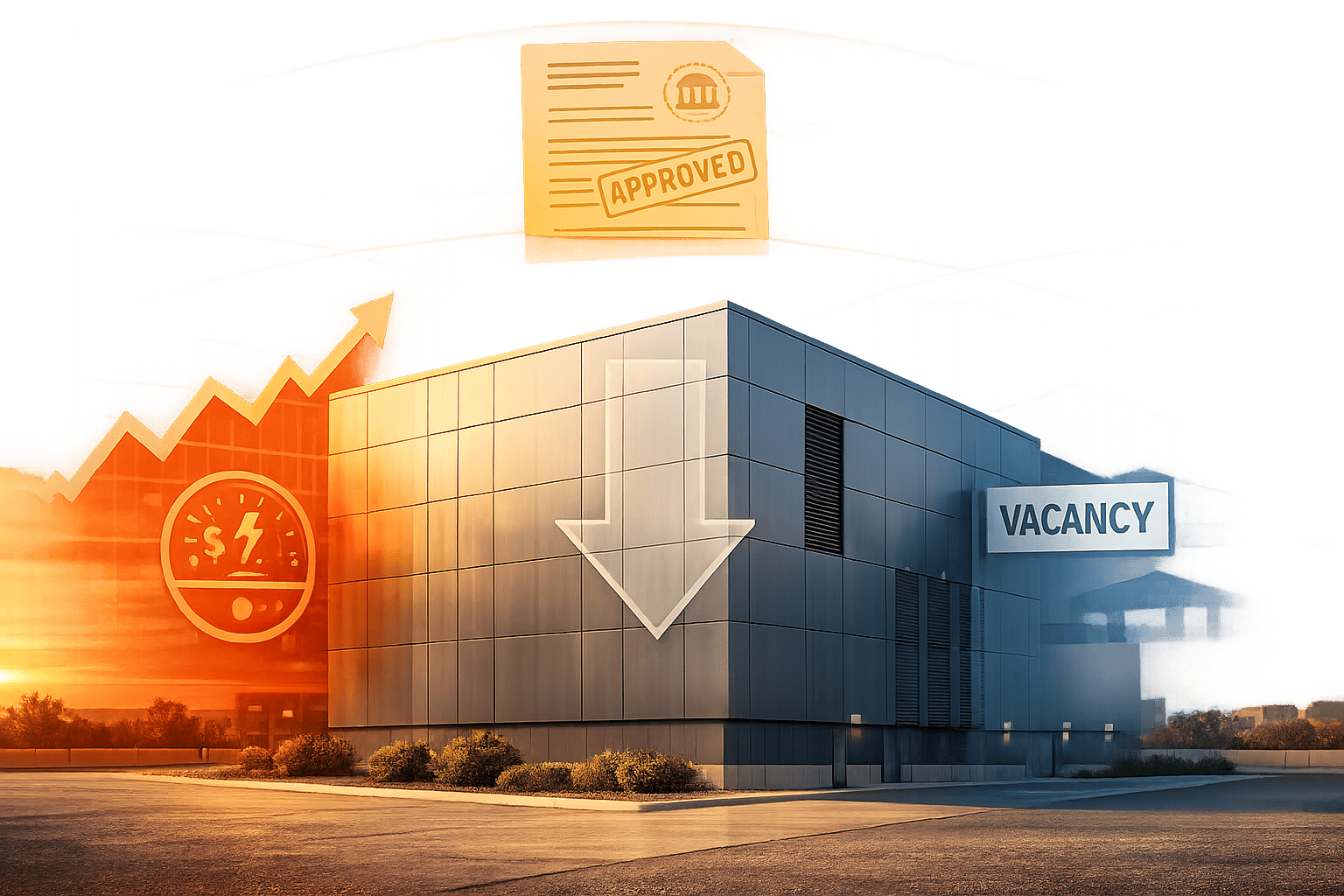
Data centers are challenging to value because of their specialized infrastructure and limited comparable properties. The cost approach is often the most reliable method, focusing on the expense of replacing the property rather than relying on market comparisons or income potential. A key factor in this approach is external obsolescence, which refers to value loss caused by factors outside the owner’s control, like rising energy costs, regulatory changes, or market oversupply.
Key Takeaways:
- Cost Approach Formula: (Cost of Construction – Depreciation) + Land Value = Property Value.
- External Obsolescence: Depreciation from external factors such as:
- Rising energy costs (e.g., 16% increase in some states from 2025–2026).
- Market oversupply reducing demand for large data centers.
- Regulatory restrictions or economic shifts affecting operations.
- Valuation Methods:
- Paired Sales Analysis: Compares property values before and after external changes.
- Income Capitalization: Calculates lost income due to external factors and converts it into a value reduction.
For accurate appraisals, methods like Highest and Best Use Analysis and tools like CoreCast provide real-time data to measure external obsolescence and refine valuations.
External Obsolescence in Real Estate Appraisal
What Is External Obsolescence?
External obsolescence refers to a type of property depreciation caused by factors outside the property owner’s control – things like economic shifts, changes in zoning laws, or new environmental regulations [1]. Unlike physical wear and tear or outdated design, this type of depreciation originates from external forces beyond the property’s boundaries. As FasterCapital explains:
It is the external factors, those beyond the control of the property owner, that can significantly impact value [1].
What makes external obsolescence particularly challenging is that it’s usually impossible to fix through property improvements. For example, upgrading a building won’t fix a weak local economy or undo the effects of a new highway rerouting traffic away from the area. In real estate appraisals, especially when using the cost approach, external obsolescence accounts for the loss of value that repairs or upgrades simply can’t address. This concept becomes even more critical when evaluating properties like data centers.
How External Obsolescence Affects Data Centers
Understanding external obsolescence is especially important when appraising data centers. These facilities are particularly sensitive to external factors because they depend on reliable power, strong connectivity, and stable energy costs [1]. Several key issues illustrate how external forces can impact their value:
- Technological Advancements: Rapid changes in technology can quickly make a facility less competitive. For example, a data center in an area lacking support for high-speed connectivity or advanced cooling systems may struggle to attract clients.
- Economic Shifts: A regional economic downturn or the relocation of major tech companies can reduce demand for data center services, driving down property values.
- Regulatory Challenges: Stricter environmental or floodplain regulations can increase operational costs or limit what a facility can do [1].
- Market Oversupply: When too many data centers are built in the same area, competition can drive down rental rates and occupancy levels, reducing income potential and overall property value [1].
These external pressures underscore why appraisers must carefully consider factors beyond the property itself when valuing data centers. External obsolescence can have a profound impact on their long-term viability and financial performance.
sbb-itb-99d029f
Common Causes of External Obsolescence in Data Centers
Energy Costs and Power Availability
Rising energy costs are a major challenge for data centers, significantly impacting their value. In states like Virginia, Illinois, and Ohio, electricity rates have surged by as much as 16% in a single year [2]. This trend isn’t expected to slow down, with data centers projected to consume between 7% and 12% of the total U.S. power supply by 2030, up from about 2% in 2026 [2].
To understand the financial impact, consider this: a 10% increase in utility costs for a property with $200,000 in annual energy expenses translates to an additional $20,000 per year. At a 6% cap rate, this would reduce the property’s implied value by a staggering $333,000 [2]. Even for facilities that generate their own power, grid limitations remain a persistent issue.
As Brandon Owens, a Grid Policy Analyst, points out:
Most of today’s cost pressure is coming from transmission, distribution, and system readiness, not energy supply. Those costs remain even if a data center self-supplies generation [2].
The power grid’s struggle to keep up with demand is particularly evident in Northern Virginia’s "Data Center Alley." By 2025, this area had commissioned over 4.5 gigawatts of data center capacity, with an additional 2.4 gigawatts under construction [2]. While being near such hubs boosts demand, it also leads to higher utility rates and infrastructure fees [2].
In February 2026, the White House introduced an AI ratepayer protection pledge. This initiative requires major tech companies like Amazon, Google, Meta, Microsoft, and OpenAI to secure their own power supply for new AI data centers to prevent costs from being passed on to general ratepayers [2].
These energy challenges tie directly into broader market trends that further impact the value of data centers.
Market Oversupply and Reduced Demand
Market saturation is another significant threat. When too many data centers flood the market, property values can plummet. The rise of edge computing and localized processing has reduced the demand for massive, centralized data centers, especially for latency-sensitive applications [3].
This shift can have serious financial consequences. For instance, in April 2026, a large retail corporation reported a $250 million write-off on a newly built data center. The facility became largely unused after the company transitioned its workloads to the cloud faster than anticipated [3]. Data centers built today face the risk of technological obsolescence within 5 to 7 years, often requiring substantial reinvestment or write-offs [3].
The cost of constructing a hyperscale data center can easily run into hundreds of millions of dollars [3]. This makes them highly vulnerable to market changes. For example, in health-tech applications, localized edge data centers have reduced costs by 40% compared to traditional centralized models [3], highlighting how quickly evolving technology can make older facilities less competitive.
Economic and Location Factors
Beyond energy and market dynamics, regional economic shifts and location-specific challenges also play a role in reducing data center value. When major tech companies relocate or a region experiences an economic downturn, data centers can lose their appeal, leading to vacancies and declining property values [1]. This is similar to the economic struggles seen in former manufacturing hubs [1].
Legislation often exacerbates these issues. Stricter environmental regulations, noise ordinances, or zoning changes can limit how a property is used or increase its operating costs. These external pressures are particularly damaging because they can’t be resolved through renovations or upgrades. No amount of investment can overcome unfavorable regulations or a weak regional economy.
| Market | Electricity Rate Increase (2025-2026) | Primary Driver |
|---|---|---|
| Virginia (Loudoun/Prince William) | Up to 16% | Data Center Density / Grid Upgrades |
| Illinois (Chicago I-88 Corridor) | Up to 16% | AI Infrastructure Demand |
| Ohio (Columbus) | Up to 16% | New Hyperscale Facilities |
| National Average (Projected) | 5% – 15% (in tech hubs) | Transmission & Distribution Costs |
Measuring External Obsolescence in Data Centers
Highest and Best Use Analysis
In the cost approach, Highest and Best Use (HBU) analysis helps identify value losses caused by external obsolescence. This process examines whether a data center’s setup is optimized to deliver maximum value under external constraints, such as power grid limitations or market oversupply, which can diminish its overall potential. Appraisers evaluate whether the property’s use is legally allowable, physically achievable, financially viable, and most productive[5].
When external conditions hinder a data center from operating at its most profitable capacity, the resulting value gap highlights external obsolescence. For instance, a facility originally designed for hyperscale operations may face reduced capacity due to power grid restrictions. In such cases, HBU analysis calculates the corresponding value loss. As REIPRIME explains:
External obsolescence is the depreciation that no renovation budget can fix[4].
To anticipate such issues, appraisers should examine city council records, environmental impact reports, and industrial permits within a half-mile radius for any planned infrastructure changes that might influence the property’s value[4]. Afterward, paired sales and income capitalization methods can quantify the effects of these external factors.
Market Extraction and Income Capitalization Methods
Paired sales analysis is a technique that pinpoints the financial impact of external conditions by comparing the sale prices of similar properties before and after the emergence of an external factor. For example, appraisers evaluate data centers sold under different circumstances to determine the monetary loss caused by external changes[4].
The income capitalization method focuses on lost revenue potential to measure obsolescence. This involves comparing the market rents of affected properties with those of unaffected ones. The difference in Net Operating Income (NOI) is then capitalized using a market-appropriate cap rate. For example, if a property offers $50,000 less in annual rent due to concessions, applying a 6% cap rate translates to an obsolescence impact of roughly $833,000[4]. This method is particularly useful in cases where external factors, such as higher utility costs or new industrial developments, directly reduce rental income or increase operational expenses.
Why Old Data Centers Are Becoming Obsolete?
Applying the Cost Approach with External Obsolescence Adjustments

Cost Approach Formula for Data Centers with External Obsolescence Adjustments
Step-by-Step Process for Adjusting External Obsolescence
To adjust for external obsolescence using the cost approach, follow these four steps:
First, assess the land value as if it were vacant and optimized for its highest and best use [1]. This provides a baseline independent of any current structures or improvements.
Next, calculate the current cost of building an equivalent data center, factoring in critical infrastructure like power systems and cooling [1][3]. For hyperscale facilities, these costs can surpass $100 million [3].
Then, after determining the replacement cost, subtract physical and functional depreciation. Identify any external factors, such as market trends or regulatory changes, that may impact the property’s value [1][3]. Use methods like comparative market analysis or income capitalization – dividing the rental income loss by the cap rate – to quantify these external effects [1].
Finally, combine the land value with the depreciated building cost and subtract the quantified external obsolescence [1]. This provides the final property valuation. As FasterCapital explains:
External obsolescence is quantified as a form of depreciation, and it’s crucial to differentiate it from other forms because it is not caused by the property itself. [1]
This process ensures the appraisal accounts for the specific challenges data centers face, as detailed earlier. The example below demonstrates how this adjustment works in practice.
Case Example: External Obsolescence Calculation
Imagine a data center with a land value of $500,000 and a replacement cost of $1,000,000. After deducting $100,000 for depreciation, consider a zoning restriction that results in a $20,000 annual rental loss compared to unrestricted sites [1].
Using the income capitalization method with a 5% market cap rate, the external obsolescence is calculated as $400,000 ($20,000 ÷ 0.05) [1]. The final property value is:
$500,000 (land) + [$1,000,000 (replacement cost) – $100,000 (depreciation)] – $400,000 (external obsolescence) = $1,000,000 [1].
These calculations mirror real-world situations. For example, in April 2026, a major retail company reported a $250 million write-off on a newly built data center that became obsolete when the company shifted to cloud services and localized processing [3]. Similarly, a health-tech startup cut costs by 40% by transitioning to localized edge data centers for patient monitoring, highlighting the external pressures on traditional large-scale facilities [3].
Tools and Technologies for External Obsolescence Analysis
Using CoreCast for Market Analysis

For appraisers working with data centers, having access to real-time data is essential to pinpoint and measure external obsolescence accurately. CoreCast stands out by offering real-time infrastructure tracking and market insights. It monitors key metrics like power capacity (in gigawatts), proximity to substations, availability zones, and cloud on-ramps across more than 440 global markets [7]. These insights help appraisers evaluate whether a data center’s location remains competitive or is being impacted by external factors that could lower its value.
One of CoreCast’s standout features is its live comparables tool, which provides access to verified transaction and leasing data. This allows appraisers to conduct comparative market analyses that isolate the effects of specific external factors, such as regional power shortages, zoning law changes, or economic slowdowns [6][1]. The platform integrates this data directly into appraisal workflows, while its AI-generated narratives create concise explanations for use in appraisal reports [6].
By combining real-time monitoring with other digital tools, CoreCast enhances the appraisal process, making it more efficient and precise.
Integrating Data Platforms for Better Appraisals
To accurately assess the impact of external factors, advanced data platforms like CoreCast play a crucial role in refining valuation models. These technologies not only improve the accuracy of appraisals but also streamline the process. CoreCast, for instance, integrates live market data through APIs, reducing the risk of manual entry errors and ensuring valuations reflect current market conditions [6][8].
Its comprehensive system allows appraisers to handle tasks such as underwriting properties, analyzing comparables, visualizing competitive landscapes through integrated mapping tools, and generating branded reports – all within a single platform. This end-to-end functionality is particularly beneficial for teams managing multiple appraisals.
For pricing, CoreCast offers several options: $160/month for individuals, $400/month for small teams, and $1,200/month for active platforms. Custom pricing is also available for enterprise clients, with annual billing offering a 20% discount compared to monthly rates [6].
Conclusion and Key Takeaways
Summary of Main Concepts
External obsolescence refers to a loss in property value caused by factors beyond the owner’s control – things like unreliable power grids, zoning changes, or economic downturns in the area. As Reiprime puts it:
External obsolescence is the depreciation that no renovation budget can fix. [4]
When appraising data centers through the cost approach, external obsolescence places a hard limit on property value as long as these external conditions persist. Appraisers commonly use two methods – paired sales analysis and income capitalization – to measure and quantify these effects. For instance, a $257,000 reduction in value could result from an $18,000 annual Net Operating Income loss, capitalized at a 7% rate [4].
For investors, appraisers, and property owners, understanding these principles is crucial. A thorough location analysis before buying can help negotiate better prices upfront, potentially avoiding unexpected losses later. Additionally, documented external obsolescence can be a valuable tool for appealing property taxes, possibly leading to lower annual tax bills [4].
In the cost approach, adjusting for external obsolescence is a key step in fully accounting for all forms of depreciation that affect data center values. Tackling these challenges effectively often requires the use of advanced tools, as outlined below.
The Role of Technology in Modern Appraisals
Quantifying external obsolescence accurately calls for sophisticated analytics. Valuation Research Corporation explains:
Identifying, measuring and applying the adjustment for [Economic Obsolescence] can be a complex and iterative process, requiring expertise and interaction across multiple valuation disciplines. [9]
Platforms like CoreCast simplify this process by integrating live market data, verified comparables, and mapping tools into a single, seamless workflow. This streamlined approach allows appraisers to evaluate competitive conditions and produce detailed reports without juggling multiple systems. By reducing manual tasks and ensuring valuations reflect up-to-date market realities, these tools enhance both efficiency and accuracy in assessing external obsolescence.
This technology-driven approach complements the cost methodology discussed earlier, equipping appraisers with the resources they need to account for all depreciation factors, particularly those external forces that heavily influence data center valuations.
FAQs
How do I distinguish external obsolescence from physical or functional depreciation?
External obsolescence refers to a decrease in property value caused by external factors rather than issues within the property itself. Unlike physical or functional depreciation, which are tied to the property’s condition or design, external obsolescence arises from influences beyond the property’s boundaries.
When the property’s current use aligns with its highest and best use, this type of obsolescence impacts the land value. However, if the property does not represent its highest and best use, the external obsolescence is attributed to the building instead.
What’s the fastest way to quantify external obsolescence for a data center?
The fastest way to assess external obsolescence for a data center is to compare the current land value based on its existing use with its value in the highest and best use. The gap between these two values reveals external obsolescence, particularly if the structure no longer aligns with the land’s highest and best use.
How can rising power costs be converted into a value adjustment?
Rising power costs can directly influence property value. This is calculated by estimating how much the property’s value decreases due to increased energy expenses. That estimated loss is then divided by the property’s capitalization rate. This process helps quantify the effect of higher energy prices on the property’s overall worth.