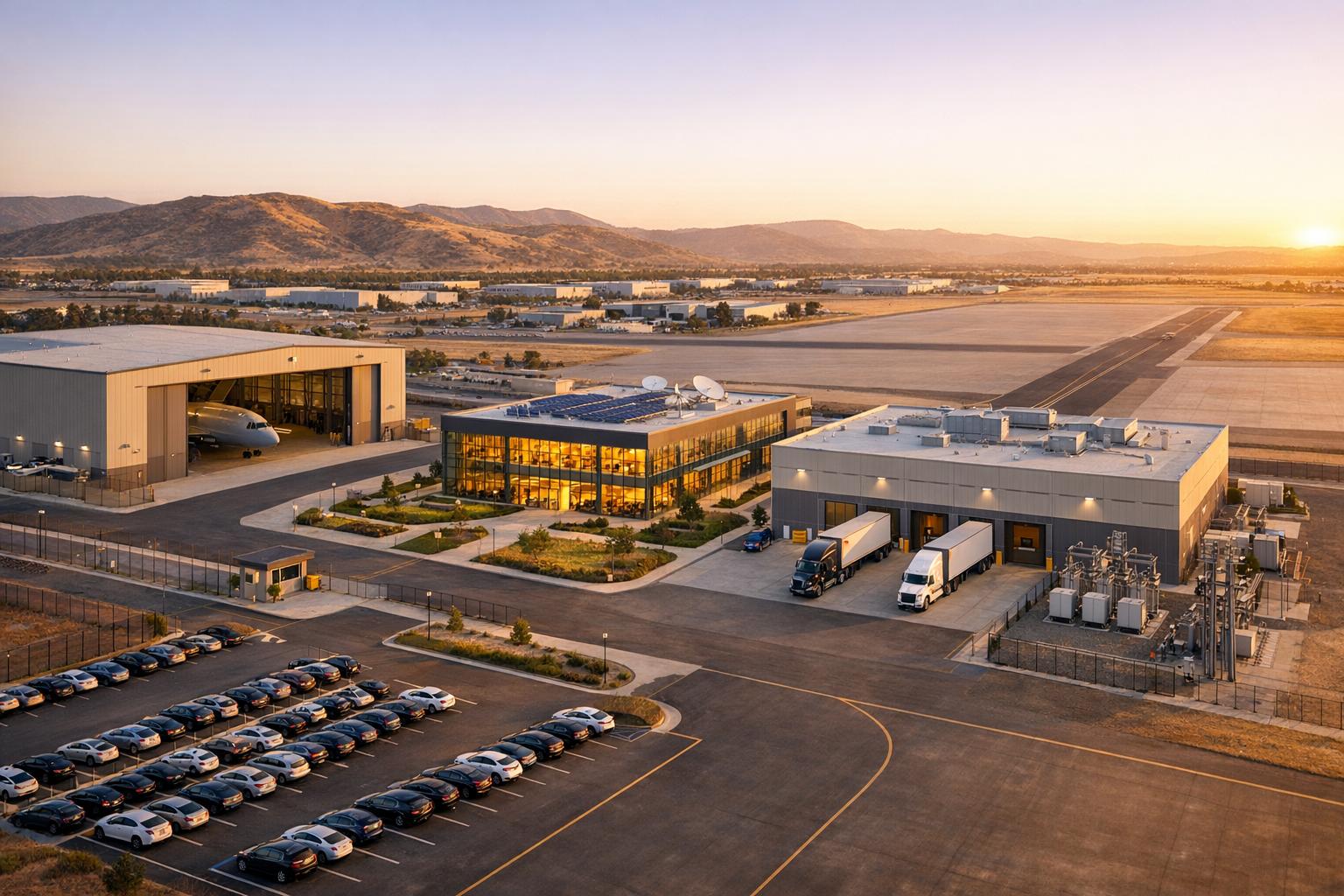
In 2026, aerospace real estate is surging due to a shift in U.S. defense funding. A staggering $838.7 billion has been allocated to military modernization, fueling demand across defense, technology, and manufacturing sectors. Companies are competing for highly specialized facilities with unique requirements like high-clearance spaces, robust power systems, and advanced security.
Key insights:
- Defense: Focused on large-scale production and secure facilities, with hubs in Southern California and Ohio.
- Technology: Driven by AI, robotics, and innovation, with strong venture capital backing in areas like Los Angeles.
- Manufacturing: Experiencing a 354% demand increase since 2018, requiring massive spaces near airports for production.
Limited supply, with industrial vacancy rates below 2% in key markets, is intensifying competition. Stakeholders must analyze market trends, workforce availability, and infrastructure readiness to navigate this evolving landscape.
1. Defense Sector
Real Estate Needs
Defense contractors have very specific needs when it comes to real estate. Unlike standard warehouses, their facilities must support advanced manufacturing operations. This means higher power capacity, taller overhead clearance for large equipment and drone testing, and vertical storage systems. On top of that, these facilities require strict security measures, such as controlled entry points, additional fencing, and secure rooms (known as SCIFs) for handling classified information [7][2].
A growing trend is the use of "classified space as a service." Roughly 35% of contractors now lease pre-secured facilities, opting for this approach instead of building their own [9]. Additionally, the rise of mega-factories – spanning over 1 million square feet – reflects the need to mass-produce drones, munitions, and hybrid commercial-defense aircraft at scale [6][3].
Office space is another key requirement. Many new leases allocate more than half of their square footage to engineering and administrative functions [7]. For example, Anduril Industries signed a $1 billion lease for a 1.1 million–square–foot complex in Long Beach, California. Scheduled to open its first phase by the end of 2027, this campus will include over 500,000 square feet of office space and is being developed by Sares Regis Group [5][7].
These unique requirements are reshaping the demand for defense-related real estate across the U.S.
Regional Demand
Southern California remains the heart of the defense industry. Its proximity to the U.S. Space Force headquarters in El Segundo, major ports, and a highly specialized workforce makes it a hub for innovation and research [5]. By the end of 2025, industrial vacancy in El Segundo dropped to below 2% [5]. Andrew Sinasohn, Executive Vice President at Zacuto Group, highlighted this shift:
"Last year there were between 10 and 15 available buildings [near Long Beach Airport]. Now there are zero" [2][7].
Meanwhile, Ohio is becoming a major player in defense production. Anduril Industries plans to build a $1 billion, 5 million–square–foot manufacturing campus in Columbus to ramp up production of autonomous systems [5][3]. Similarly, Joby Aviation is investing $500 million in a Dayton facility for electric vertical take-off and landing aircraft [3]. These states offer lower costs and attractive incentives, making them ideal for large-scale production, while California continues to lead in innovation-driven projects.
Growth Impact on Metrics
The defense sector’s rapid growth is driving down vacancy rates in aerospace hubs. In Los Angeles’ South Bay area alone, aerospace and defense tenants leased over 1.4 million square feet across 11 major deals in 2025 [2][7]. Northern Virginia also saw growth, recording 122,000 square feet of positive occupancy gain through Q3 2024, fueled by a 9.3% year-over-year increase in defense spending [8].
Lease activity reflects the confidence and capital backing in this sector. For instance, FlightWave Aerospace Systems signed a five-year lease for a 51,000–square–foot facility in Torrance, California, valued at $5.4 million in March 2026 [7][2]. President Shawn Webb described their rapid expansion:
"We increased our space by three to four times, and we’ve increased our workforce by more than four times in that same period. So it’s incredible growth." [5]
sbb-itb-99d029f
2. Technology Sector
Real Estate Needs
Aerospace technology companies have unique demands when it comes to real estate. Unlike standard warehouses, these firms – ranging from drone manufacturers to satellite developers and electric aircraft startups – require facilities with higher power capacities and greater clear heights to accommodate their specialized manufacturing and testing equipment [2][7]. Security is another top priority, especially for defense-technology startups handling sensitive projects. These companies often need advanced security measures, such as controlled access and secure perimeters, to safeguard their research and development operations [2][7]. Additionally, many firms look for hybrid office-industrial campuses that combine R&D spaces with production floors. Interestingly, older submarkets are often preferred due to their better parking ratios, which cater to these unique setups [7]. This specific demand is reshaping the real estate landscape in key aerospace hubs.
Regional Demand
Southern California remains the heart of aerospace technology innovation. In 2025, aerospace and defense firms attracted 34% of the $12 billion in venture capital invested in Los Angeles-based companies. The Long Beach Airport area, a key industrial zone, saw its inventory of available buildings shrink dramatically – from 10 to 15 properties in late 2024 to none by early 2026 [2][7].
Meanwhile, new aerospace hubs are gaining traction. For example, in June 2025, JetZero announced a massive $4.7 billion investment to build a 3 million–square-foot manufacturing facility at North Carolina’s Piedmont Triad Airport. This project, bolstered by nearly $500 million in state infrastructure incentives, is expected to create 14,500 jobs [6]. Arizona has also seen impressive growth, with over 60 industry expansions in five years, representing $2.8 billion in investments [4]. Similarly, in January 2026, Joby Aviation invested $500 million to acquire a 700,000–square-foot manufacturing site in Dayton, Ohio, to produce electric vertical take-off and landing aircraft [3][6].
Growth Impact on Metrics
The rapid expansion of the technology sector is reshaping aerospace real estate metrics across the U.S., aligning closely with the needs of the defense and manufacturing sectors. Venture capital funding for defense technology in Los Angeles surged to over $4 billion in 2025 – more than doubling the amount raised in 2024. This influx of funding has sparked a wave of leasing activity, tightening vacancy rates, particularly in Southern California [2][7].
Mac Burridge, Managing Director at JLL, highlighted the region’s prominence:
"Southern California is the epicenter for advanced manufacturing right now, and that is also talent driven" [5].
Aerospace and defense accounted for 49% of the 53,000 manufacturing job announcements in the U.S. in 2025, representing $42 billion in capital investments [6]. Demand for manufacturing facilities has skyrocketed, increasing 354% since 2018, and projections suggest this demand will make up 25% of the total U.S. industrial property market by 2028 [3]. Additionally, the FAA predicts the U.S. recreational and commercial drone fleet will exceed 1 million units by 2028, further amplifying the need for specialized manufacturing spaces [10]. These trends indicate that aerospace real estate needs will continue to evolve alongside emerging manufacturing demands.
3. Manufacturing Sector
Real Estate Needs
Aerospace manufacturing facilities demand far more than your typical warehouse setup. These spaces need to accommodate high overhead clearances for large assembly equipment, robust power systems to handle heavy machinery, and advanced security measures for defense-related production. Companies producing drones, satellites, and electric VTOL aircraft often require a mix of manufacturing spaces, research and development (R&D) areas, and Class A office environments.
Interestingly, older industrial buildings are often better suited for these needs than newly constructed ones. Many legacy facilities come with higher parking ratios – essential for a dense technical workforce – and already have the power infrastructure needed for heavy manufacturing. Nick Buss, Principal at Klabin Co., shared his thoughts on this:
"The aerospace and advanced manufacturing companies that can make an existing facility work will lease those… But for those with more specialized needs, new construction often makes the most sense." [7]
Another critical factor is proximity to airports. This is becoming increasingly important, particularly for testing aviation innovations like blended-wing aircraft.
Regional Demand
The demand for specialized facilities is driving notable regional trends in aerospace manufacturing real estate. Southern California’s South Bay, for example, is seeing a revival in manufacturing activity. In January 2026, Anduril Industries signed a groundbreaking $1 billion lease for a 1-million–square-foot complex near Long Beach Airport. Developed by Sares Regis Group, this facility will focus on large-scale production of autonomous defense systems [2]. Similarly, FlightWave Aerospace Systems expanded in October 2025, moving from a 15,000–square-foot space in Carson to a 51,000–square-foot facility in Torrance under a $5.4 million five-year lease [5].
Meanwhile, emerging hubs are stepping up to handle high-volume production. Pratt & Whitney invested $200 million in February 2026 to expand its Columbus, Georgia campus for commercial and military engine manufacturing [1]. AeroVironment followed suit with a $30 million investment in Albuquerque on March 17, 2026, adding 450 defense-related jobs [1]. These trends highlight a growing pattern: keeping R&D operations in talent-rich areas like Southern California while shifting large-scale production to regions with lower costs and more available labor.
Growth Impact on Metrics
The rapid growth in aerospace manufacturing is reshaping industrial real estate nationwide. A global aircraft shortfall of 17,000 jets – equivalent to a 12-year production backlog – is fueling a surge in facility expansion [6]. Aleksey Matyushev, CEO of Natilus, captured the scale of the challenge:
"We need some of the biggest buildings in the entire world." [6]
This wave of activity, driven by both retrofitting older facilities and constructing new ones, has led to a remarkable 354% increase in industrial property demand since 2018 [3]. These shifts highlight how regional incentives and technological advances are shaping the aerospace manufacturing landscape, creating a dynamic and evolving market for industrial real estate.
Advantages and Challenges by Industry

Aerospace Real Estate Demand by Industry: Defense, Technology & Manufacturing Comparison
Each industry comes with its own set of strengths and hurdles, shaped by its unique real estate and operational requirements. Here’s a closer look at how the defense, technology, and manufacturing sectors navigate these dynamics:
The defense sector benefits from the predictability of federal contracts, supported by a hefty $839 billion discretionary budget projected for 2026 [2]. This stability ensures consistent demand for facilities. However, these properties often require highly specialized infrastructure and strict security measures, making them less adaptable to standard industrial spaces. Geographic flexibility is also a challenge, as these facilities are usually tied to specific strategic locations [7].
The technology sector has seen remarkable growth, with 34% of Los Angeles-based venture capital funding in 2025 flowing into this field [7]. This growth has driven demand for "industrial flex" spaces – hybrid facilities that blend R&D labs with substantial office areas, sometimes with office components reaching up to 50%. Yet, the sector’s reliance on venture capital means it’s highly susceptible to funding cycles and trends like artificial intelligence, making it less predictable [3].
Manufacturing plays a transformative role in regional economies but faces steep logistical and workforce challenges. While global aircraft production backlogs – equivalent to 12 years of capacity – ensure long-term demand, the sector requires enormous facilities, often near airports, to meet operational needs. Workforce shortages remain a pressing issue, as highlighted by Aleksey Matyushev, CEO of Natilus:
"The thing that’s really like keeping me up at night isn’t power or water, it’s the job pool. Where do you get 11,000 technicians that can build a plane?" [6]
To sum up these insights, here’s a quick comparison of the sectors:
| Sector | Key Advantages | Primary Challenges | Market Stability |
|---|---|---|---|
| Defense | Stable federal contracts and a projected $839B discretionary budget [2]. | High-security requirements, limited geographic flexibility, and need for specialized infrastructure [7]. | Very High |
| Technology | Strong VC funding (34% in Los Angeles), rapid growth, and flexible locations [7]. | Volatile funding cycles and evolving R&D space demands with high office-to-industrial ratios [3]. | Moderate |
| Manufacturing | Long-term stability from a 12-year aircraft production backlog [6]. | Massive space needs (up to 3 million sq ft), workforce shortages, and airport-adjacent site demands [6]. | High |
This table illustrates the varied demands, opportunities, and stability levels across these industries, providing a snapshot of their real estate and operational landscapes.
Conclusion
Aerospace real estate is shaped by three main sectors, each with unique needs. The defense sector thrives on a massive $839 billion federal budget, fueling demand for secure, strategically located facilities. The technology sector benefits from robust venture capital funding – 34% of the $12 billion invested in Los Angeles-based companies goes to aerospace ventures. Meanwhile, the manufacturing sector requires expansive, specialized spaces – sometimes as large as 3 million square feet near airports – to support advanced production processes [2][6].
Meeting these varied demands requires a strategic approach to real estate analysis. Professionals navigating this field must consider a wide range of data points, such as federal contract awards, venture capital trends, job postings, and infrastructure capabilities. Each sector has its own set of challenges, from strict security requirements to workforce availability, making in-depth market insights indispensable.
CoreCast provides a comprehensive solution for tackling these complexities. This platform equips professionals with tools to analyze aerospace properties, track deal pipelines, map competitive landscapes near key locations like military bases or research universities, and conduct portfolio assessments tailored to specialized needs, such as SCIF capabilities or power requirements. With 82% of top aerospace and defense companies already leveraging AI-driven analytics [9], access to integrated data and forecasting tools is becoming increasingly critical for staying ahead in a dynamic market.
The rise of emerging markets like Wichita, Kansas, and Grand Rapids, Michigan, highlights how quickly the industry is evolving. Aerospace job postings in these areas have jumped by over 300% since 2020 [9]. Professionals who can evaluate factors like talent availability, infrastructure readiness, and supply chain proximity will be better positioned to seize opportunities in this rapidly changing landscape. Whether supporting defense projects or enabling large-scale manufacturing, aligning with these trends will help stakeholders navigate and thrive in the evolving aerospace sector.
FAQs
What makes aerospace facilities different from standard industrial space?
Aerospace facilities stand apart from typical industrial spaces because of their specialized requirements. They often feature high overhead clearance, enhanced security systems, and are strategically located near aerospace manufacturing hubs. These characteristics are shaped by the industry’s need for precision manufacturing and its fast-paced expansion.
Which U.S. markets are best positioned for aerospace real estate growth?
Southern California, particularly Los Angeles and its bustling aviation hubs, is at the forefront of aerospace real estate development. This surge is fueled by growing demand within the aerospace and defense sectors. Other cities experiencing similar growth include Tucson, Phoenix, Baltimore, and Indianapolis. These locations are benefiting from increased defense contracts, advancements in technology, and efforts to diversify supply chains. Together, these factors have spurred notable industry growth, positioning these regions as central players in the aerospace sector.
How can owners and investors reduce risk when vacancy is below 2%?
Owners and investors can minimize risks when vacancy rates stay below 2% by focusing on maintaining high-quality, specialized facilities tailored to the specific needs of aerospace and defense tenants. This includes features like advanced infrastructure and robust security measures. Another smart strategy is diversifying tenant portfolios within these expanding sectors, which helps spread risk across multiple reliable sources.
Using tools like CoreCast can further enhance decision-making. By providing data-driven insights, tracking pipelines, and offering portfolio analysis, platforms like this enable investors to make informed choices while taking advantage of growth opportunities in the industry.