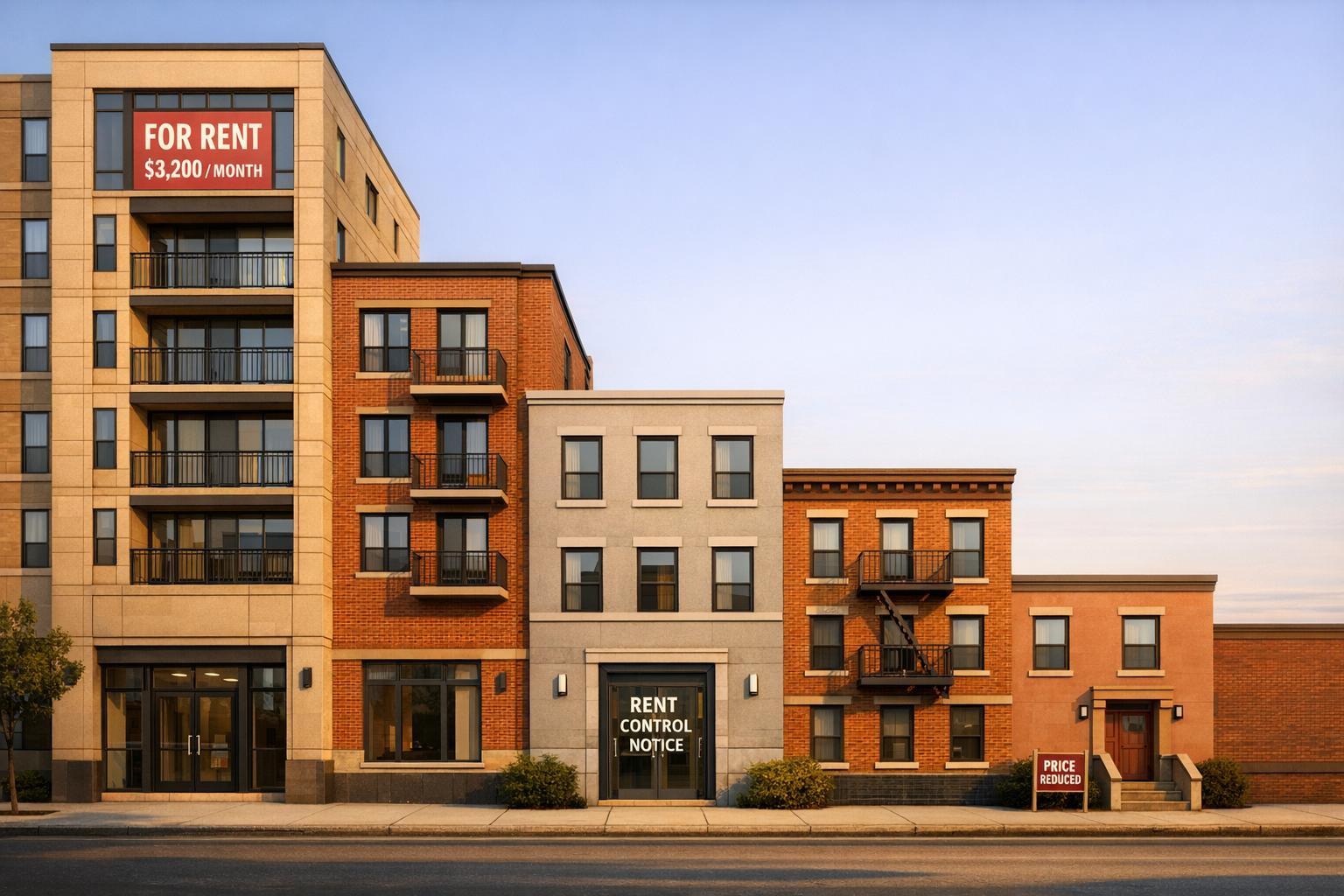
Rent control policies aim to protect tenants from sharp rent increases, but they often lead to unintended consequences that disrupt housing markets. Here’s how rent control affects market stability:
- Reduces Rental Housing Supply: Landlords may convert rentals into condos or withdraw properties, leading to fewer units available. Cities with rent control often see slower housing stock growth and a 10% decrease in rental units.
- Raises Rents for Unregulated Units: Limited supply and tenant retention push up rents in non-controlled units, creating a tighter and more expensive market.
- Lowers Property Values: Rent caps reduce rental income, causing property values to drop. This also impacts city tax revenues and funding for public services.
- Discourages Maintenance and Investment: Landlords cut upkeep costs to offset losses, leading to more maintenance issues. Developers also hesitate to build new rental properties.
- Creates Neighborhood Inefficiencies: Tenant immobility disrupts housing allocation, leaving units mismatched to household needs and reducing job mobility.
While rent control offers short-term relief for tenants, it often results in reduced housing availability, rising costs, and market inefficiencies. Policymakers must carefully weigh these trade-offs when considering such regulations.

5 Ways Rent Control Impacts Housing Market Stability: Key Statistics
What Rent Control ACTUALLY Does to Rent Prices
1. Reduces Available Rental Housing
Rent control often pushes landlords to leave the rental market. Many convert rental apartments into owner-occupied condominiums to avoid regulatory restrictions. For instance, in San Francisco, rent-controlled buildings were 10% more likely to be turned into condos compared to non-controlled ones [5]. After a 1994 ballot initiative expanded rent control to small multi-family buildings built before 1980, these properties were 8 percentage points more likely to convert to condos by 2012. This shift resulted in a 15% drop in renters and a 25% reduction in tenants living in rent-controlled units compared to 1994 levels [7][8]. Similarly, New York City has lost 152,000 rent-stabilized units since 1993 [5], and Washington, D.C. saw a 14% decline in rent-controlled units, shrinking from 85,000 in 1984 to about 72,878 in 2020 [7].
In some cases, landlords go as far as demolishing properties or using laws like California’s Ellis Act to withdraw units when upkeep costs become unmanageable. Studies show that strict rent control policies correlate with a 10% drop in the total number of rental units in a city [6].
"Rent control and rent stabilization laws lead to a reduction in the available supply of rental housing in a community." – Dr. Lisa Sturtevant, Researcher [3]
The impact doesn’t stop at individual properties. California cities with rent control saw their housing stock grow 9% slower than cities without such policies [7]. Similarly, rent-controlled municipalities in New Jersey have about 25% fewer rental units than those without controls [5]. Even when new construction is exempt from rent control, developers often hesitate to build rental housing, fearing future regulations might limit their returns. These supply constraints create broader market challenges, which will be explored in the next section.
2. Drives Up Rents in Non-Controlled Units
Rent control limits the rent landlords can charge for regulated units, but it often leads to higher rents for unregulated properties. Landlords of these non-controlled units raise prices to offset potential losses, creating a tighter and more expensive market for new renters.
Research from cities like New York, Los Angeles, and Cambridge highlights this trend. For example, unregulated rents have been shown to increase by 22% to over 46% after rent control policies are introduced [9]. In Cambridge, Massachusetts, prior to the repeal of rent control in 1994, rents for controlled units were at least 40% lower than those for nearby non-controlled units [9][8].
This disparity doesn’t just stop at initial price differences. The reduced availability of rental units exacerbates the issue. Rent control encourages tenants to stay put – tenant retention increases by nearly 20% [2] – which reduces turnover and leaves fewer options for new renters. In San Francisco, this dynamic contributed to a 5.1% increase in city-wide rents [2][4].
"Rent control policies generally lead to higher rents in the uncontrolled market." – Dr. Lisa Sturtevant [3]
Landlords’ reactions to potential future regulations can make matters worse. For instance, after New York’s 2025 Good Cause Eviction law was announced, landlords began implementing the maximum allowable rent increases – jumping from modest 2%-3% hikes to the cap of 8.79% [10]. This behavior, often referred to as anchoring, drives up rents in anticipation of tighter controls, further inflating prices in the unregulated market.
3. Decreases Property Values
Rent control can significantly lower property values by directly limiting rental income. Since property values are often tied to Net Operating Income (NOI), any cap on potential revenue reduces the overall market value of the property.
The case of Cambridge, Massachusetts, provides a striking example. When rent control was abolished in November 1994, property values for previously controlled units shot up by 45% almost overnight. Over the next decade (1994–2004), the city’s total housing stock value climbed by $2.0 billion. Interestingly, only $300 million of this increase came from the decontrolled units themselves, while the remaining $1.7 billion resulted from neighborhood spillover effects [8]. Properties located near rent-controlled units saw their values rise by about 13% [8].
"Rent controlled properties create substantial negative externalities on the nearby housing market, lowering the amenity value of these neighborhoods and making them less desirable places to live." – Rebecca Diamond, Associate Professor of Economics, Stanford Graduate School of Business [8]
This downward pressure on property values doesn’t just harm individual owners – it also strains municipal budgets. In St. Paul, Minnesota, for instance, the introduction of strict rent control in November 2021 caused controlled properties to lose between 7% and 13% of their value, dragging citywide averages down by 5% [7]. Similarly, in New York City, universal rent control led to sale prices of affected multi-family buildings plummeting by over 17% [7]. Declining property values mean less property tax revenue, leaving cities with tough choices: cut essential services or shift the tax burden elsewhere.
sbb-itb-99d029f
4. Discourages Investment and Property Upkeep
When rent increases are capped below inflation and operational costs, landlords often find themselves in a tough spot: either absorb financial losses or cut back on expenses. Most opt for the latter, which usually means reducing maintenance budgets to protect their profit margins. For example, in New York City, 64% of rent-controlled units reported maintenance deficiencies, compared to 47% of unregulated units. Even more striking, rent-controlled properties were over twice as likely to have three or more major maintenance issues – 18% versus 7.5% for market-rate units [7]. These deficiencies can lead to serious safety and structural problems, ultimately affecting residents’ quality of life.
"When rent revenue cannot cover operational costs, housing providers may cut back maintenance or delay renting units that require costly repairs." – D.C. Policy Center [7]
But it’s not just about maintenance. The reduced profitability of rent-controlled properties discourages new investments altogether. Evidence from major cities shows that when returns are suppressed, property owners often choose to leave the regulated market. This hesitancy to invest has ripple effects on the broader housing market.
A clear example of this can be seen in Cambridge, Massachusetts. After the repeal of rent control in 1994, the city saw a surge in property investment. Over the next decade, neighborhoods improved, property upkeep increased, and crime rates dropped by 16%, translating to around 1,200 fewer crimes annually [4][7]. This demonstrates how lifting restrictions can revitalize housing markets and improve community conditions.
5. Produces Unintended Neighborhood Effects
Rent control doesn’t just affect individual properties – it reshapes entire neighborhoods. One noticeable impact is reduced tenant mobility. When tenants secure rent-controlled units, they are far less likely to move. For instance, in San Francisco, rent control increased the likelihood of tenants staying at their current address by nearly 20% [2]. While this stability might seem like a win, it comes with complications. Tenants staying put also disrupts the natural flow of housing, leading to allocation issues.
This reduced mobility often means tenants remain in units that no longer suit their needs. In New York City, studies revealed that 20% of renters lived in spaces that didn’t match their household size – like empty-nesters holding onto large apartments while young families squeeze into tiny studios [7]. This mismatch prevents housing turnover, making it harder for the market to meet changing demands. The problem doesn’t stop there. Rent control can also ripple into the job market. By discouraging people from relocating for better work opportunities, it’s been linked to a 5% rise in unemployment [4]. Choosing to stay for cheaper rent over moving for a job creates friction in the labor market.
The consequences of rent control don’t stay confined to regulated buildings – they spill over into neighboring properties. When investment in rent-controlled units declines, neighborhood amenities can take a hit, which in turn drags down property values and slows appreciation. This shows how rent control policies can affect entire communities, not just the buildings they target.
Conclusion
Rent control has a far-reaching impact on housing markets, affecting not just tenants and landlords but entire communities. Data shows some striking consequences: rental supply often decreases by about 10%, rents in unregulated markets climb significantly, and property values can take a hit. For instance, St. Paul’s 2021 ordinance resulted in a staggering $1.6 billion loss in property values [4][7]. Additionally, rent caps discourage both new construction and regular upkeep. In New York, 64% of rent-controlled units reported maintenance issues compared to just 47% of unregulated ones [7]. These trends highlight the need for a thoughtful, data-driven approach to managing these shifts.
This creates what experts call a "divided housing market." Long-term tenants may enjoy stability, but others face rising costs and fewer housing options [7]. It also affects broader issues like housing availability, job mobility, neighborhood development, and even local tax revenues. For example, when Cambridge, Massachusetts, repealed its rent control laws in 1994, property values across the city surged by $1.7 billion over the next decade, showing how such regulations can influence entire communities [7].
In light of these rapid changes, real-time data becomes essential. Regulatory shifts can dramatically alter market conditions – Montgomery County, Maryland, saw multi-family construction permits drop by 97% after its 2023 rent control law [1]. Tools like CoreCast (https://corecastre.com) help professionals stay ahead of these changes. With features like deal pipeline tracking, portfolio analysis, integrated mapping, and market trend monitoring, platforms like this provide the insights needed to navigate the ripple effects of rent control. When declining property values in regulated areas spill over into nearby neighborhoods, having up-to-date data can be the difference between protecting your investments and taking unnecessary losses.
While rent control aims to protect tenants, it introduces complex market disruptions that require careful navigation. Understanding these dynamics is just the beginning. The next step is using timely market intelligence to adapt your strategies and make informed decisions in an ever-changing landscape.
FAQs
How does rent control influence property investment choices?
Rent control can greatly influence property investment choices by restricting the income landlords and investors can generate. These policies typically place a cap on how much rent property owners can charge, which can make it challenging to cover maintenance expenses or achieve competitive financial returns. Because of this, many investors may shy away from funding new construction or upgrading existing properties, which can ultimately shrink the overall supply of rental housing.
On top of that, rent control often brings about unintended ripple effects. For instance, property owners might neglect upkeep to save costs or redirect their investments to less regulated markets or entirely different asset classes. This can create a domino effect – market instability, rising rents in areas without controls, and a gradual decline in housing quality.
How do rent control policies contribute to higher rents in non-regulated units?
Rent control policies can cap the income landlords earn from regulated units. While this might seem like a win for tenants, it often discourages landlords from investing in rental properties, leading to a decrease in the overall housing supply. When fewer units are available, the pressure shifts to unregulated units, where landlords may take advantage of the increased demand by raising rents.
On top of that, property owners might hike rents in unregulated units to balance out potential losses or risks associated with rent-controlled properties. This ripple effect can make housing costs climb even higher for renters who don’t benefit from rent control protections, making affordability a growing challenge in the open market.
How does rent control impact long-term neighborhood development?
Rent control can shape neighborhoods in ways that aren’t always obvious at first glance. By capping the potential returns for property owners, it often discourages landlords from investing in upkeep or improvements. Over time, this can shrink the overall supply of rental housing, as some owners might even pull their properties off the market entirely. The result? Fewer options for renters and a slowdown in neighborhood growth.
Another ripple effect is the impact on new construction. Developers may think twice about building in areas with rent control, worried about limited profitability. This hesitation can stifle economic activity and stall opportunities for growth. Over time, these factors can lead to uneven housing quality, fewer available units, and a less dynamic community. While rent control is designed to make housing more affordable, the unintended side effects often include a tighter housing market and less investment in the very neighborhoods it aims to support.